Association of achieved LDL-C levels with global coagulability and clinical outcomes in patients with acute coronary syndrome receiving PCSK9 inhibitors: a prospective cohort study - Report - MDSpire

Association of achieved LDL-C levels with global coagulability and clinical outcomes in patients with acute coronary syndrome receiving PCSK9 inhibitors: a prospective cohort study

  • By

  • Tianfu Fu

  • Song Yao

  • Shaojiang Zhang

  • Hui Linghu

  • June 10, 2026

  • 0 min

Share

Impact of Target LDL-C Levels on Coagulability in ACS Patients

Overview

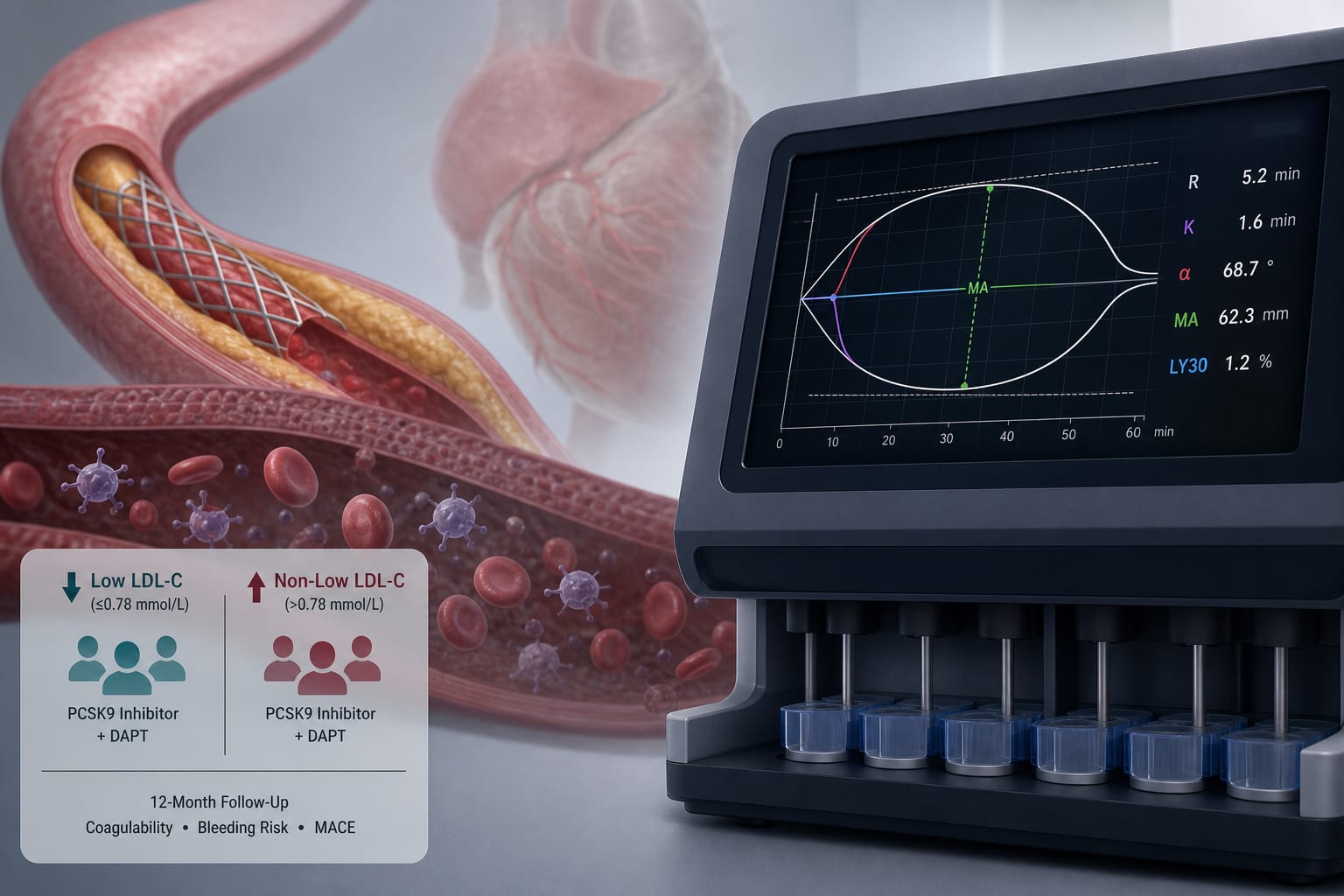
This study evaluates the safety of achieving ultra-low LDL-C levels in ACS patients treated with PCSK9 inhibitors and dual antiplatelet therapy. Findings indicate no significant increase in bleeding risk or changes in global coagulability, supporting the safety of aggressive lipid-lowering strategies in this population.

Background

Acute coronary syndrome (ACS) is a leading cause of cardiovascular mortality, necessitating effective management strategies. The interplay between LDL-C levels and thrombotic risk is critical, as elevated LDL-C is linked to increased platelet reactivity. Understanding the safety of achieving very low LDL-C levels in ACS patients on antiplatelet therapy is essential for optimizing treatment outcomes.

Data Highlights

GroupClinically Relevant Bleeding (%)MACE (%)
Low LDL-C (≤0.78 mmol/L)6.76.7
Non-Low LDL-C (>0.78 mmol/L)5.013.3

Key Findings

  • No significant difference in clinically relevant bleeding between Low LDL-C (6.7%) and Non-Low LDL-C (5.0%) groups.
  • Major adverse cardiovascular events (MACE) occurred in 6.7% of the Low LDL-C group compared to 13.3% in the Non-Low LDL-C group.
  • Global coagulability and specific platelet reactivity remained stable throughout the follow-up period.
  • The study's non-inferiority analysis was underpowered due to a low number of bleeding events.
  • Exploratory time-to-event analysis showed no significant difference in overall bleeding risk (log-rank P = 0.72).

Clinical Implications

The findings suggest that achieving LDL-C levels ≤0.78 mmol/L in ACS patients treated with PCSK9 inhibitors and DAPT does not increase bleeding risk or alter coagulability. Clinicians can consider aggressive lipid-lowering strategies in this high-risk population without heightened concern for bleeding complications.

Conclusion

This study supports the clinical safety of achieving very low LDL-C levels in ACS patients on dual antiplatelet therapy, indicating that such strategies may be beneficial without increasing bleeding risks.

Related Resources & Content

  1. Clinical Research in Cardiology, 2016 -- Targeted Objectives for Reducing LDL-C Levels Based on Evidence
  2. European Journal of Preventive Cardiology, 2022 -- Impact of PCSK9 inhibitors on lipoprotein(a) levels: a multi-centre study
  3. Clinical Research in Cardiology, 2026 -- Short-term lesion-level impact of extensive LDL-C reduction with statins and PCSK9 inhibitors
  4. JAMA Network Open, 2021 -- Theoretical Cost-Effectiveness of PCSK9 Inhibitors in Stroke Due to Intracranial Atherosclerosis
  5. 2025 ACC/AHA/ACEP/NAEMSP/SCAI Guideline for the Management of Patients With Acute Coronary Syndromes
  6. American College of Cardiology -- Evaluation of Cardiovascular Outcomes After an Acute Coronary Syndrome During Treatment With Alirocumab
  7. LDL Cholesterol Lowering: Is There a Risk for Dementia and Hemorrhagic Stroke?
  8. 2025 ACC/AHA/ACEP/NAEMSP/SCAI Guideline for the Management of Patients With Acute Coronary Syndromes: A Report of the American College of Cardiology/American Heart Association Joint Committee on Clinical Practice Guidelines | JACC
  9. Evaluation of Cardiovascular Outcomes After an Acute Coronary Syndrome During Treatment With Alirocumab - American College of Cardiology

Original Source(s)

Related Content