Why it’s better to believe in a larger definition of the diametaphyseal junction zone in pediatric distal radius fractures - Report - MDSpire

The Importance of an Expanded Understanding of the Diametaphyseal Junction Zone in Pediatric Distal Radius Fractures

  • By

  • Christoph von Schrottenberg

  • Susann Marie Beck

  • Philipp Schwerk

  • Guido Fitze

  • Jurek Schultz

  • July 20, 2026

Share

Clinical Report: The Importance of an Expanded Understanding of the Diametaphyseal Junction Zone in Pediatric Distal Radius Fractures

Overview

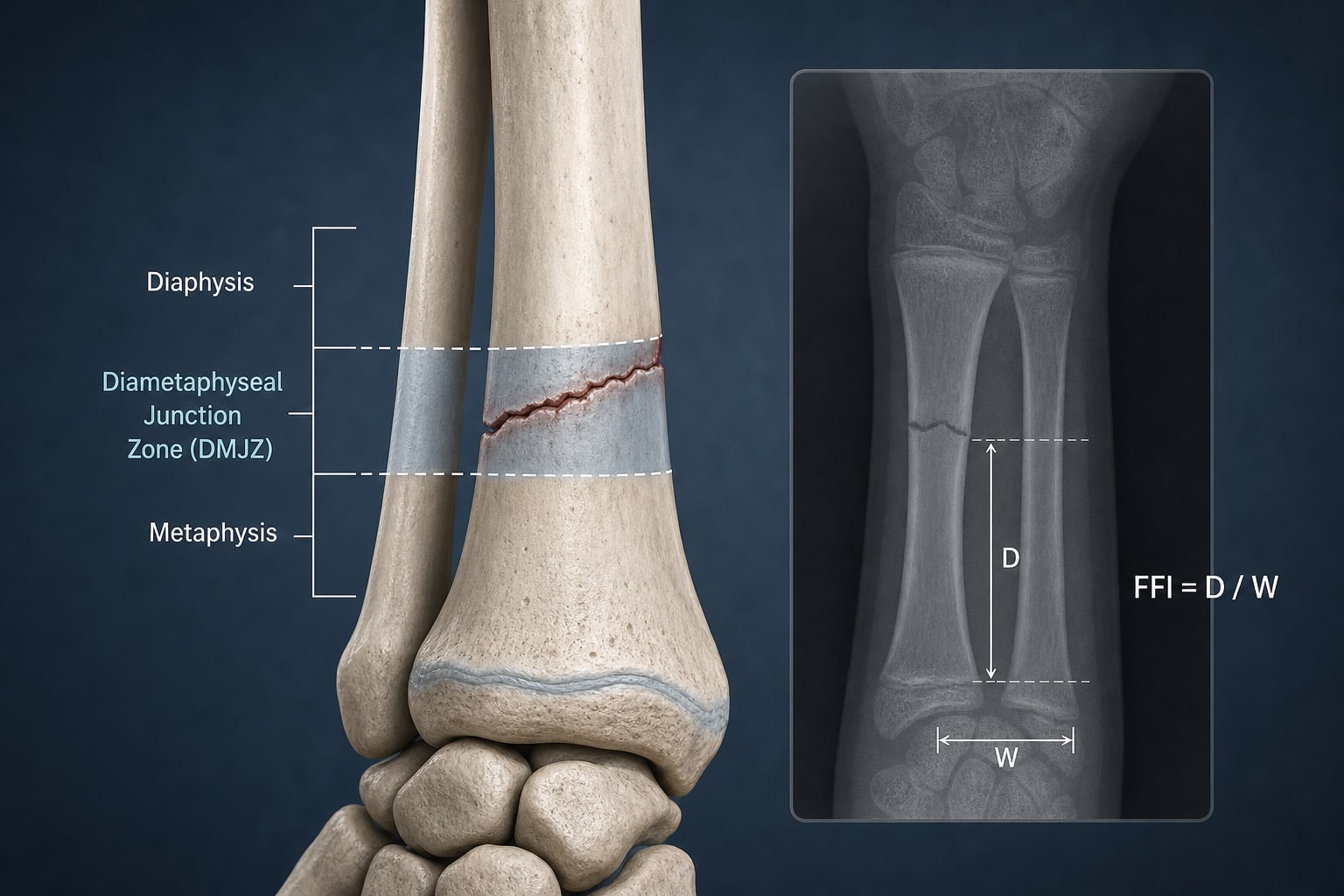
This study investigates the definition and implications of the diametaphyseal junction zone (DMJZ) in pediatric distal radius fractures (DMRF). It highlights the introduction of the forearm fracture index (FFI) and its impact on categorizing DMRF.

Background

Diametaphyseal radius fractures in children are common and present unique challenges in treatment due to their location. The definition of the DMJZ varies across studies, leading to inconsistencies in diagnosis and management.

Data Highlights

No numerical data or trial data is provided in the source material.

Key Findings

  • The most commonly used definition of the DMJZ places it entirely within the metaphysis.
  • The introduction of the FFI allows for a broader definition of DMRF, including parts of the distal diaphysis.
  • Using the FFI, the identification of DMRF increased by 6% compared to traditional definitions.
  • Critics argue that the FFI may include too large a portion of the radius for effective treatment.
  • Conventional ESIN techniques may still be applicable for fractures categorized as diaphyseal according to the AO-PCCF.

Clinical Implications

Clinicians should be aware of the varying definitions of the DMJZ and consider the implications of using the FFI in practice.

Conclusion

The study discusses the definition of the DMJZ and the FFI's role in categorizing DMRF.

Related Resources & Content

  1. Establishing the Forearm Fracture Index for Clinical Assessment of the Diametaphyseal Junction Zone in a Study of 366 Radius Fractures
  2. Assessment of Risk Factors for Conservative Treatment Failure in a Study of 270 Diametaphyseal Radius Fractures
  3. Biomechanical Insights into a CT-Driven Classification System for Radius Fractures Treatment
  4. baptist health south florida — Rethinking Distal Radius Fractures: Evolving Strategies for the Active Osteoporotic Patient
  5. Rethinking Distal Radius Fractures: Evolving Strategies for the Active Osteoporotic Patient
  6. Introducing the forearm fracture index to define the diametaphyseal junction zone through clinical evaluation in a cohort of 366 diametaphyseal radius fractures
  7. Non-surgical casting versus surgical reduction for children with severely displaced distal radial fractures (the CRAFFT Study)

Original Source(s)

Related Content