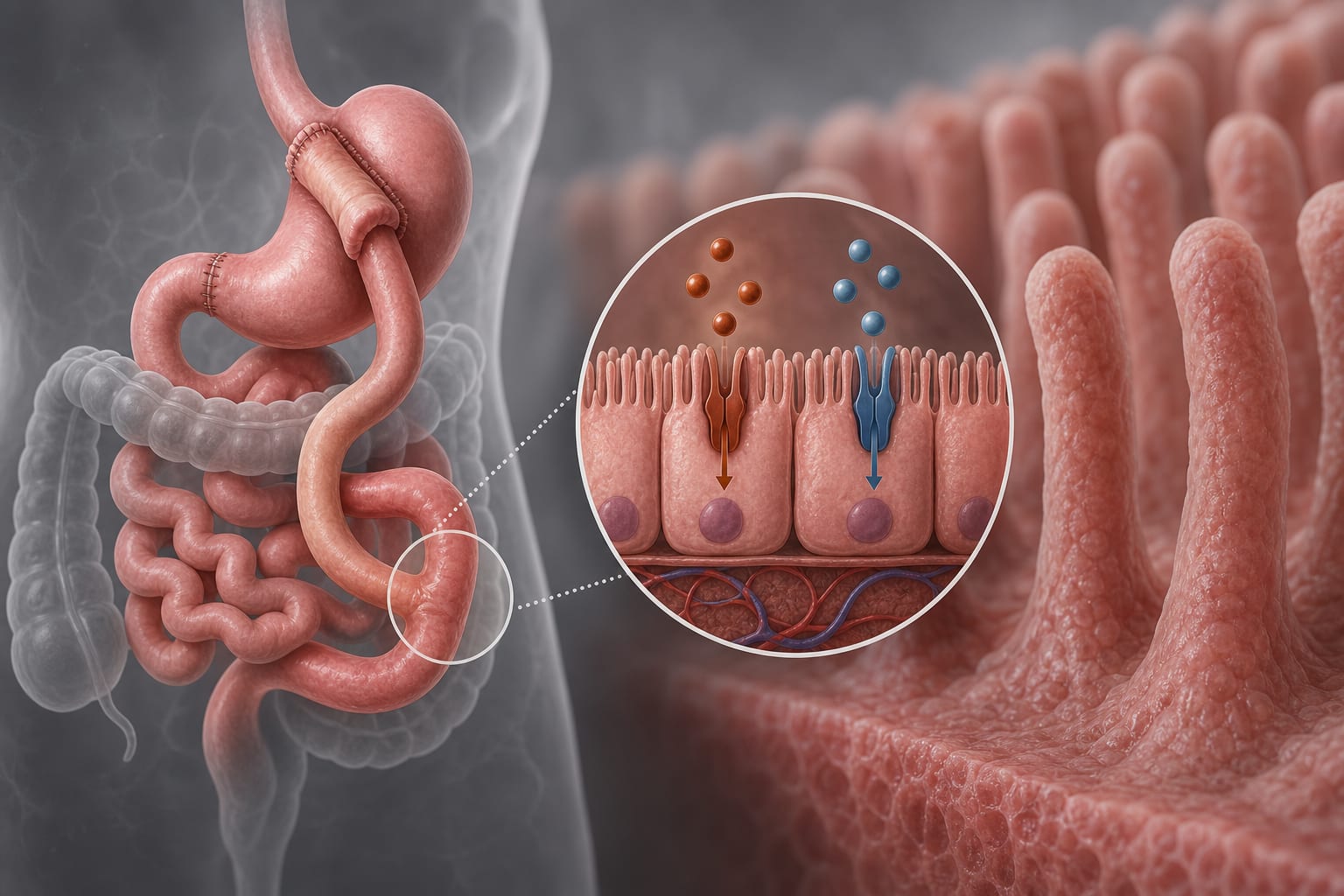
One-Anastomosis Gastric Bypass (OABG) vs. Single Anastomosis Duodeno-Ileal Bypass (SADI) as revisional procedure following Sleeve Gastrectomy: results of a multicenter study - Report - MDSpire
Advertisement
One-Anastomosis Gastric Bypass (OABG) vs. Single Anastomosis Duodeno-Ileal Bypass (SADI) as revisional procedure following Sleeve Gastrectomy: results of a multicenter study
Comparative Outcomes of OAGB and SADI as Revisional Surgeries After Sleeve Gastrectomy
Overview
This multicenter retrospective study compared One-Anastomosis Gastric Bypass (OAGB) and Single Anastomosis Duodeno-Ileal Bypass (SADI) as revisional surgeries following Sleeve Gastrectomy (SG). The analysis focused on perioperative outcomes, complication rates, and weight loss efficacy over a two-year follow-up period.
Background
Sleeve Gastrectomy (SG) is the most commonly performed bariatric surgery worldwide, offering significant short-term weight loss and comorbidity improvements. However, 15 to 50% of patients experience suboptimal clinical response or weight regain long term, sometimes complicated by refractory gastroesophageal reflux disease (GERD). Revisional options after SG include Roux-en-Y Gastric Bypass (RYGB), One-Anastomosis Gastric Bypass (OAGB), Biliopancreatic Diversion with Duodenal Switch (BPD/DS), and Single Anastomosis Duodeno-Ileal Bypass (SADI). OAGB and SADI are simpler alternatives to BPD/DS with promising outcomes but require further comparative evaluation.
Data Highlights
The study included patients undergoing OAGB or SADI as revisional surgery after SG with at least 2 years of follow-up. Propensity score matching was used to balance groups by gender, BMI, age, surgery type, and comorbidities. Weight loss was assessed by %EWL and %TWL. Follow-up visits occurred at 30 days, 3, 6, 12, and 24 months postoperatively. Primary endpoints were early and mid-term complication rates; secondary endpoints included conversion rates to RYGB and weight loss outcomes.
Key Findings
Both OAGB and SADI are feasible revisional procedures after SG with acceptable safety profiles.
SADI involves a single anastomosis with a common channel length of approximately 300 cm, potentially reducing operative time and complications.
OAGB limb length varied between 150 to 250 cm based on surgeon preference and weight loss goals.
Weight loss efficacy was measured by %EWL and %TWL, with both procedures showing promising results at 2 years.
Complication rates, including early and mid-term events, were compared, with no definitive superiority established between the two approaches.
Conversion to RYGB was evaluated as a secondary outcome to assess the need for further revisional surgery.
Clinical Implications
Surgeons can consider both OAGB and SADI as effective revisional options after SG, tailoring the choice based on patient characteristics and surgeon expertise. The simpler surgical technique of SADI may offer advantages in operative time and complication risk, while OAGB provides flexibility in limb length for weight loss optimization. Close follow-up is essential to monitor for complications and weight loss maintenance.
Conclusion
This multicenter analysis supports the use of both OAGB and SADI as viable revisional bariatric procedures after Sleeve Gastrectomy, with comparable safety and efficacy profiles over a two-year follow-up. Further prospective studies are warranted to refine patient selection and optimize long-term outcomes.
References
Italian Society of Bariatric Surgery and Metabolic Disorders (SICOb) Guidelines 2020
Studies on OAGB and SADI Surgical Techniques and Outcomes 2014-2021
by Pierpaolo Gallucci, Giuseppe Marincola, Francesco Pennestrì, Priscilla Francesca Procopio, Francesca Prioli, Giulia Salvi, Luigi Ciccoritti, Francesco Greco, Nunzio Velotti, Vincenzo Schiavone, Antonio Franzese, Federica Mansi, Matteo Uccelli, Giovanni Cesana, Mario Musella, Stefano Olmi, Marco Raffaelli
A four-factor staging system stratified response rates from 90.9% to 37.5% in a retrospective cohort study, although the model showed only moderate discrimination (C statistic, 0.68) and requires external validation