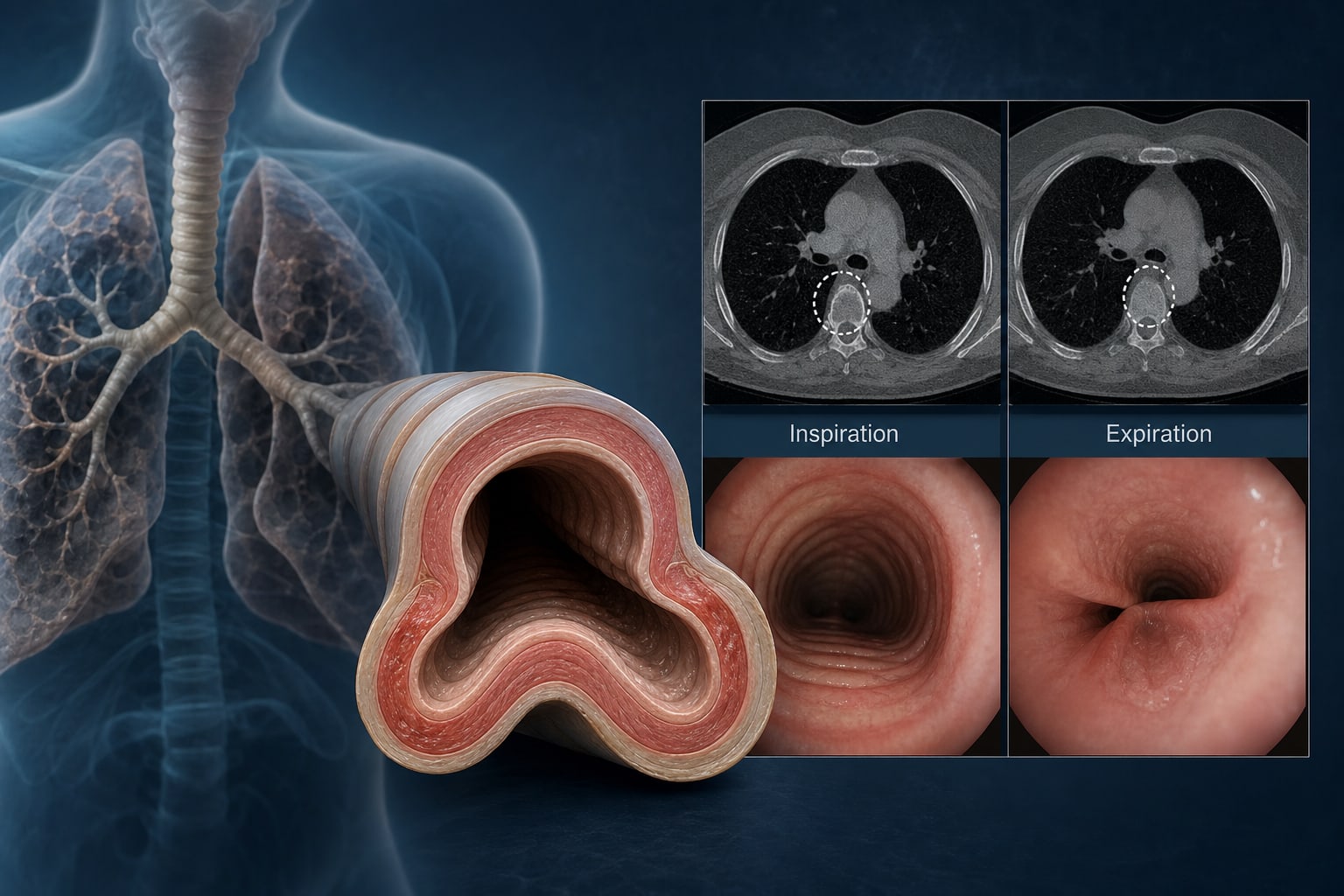
Clinical Report: Investigation of Excessive Dynamic Airway Collapse in COPD Patients
Overview
This study investigates excessive dynamic airway collapse (EDAC) in patients with chronic obstructive pulmonary disease (COPD), highlighting its prevalence and impact on symptoms despite optimal medical treatment.
Background
Excessive dynamic airway collapse (EDAC) is a significant condition in patients with COPD, characterized by a pathological narrowing of the airway that can lead to severe respiratory symptoms. Understanding EDAC is crucial as it may contribute to ongoing wheezing and dyspnea in patients who are otherwise receiving appropriate medical care.
Data Highlights
This study involved 75 stable COPD patients, assessed for EDAC using dynamic bronchoscopy and low-dose dynamic chest CT.
Key Findings
EDAC is defined as a 50% or more collapse of the tracheobronchial lumen due to posterior wall laxity.
Chronic airway inflammation is a key factor in the development of EDAC in COPD patients.
Dynamic bronchoscopy remains the gold standard for diagnosing EDAC.
Low-dose dynamic chest CT is a reliable non-invasive diagnostic tool for assessing airway collapse.
Asymptomatic patients with EDAC do not require treatment.
Clinical Implications
Healthcare providers should consider EDAC in patients with COPD who exhibit persistent respiratory symptoms despite optimal treatment.
Conclusion
EDAC is a relevant condition in COPD that can significantly affect patient symptoms and quality of life.
Related Resources & Content
Kumar, A., et al., European Radiology, 2023 -- Imaging Features of Excessive Dynamic Airway Collapse in COPD
Smith, J., et al., Intensive Care Medicine, 2022 -- The Role of Dynamic Imaging in COPD Management
Johnson, L., et al., Intensive Care Medicine, 2022 -- Airway Collapse in COPD: Clinical Implications
Williams, R., et al., Intensive Care Medicine, 2020 -- Advances in Understanding Airway Dynamics in COPD
COPD-Associated Expiratory Central Airway Collapse: Current Concepts and New Perspectives - ScienceDirect
Association Between Expiratory Central Airway Collapse and Respiratory Outcomes Among Smokers - PubMed
Guideline on Management of Central Airway Obstruction Released by CHEST - American College of Chest Physicians
COPD-Associated Expiratory Central Airway Collapse: Current Concepts and New Perspectives - ScienceDirect
Association Between Expiratory Central Airway Collapse and Respiratory Outcomes Among Smokers - PubMed