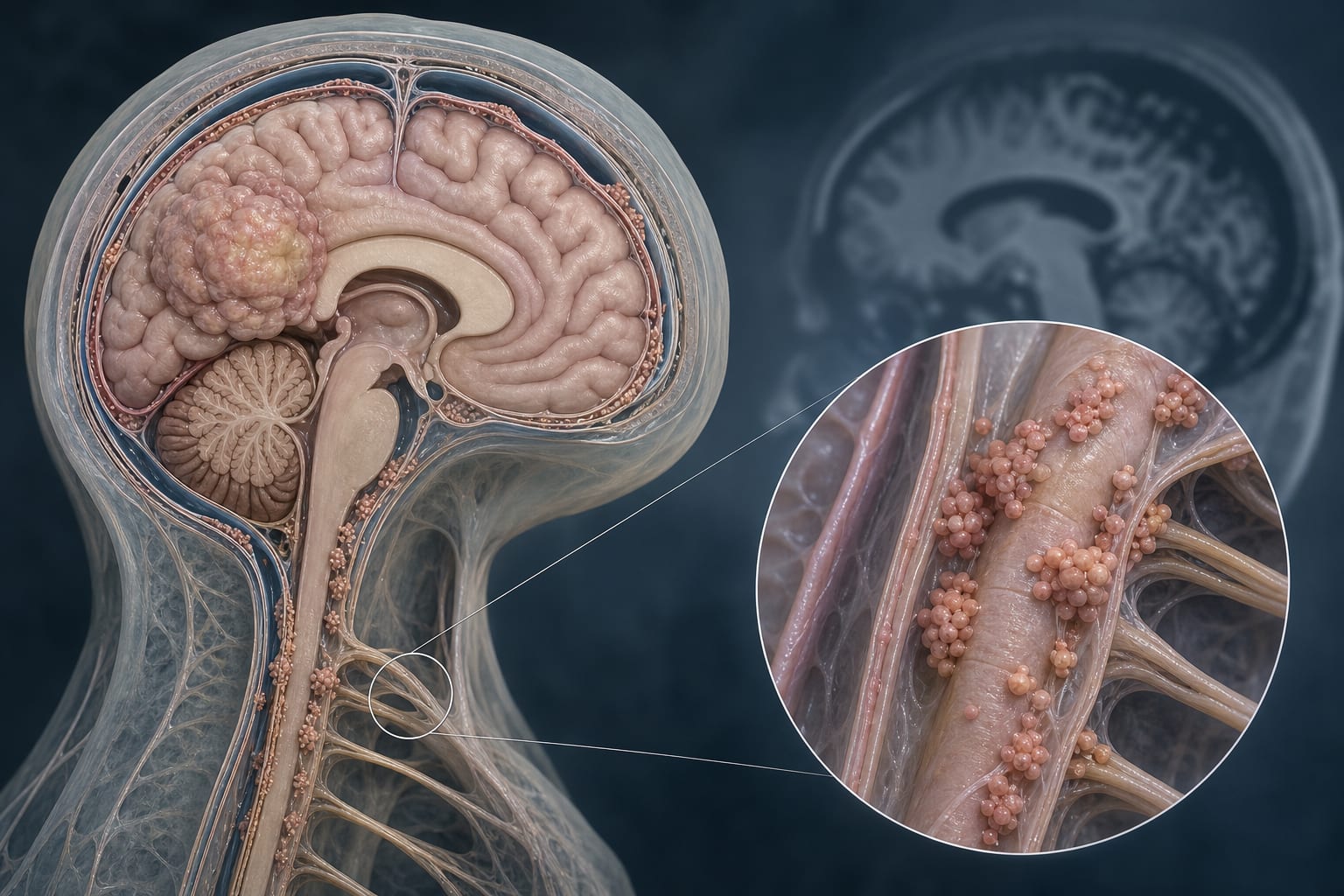
Clinical Report: Can Leptomeningeal Dissemination in Oligodendroglioma Be Anticipated?
Overview
This scoping review synthesizes literature on leptomeningeal dissemination (LMD) in oligodendrogliomas, identifying potential risk markers. Key findings indicate that LMD is rare but associated with poor prognosis and specific tumor characteristics.
Background
Oligodendrogliomas (ODGs) are a subtype of gliomas characterized by IDH mutations and 1p/19q co-deletion, often linked to better outcomes compared to other gliomas. However, symptomatic LMD in ODGs is exceptionally rare and poorly understood, with limited predictive markers available. Understanding LMD in ODG is crucial for optimizing surveillance and treatment strategies.
Data Highlights
Characteristic
Findings
Mean age at LMD diagnosis
43.1 years
Male predominance
M:F = 2.4:1
WHO grade 3 ODG at LMD diagnosis
85.7% (39 of 41 patients)
Median time from ODG diagnosis to LMD
35 months (range 0–274 months)
Median survival after LMD
9.9 months (range 1.8-67.7)
Key Findings
LMD in ODG is rare but associated with poor prognosis.
85.7% of patients with LMD had WHO grade 3 ODG.
Features indicating potential risk markers include surgical entry into the ventricles and a Ki-67 index of ≥15%.
Median survival after LMD was 9.9 months.
Long-term whole-neuroaxis MRI surveillance may be beneficial in selected patients.
Clinical Implications
Clinicians should consider specific tumor characteristics, such as grade and Ki-67 index, when assessing the risk of LMD in ODG patients. Regular MRI surveillance may be warranted for high-risk individuals to monitor for potential dissemination.
Conclusion
The findings highlight the rarity of LMD in ODG and suggest specific clinical features that may serve as risk markers, emphasizing the need for further research in this area.
by Hanna Veronika Salvotti, Francesco Brigo, Paolo Cipriano Cecchi, Davide Costazza, Vania Pirillo, Luca Zavatto, Francesco Erdini, Andreas Schwarz, Pier Paolo Berti