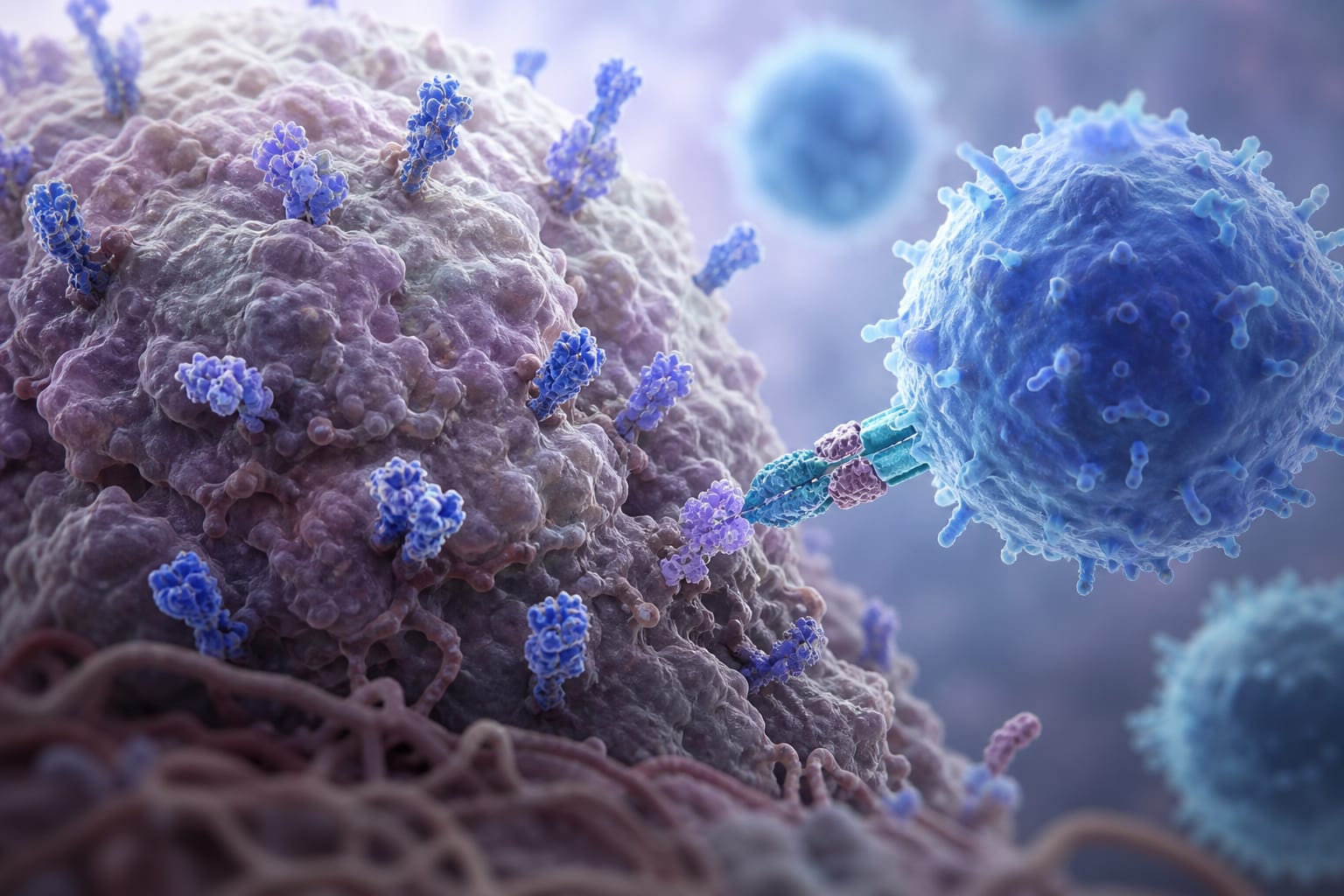
Real-World Evaluation of Talquetamab for the Treatment of Relapsed/Refractory Multiple Myeloma (RRMM): An International Myeloma Working Group Immunotherapy Registry Real-World Analysis - Report - MDSpire
Clinical Report: Assessment of Talquetamab in Treating Relapsed/Refractory Multiple Myeloma
Overview
Talquetamab, a GPRC5D bispecific antibody, shows a 74% overall response rate in T-cell–redirection–naive patients with relapsed refractory multiple myeloma. Real-world data from 151 patients indicate significant treatment responses.
Background
Relapsed refractory multiple myeloma (RRMM) poses significant treatment challenges, particularly in heavily pretreated patients. Talquetamab has received accelerated approval for RRMM after multiple lines of therapy. This analysis aims to provide insights into talquetamab's use outside clinical trial settings.
Data Highlights
Parameter
Value
Overall Response Rate (ORR) in T-cell–redirection–naive patients (0.4 mg/kg weekly)
74%
Overall Response Rate (ORR) in T-cell–redirection–naive patients (0.8 mg/kg every-2-weeks)
69%
Overall Response Rate (ORR) in previously treated patients
67%
Median Progression-Free Survival (PFS)
7.7 months
Median Age of Patients
64 years
Key Findings
Talquetamab achieved an overall response rate of 74% in T-cell–redirection–naive patients.
Patients in the study had a median of 6 prior lines of therapy, with 91% being triple-refractory.
High-risk cytogenetic abnormalities were present in 42% of patients.
Adverse events included cytokine release syndrome, immune effector cell-associated neurotoxicity syndrome, and infections.
55% of patients would not have met eligibility criteria for the MonumenTAL-1 study.
Clinical Implications
Monitoring for adverse events such as cytokine release syndrome and neurotoxicity is important in patients receiving talquetamab.
Conclusion
Talquetamab demonstrates efficacy in a real-world setting for patients with relapsed refractory multiple myeloma.