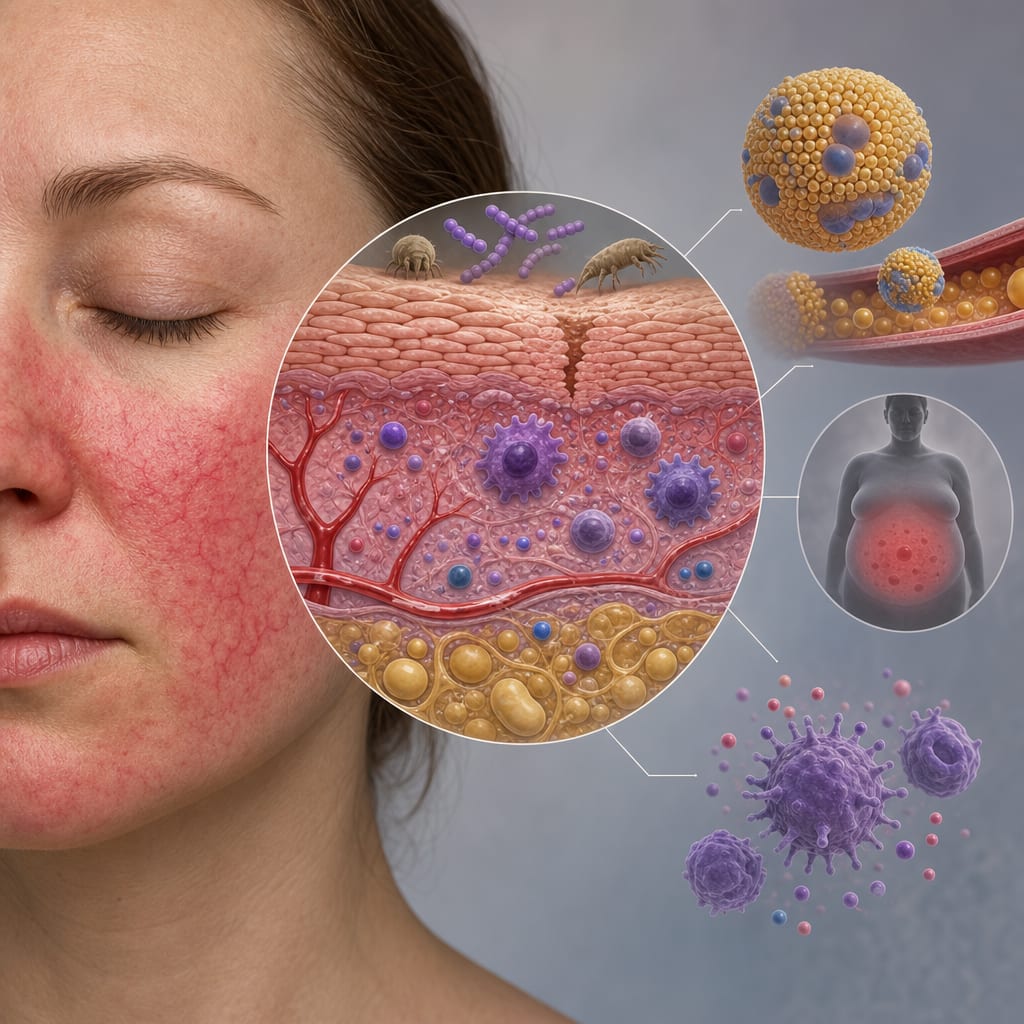
The Role of Lipids and Inflammation in Rosacea: Insights into Mechanisms and Treatment Options
-
By
-
Xiaoyu Zhang
-
Tao Ning
-
Yanyan Feng
-
May 4, 2026
Clinical Report: The Role of Lipids and Inflammation in Rosacea
Overview
This report examines the complex interplay between lipid metabolism and inflammation in rosacea, highlighting significant abnormalities in serum lipid profiles and cutaneous lipid metabolism. The findings underscore the potential role of dysregulated lipid metabolism in the pathogenesis of rosacea and its associated metabolic comorbidities.
Background
Rosacea is a chronic inflammatory skin condition that significantly impacts quality of life, characterized by facial erythema, flushing, and various lesions. Understanding its multifactorial pathogenesis, including genetic, immune, and metabolic factors, is crucial for developing effective treatment strategies. Recent studies suggest a strong link between rosacea and metabolic disorders, particularly those related to lipid metabolism.
Data Highlights
No specific numerical data provided in the article.
Key Findings
Detail the significance of myristic acid levels in relation to skin barrier dysfunction.Clinical Implications
Clinicians should consider the metabolic profile of patients with rosacea when developing treatment plans, as addressing lipid metabolism may improve outcomes. Tailoring therapies based on individual clinical presentations and associated metabolic conditions is essential for effective management.
Conclusion
The interplay between lipid metabolism and inflammation is critical in understanding rosacea's pathogenesis. Further research is needed to explore targeted interventions that address these metabolic abnormalities.
Related Resources & Content
- National Rosacea Society, Rosacea.org, 2025 -- National Rosacea Society Introduces Updated Rosacea Treatment Algorithms
- Lipidomic profiling of skin surface lipids in a cohort of Chinese patients with rosacea, Scientific Reports, 2025 -- Lipidomic profiling of skin surface lipids in a cohort of Chinese patients with rosacea
- The efficacy and safety of minocycline, metronidazole, ivermectin, and azelaic acid in moderate-to-severe papulopustular rosacea: A systematic review and network meta-analysis, ScienceDirect, 2024 -- The efficacy and safety of minocycline, metronidazole, ivermectin, and azelaic acid in moderate-to-severe papulopustular rosacea
- Recognizing Atherosclerosis as an Inflammatory Condition: The Importance of Appropriate Treatment, Clinical Research in Cardiology, 2024 -- Recognizing Atherosclerosis as an Inflammatory Condition: The Importance of Appropriate Treatment
- Dry Eye Dx and Tx: Rosacea: From Skin to Eye, Contact Lens Spectrum, 2025 -- Dry Eye Dx and Tx: Rosacea: From Skin to Eye
- Optometric Management — Recognizing and Treating Ocular Rosacea in Darker Skin Tones
- Optometric Management — Recognizing and Treating Ocular Rosacea in Darker Skin Tones
- National Rosacea Society Introduces Updated Rosacea Treatment Algorithms | Rosacea.org
- The efficacy and safety of minocycline, metronidazole, ivermectin, and azelaic acid in moderate-to-severe papulopustular rosacea: A systematic review and network meta-analysis - ScienceDirect
- Lipidomic profiling of skin surface lipids in a cohort of Chinese patients with rosacea | Scientific Reports
Based on findings from:
The lipid–inflammation axis in rosacea: mechanistic insights and therapeutic implications
Xiaoyu Zhang, Tao Ning, Yanyan Feng. Frontiers In Immunology, 2026.
https://www.frontiersin.org/journals/immunology/articles/10.3389/fimmu.2026.1820173/full
This content is an AI-generated, fully rewritten summary based on a published scholarly article. It does not reproduce the original text and is not a substitute for the original publication. Readers are encouraged to consult the source for full context, data, and methodology.