Development and validation of a clinical prediction model for postoperative atrial fibrillation after lung cancer surgery: a machine-learning–based study - Report - MDSpire
Advertisement
Development and validation of a clinical prediction model for postoperative atrial fibrillation after lung cancer surgery: a machine-learning–based study
Clinical Report: Predictive Model for Postoperative Atrial Fibrillation
Overview
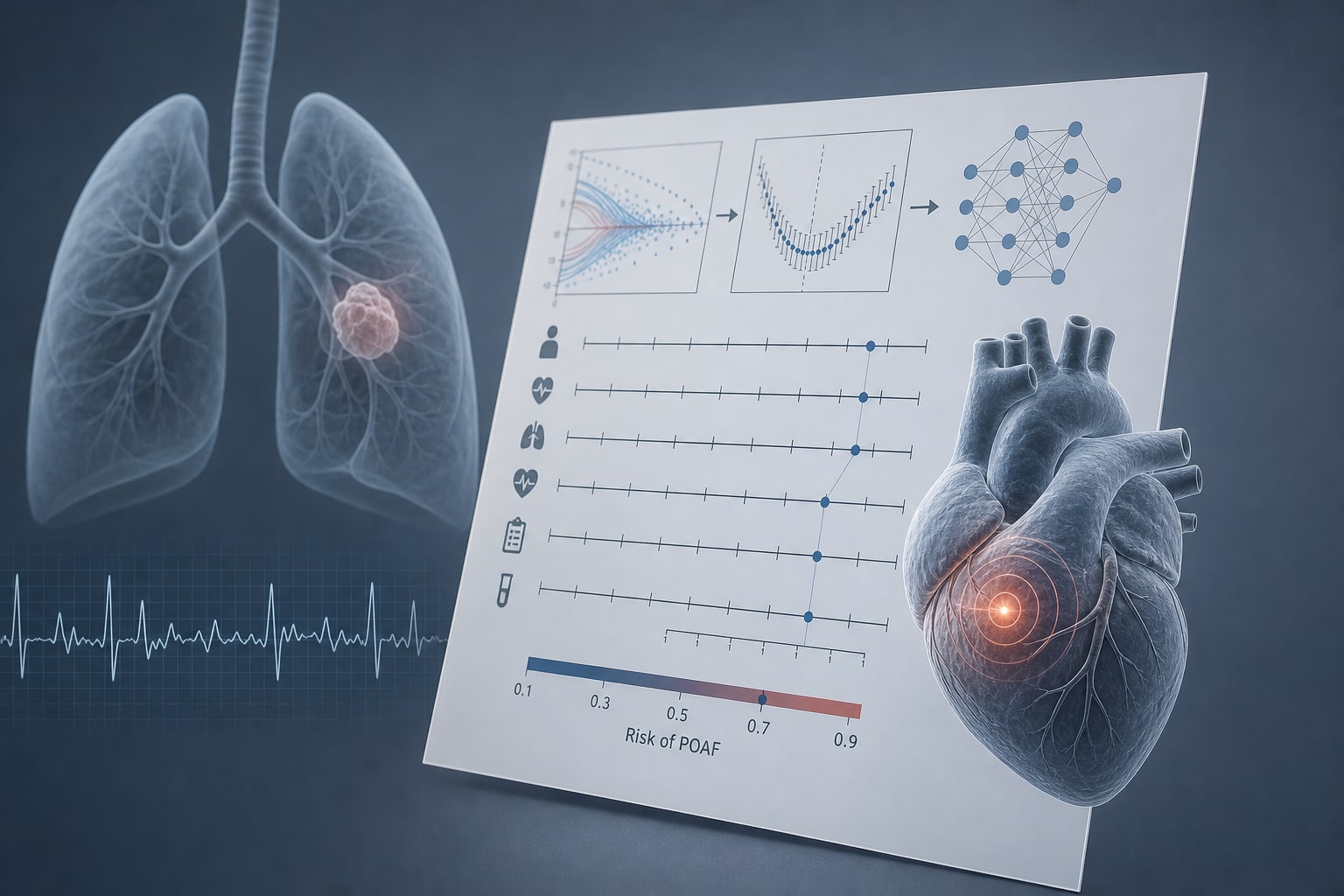
This study developed and validated machine learning-based models to predict postoperative atrial fibrillation (POAF) in lung cancer surgery patients. A logistic regression model demonstrated superior stability and clinical utility, leading to the creation of a nomogram for individualized risk assessment.
Background
Postoperative atrial fibrillation is a significant complication following lung cancer surgery, associated with increased morbidity and prolonged hospital stays. Accurate risk stratification is essential for optimizing perioperative care and preventing adverse outcomes. Traditional risk assessment methods are limited, highlighting the need for advanced predictive tools.
Data Highlights
Predictor
Significance
Age
Identified as a key predictor
Education Level
Identified as a key predictor
Hypertension
Identified as a key predictor
Marital Status
Identified as a key predictor
Postoperative Pain Score
Identified as a key predictor
Surgical Approach
Identified as a key predictor
Key Findings
19.8% of patients developed POAF after lung cancer surgery.
Six predictors of POAF were identified: age, education level, hypertension, marital status, postoperative pain score, and surgical approach.
The logistic regression model achieved the highest AUC of 0.855 in the test cohort.
Calibration curves indicated good agreement between predicted and observed POAF risks for the logistic regression model.
The developed nomogram provides a practical tool for individualised POAF risk prediction.
Clinical Implications
The logistic regression-based nomogram can aid clinicians in identifying patients at high risk for POAF, facilitating targeted monitoring and preventive strategies. This tool enhances the ability to personalize perioperative care for lung cancer surgery patients.
Conclusion
The study successfully developed a machine learning-assisted framework for predicting POAF, demonstrating that simpler models like logistic regression can offer robust performance and clinical applicability. This nomogram serves as a valuable resource for risk assessment in the perioperative setting.