Extent of the low-density line is associated with time to fracture in children with congenital anterolateral bowing of the tibia: a retrospective survival analysis - Report - MDSpire
Advertisement
Extent of the low-density line is associated with time to fracture in children with congenital anterolateral bowing of the tibia: a retrospective survival analysis
Clinical Report: Association Between Low-Density Line Extent and Fracture Timing
Overview
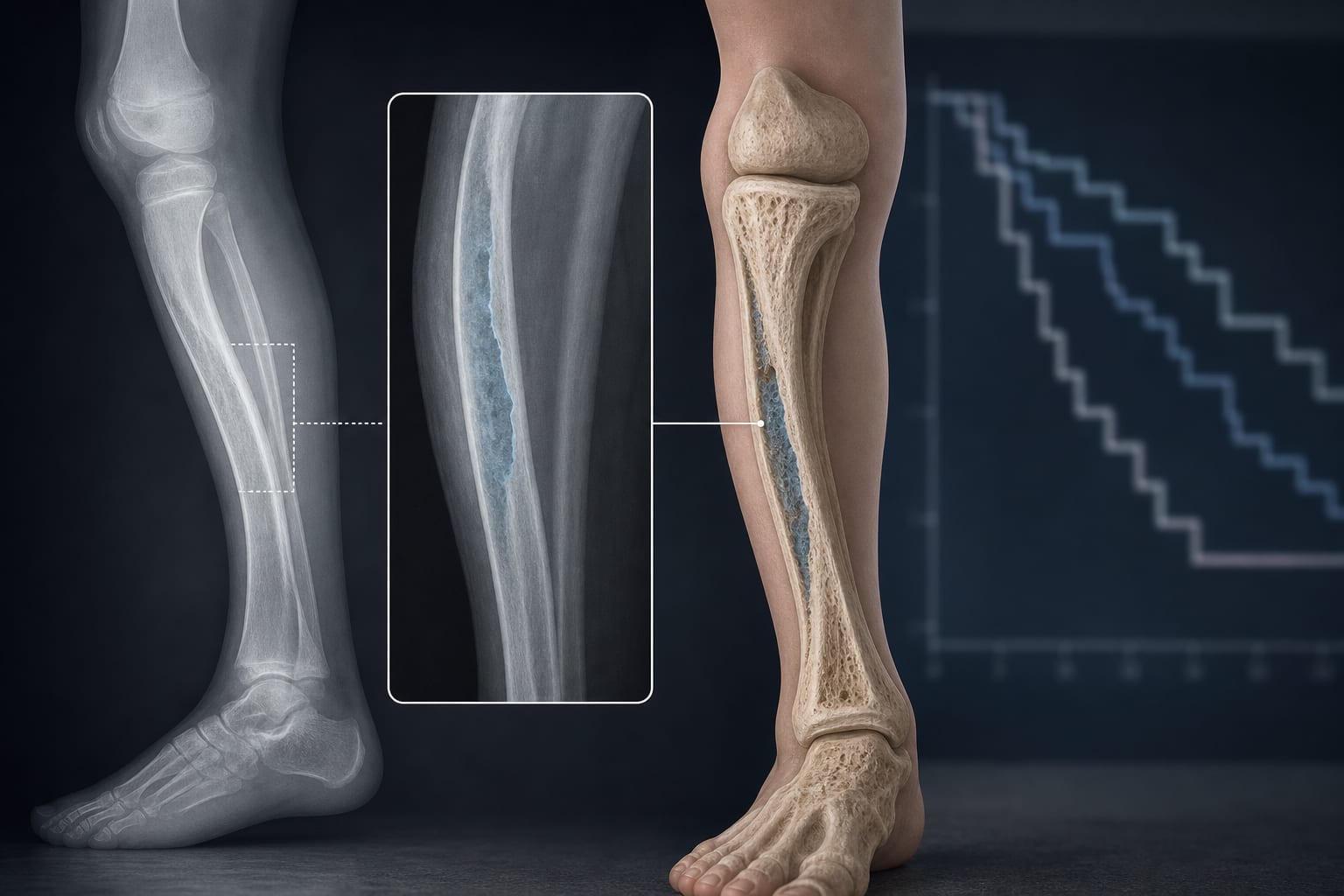
This study investigates the relationship between low-density line (LDL) extent and fracture timing in pediatric patients with congenital anterolateral bowing of the tibia (ALBT). Findings suggest that a larger LDL proportion may correlate with earlier fracture occurrence, highlighting the need for closer monitoring during the first six months post-LDL detection.
Background
Congenital anterolateral bowing of the tibia (ALBT) is a precursor to congenital pseudarthrosis of the tibia (CPT), a challenging condition in pediatric orthopedics. Understanding the risk factors for fracture in ALBT is crucial, as timely intervention can significantly impact patient outcomes. The low-density line (LDL) serves as a potential imaging marker for assessing fracture risk and timing.
Data Highlights
{'1/3 – 2/3': {'Cumulative Fracture Probability at 6 months': 'Incomplete data'}, '> 2/3': {'Cumulative Fracture Probability at 6 months': 'Incomplete data'}}
Key Findings
Fractures occurred in 77.5% of the studied cohort.
61.3% of fractures happened within 6 months after LDL detection.
Kaplan–Meier analysis indicated significant differences in fracture-free survival among LDL proportion groups (P = 0.014).
Higher LDL proportions were associated with shorter time to fracture (HR for 1/3–2/3 group: 2.784, P = 0.028; HR for >2/3 group: 3.221, P = 0.010).
After multivariable adjustment, the association between LDL proportion and fracture timing was no longer statistically significant (P = 0.145).
Clinical Implications
Clinicians should consider the LDL extent as a potential marker for fracture risk in pediatric patients with ALBT. Close monitoring during the initial six months following LDL detection may be warranted to identify and manage fractures early. Further research is needed to validate these findings in larger cohorts.
Conclusion
The study suggests that LDL proportion may be a useful indicator for predicting fracture timing in children with ALBT. These findings underscore the importance of early detection and monitoring in this patient population.
Teriparatide followed by zoledronic acid increased bone mineral density but did not reduce fracture risk compared with standard care in adults with osteogenesis imperfecta.