Comparison of hybrid surgeries for the treatment of three-level cervical degenerative disease: a systematic review and network meta-analysis - Report - MDSpire

Comparison of hybrid surgeries for the treatment of three-level cervical degenerative disease: a systematic review and network meta-analysis

  • By

  • Jiyuan Liao

  • Yuchen Duan

  • Yunfei Lu

  • Wenjie Liu

  • July 8, 2026

  • 0 min

Share

Clinical Report: Evaluation of Hybrid Surgical Approaches for Managing Three-Level Cervical Degenerative Disease

Overview

This systematic review and network meta-analysis evaluates hybrid surgical approaches for three-level cervical degenerative disease (CDD).

Background

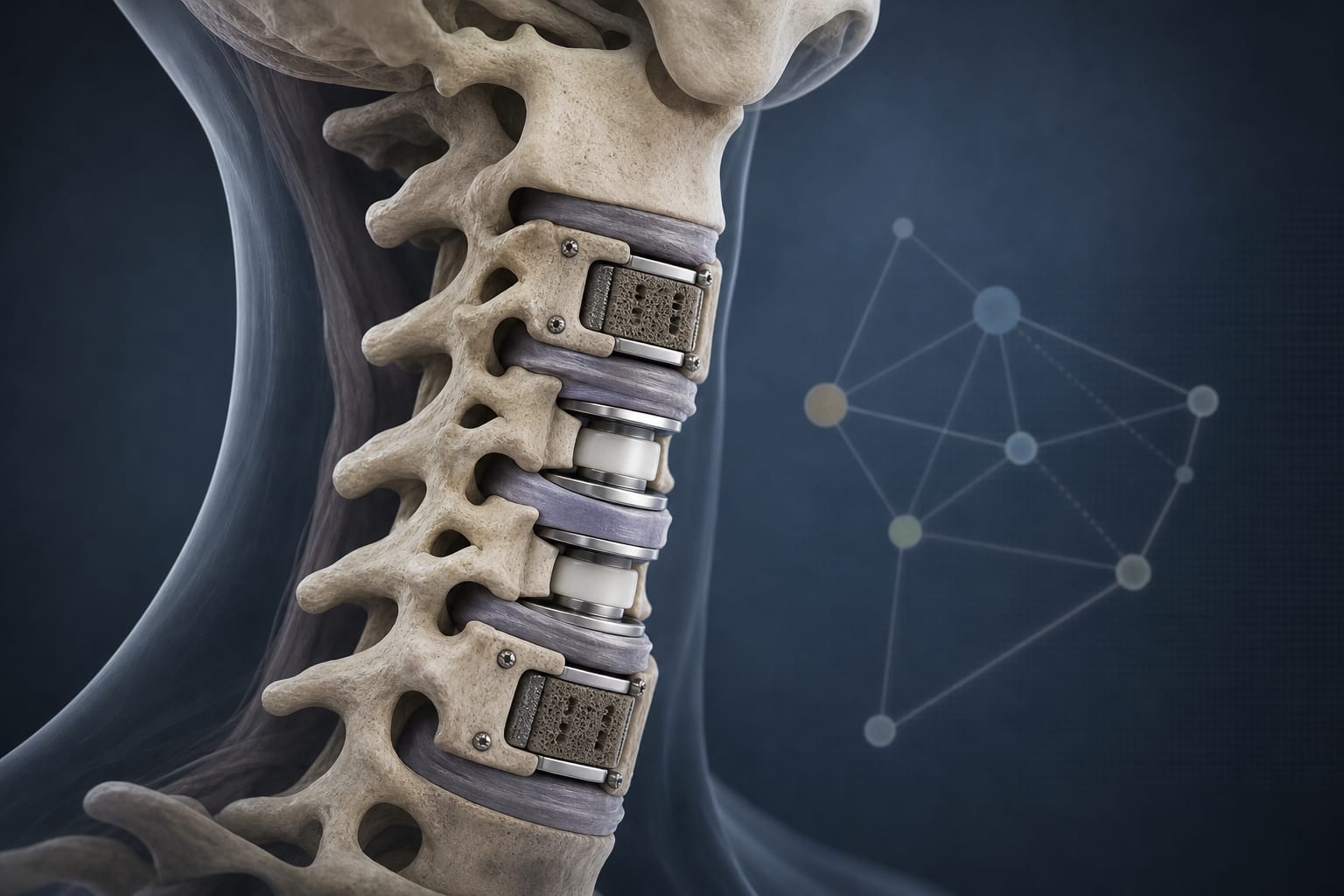
Cervical degenerative disease (CDD) is a common condition that can lead to significant morbidity due to spinal cord and nerve root compression. Traditional surgical approaches, such as anterior cervical discectomy and fusion (ACDF), have limitations, particularly concerning adjacent segment degeneration. Hybrid surgical techniques have emerged as potential alternatives that may offer improved outcomes in terms of motion preservation and complication rates.

Data Highlights

ComparisonNDIC2-7 ROMAdjacent Segment ROM
HS1 vs ACDFLowerGreaterLower
HS2 vs ACDFSimilarGreaterLower
HS1 vs HS2SimilarLowerSimilar

Key Findings

  • HS1 (1-level TDR with 2-level ACDF) shows significantly lower Neck Disability Index (NDI) compared to ACDF.
  • Both HS1 and HS2 (2-level TDR with 1-level ACDF) demonstrate significantly greater C2-7 range of motion (ROM) than ACDF.
  • HS1 has a significantly lower C2-7 ROM compared to HS2.
  • ROMs of upper and lower segments in HS1 and HS2 are significantly lower than in ACDF.
  • No significant difference in ROM of upper or lower segments between HS1 and HS2.
  • Incidences of adjacent segment degeneration (ASD) are similar across HS1, HS2, and ACDF.

Clinical Implications

Surgeons should consider the findings of this study when evaluating surgical options for patients with three-level CDD.

Conclusion

Hybrid surgical techniques for three-level cervical degenerative disease are safe and effective.
Related Resources & Content

  1. Author(s)/Org, Source, Year -- Title
  2. Author(s)/Org, Source, Year -- Title
  3. Author(s)/Org, Source, Year -- Title
  4. Author(s)/Org, Source, Year -- Title
  5. Author(s)/Org, Source, Year -- Title
  6. Author(s)/Org, Source, Year -- Title
  7. Author(s)/Org, Source, Year -- Title
  8. Author(s)/Org, Source, Year -- Title
  9. Author(s)/Org, Source, Year -- Title
  10. Author(s)/Org, Source, Year -- Title
  11. Author(s)/Org, Source, Year -- Title
  12. AO Spine Clinical Practice Recommendations for Diagnosis and Management of Degenerative Cervical Myelopathy: Evidence Based Decision Making - A Review of Cutting Edge Recent Literature Related to Degenerative Cervical Myelopathy
  13. Premarket Approval (PMA)
  14. Two-level cervical disc arthroplasty versus anterior cervical discectomy and fusion: 10-year outcomes of a prospective, randomized investigational device exemption clinical trial - PubMed
  15. Ten-Year Outcomes of 1- and 2-Level Cervical Disc Arthroplasty From the Mobi-C Investigational Device Exemption Clinical Trial - PubMed
  16. Is Motion Preservation With Three-Level Hybrid Cervical Surgery Achieved Without Compromising Clinical Outcomes? A Systematic Review and Meta-Analysis
  17. Frontiers | Comparison of hybrid surgeries for the treatment of three-level cervical degenerative disease: a systematic review and network meta-analysis
  18. Efficacy and Safety of Hybrid Surgery versus Anterior Cervical Discectomy and Fusion in Multilevel Cervical Degenerative Disc Disease: A Systematic Review and Meta-Analysis - PubMed

Original Source(s)

Related Content