Development and validation of a nomogram predicting the risk of necrosis in fingertip replantation: a single-center retrospective study - Report - MDSpire
Conexiant’s news site is now MDSpire News. Learn more
Advertisement
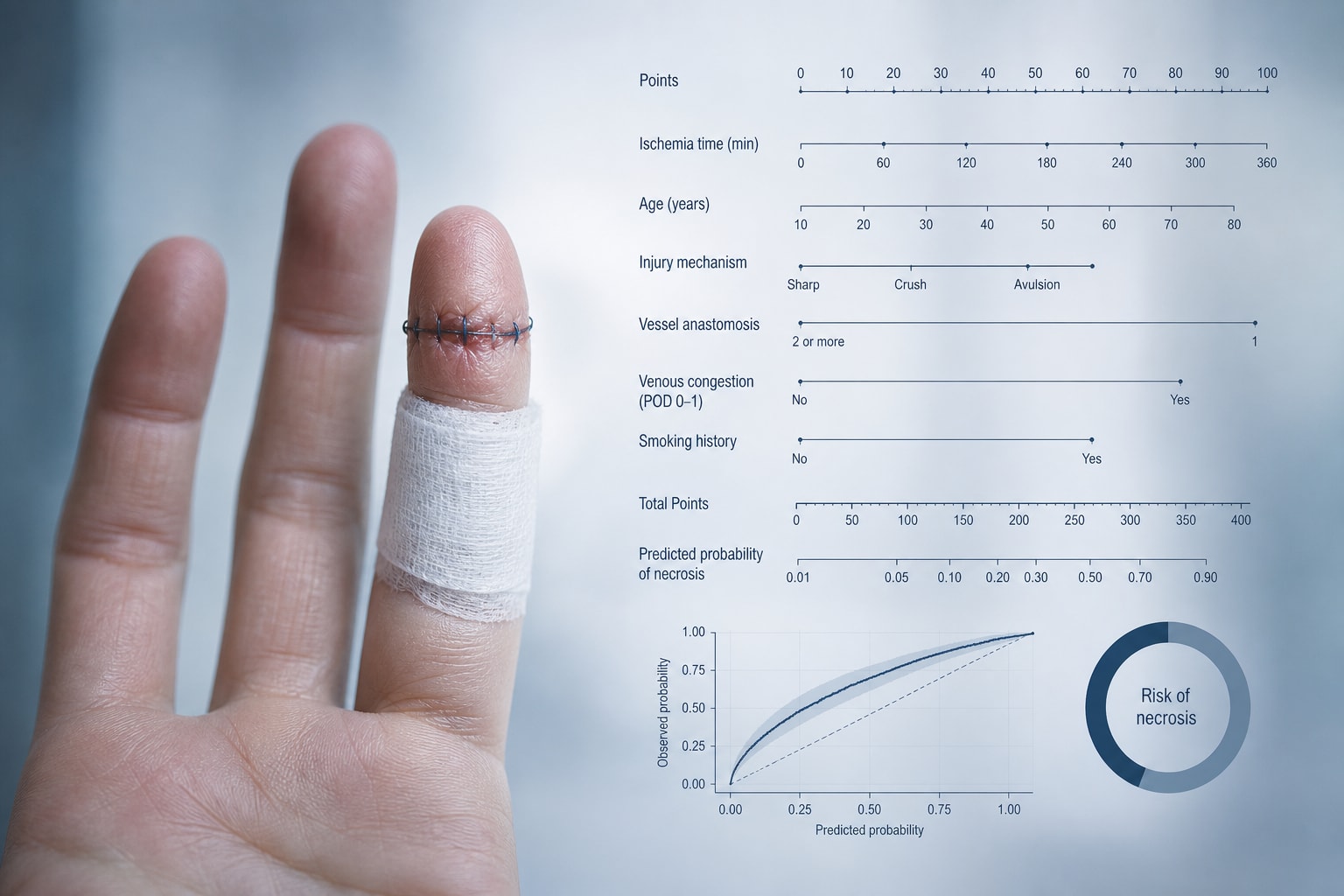
Creation and assessment of a nomogram for estimating necrosis risk following fingertip replantation: a retrospective analysis from a single institution
Clinical Report: Creation and assessment of a nomogram for estimating necrosis risk
Overview
This study developed and validated a nomogram to estimate necrosis risk following fingertip replantation based on clinical and early postoperative data.
Background
Fingertip replantation is a common procedure in hand surgery, particularly in regions with high rates of hand injuries. Despite advancements in microsurgical techniques, necrosis remains a significant complication that can affect patient outcomes. Understanding risk factors for necrosis can aid in clinical decision-making.
Data Highlights
Metric
Derivation Cohort
Validation Cohort
Patients
942
402
Necrosis Rate
12.2%
11.9%
AUC
0.953
0.974
Brier Score
0.051
0.042
Key Findings
The nomogram includes six predictors: surgeon experience, PLT, NEU%, D-dimer, hypertension, and vascular crisis.
Discrimination was strong with AUC values of 0.953 for the derivation cohort and 0.974 for the validation cohort.
The Brier scores were 0.051 for the derivation cohort and 0.042 for the validation cohort, indicating good predictive accuracy.
Calibration in the internal validation cohort showed an intercept of -0.338 and a slope of 0.759.
Necrosis affected 115 patients (12.2%) in the derivation cohort and 48 patients (11.9%) in the validation cohort.
Clinical Implications
The nomogram provides a tool for early postoperative risk stratification of necrosis in fingertip replantation.
Conclusion
The internally validated nomogram estimates necrosis risk following fingertip replantation, although external validation is necessary.
A VHA study across 11 vendors finds AI-generated primary care notes score lower than clinician-written notes, with the largest deficits in thoroughness, organization, and usefulness