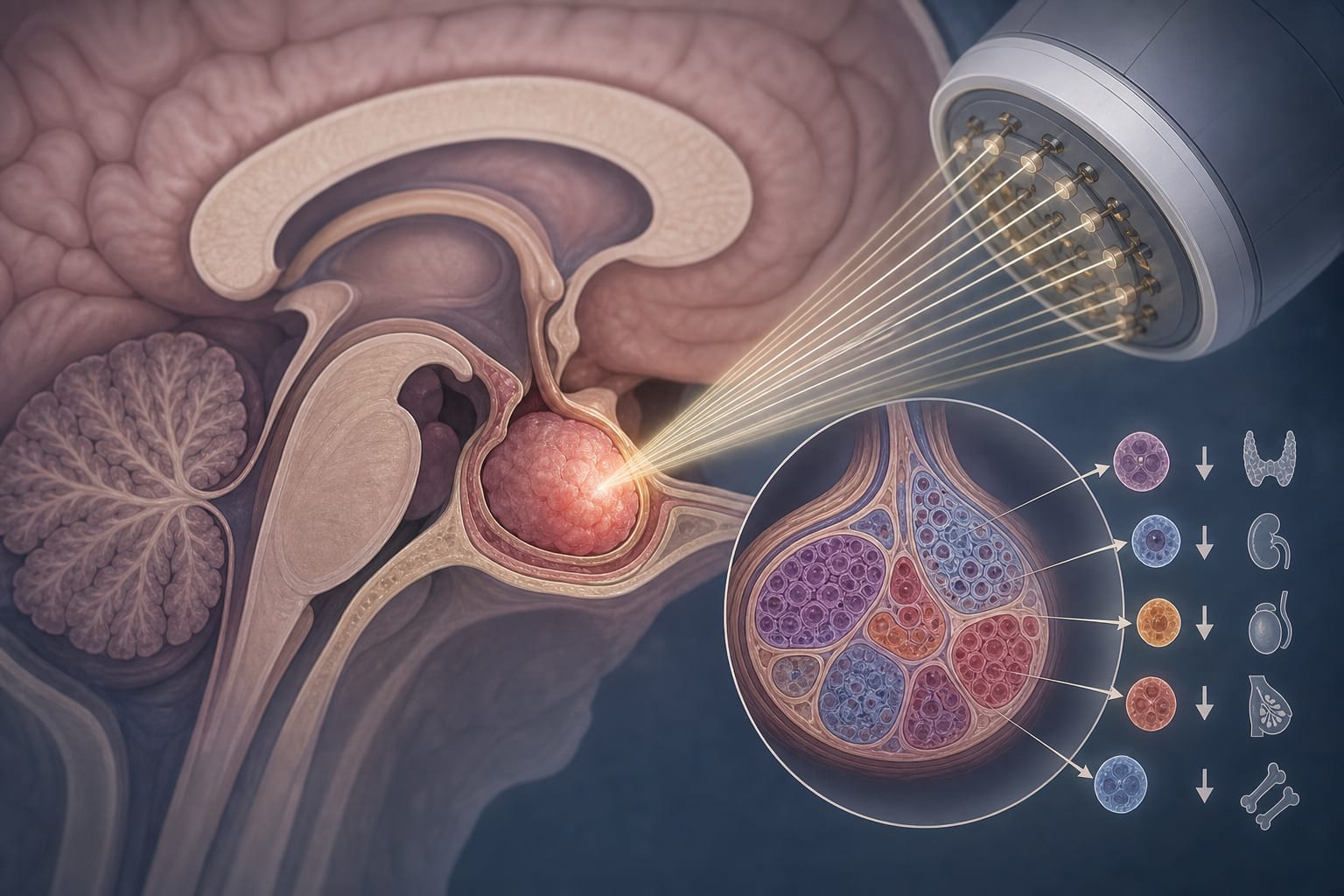
Post-Stereotactic Radiosurgery Pituitary Hormone Dysfunction in Patients with Pituitary Adenomas: Understanding Mechanisms and Treatment Approaches
-
By
-
Christina Abi Faraj
-
Ian E. McCutcheon
-
June 6, 2026
Post-Stereotactic Radiosurgery Pituitary Hormone Dysfunction in Patients with Pituitary Adenomas
Overview
Stereotactic radiosurgery (SRS) is increasingly used to manage pituitary adenomas, but it carries a significant risk of hypopituitarism, with incidence rates ranging from 21% to 50%. Understanding the mechanisms and predictors of hormone dysfunction following SRS is crucial for optimizing patient outcomes.
Background
Pituitary adenomas account for a notable percentage of intracranial tumors and can lead to significant hormonal dysfunction. The management of these tumors often involves surgical resection and radiotherapy, with SRS emerging as a less invasive option. However, the potential for post-treatment hormonal deficiencies necessitates careful consideration of treatment strategies.
Data Highlights
Hypopituitarism after SRS has been reported in approximately 21% to 50% of patients.
Residual pituitary adenomas may progress in approximately 50% of cases within 10 years after surgery.
SRS is commonly used as adjuvant treatment for residual tumors; it may reduce tumor size, but tumor shrinkage does not necessarily result in hormonal remission.
Studies use varying criteria to define biochemical remission, limiting direct comparisons of treatment outcomes.
Key Findings
Hypopituitarism is the most common complication of SRS, with an incidence of 21% to 50%.
Complete surgical resection is not always achievable, particularly in cases of tumor invasion.
Progression of residual tumors occurs in approximately 50% of pituitary adenomas within 10 years post-surgery.
SRS is primarily used as adjuvant therapy for residual tumors and can lead to tumor shrinkage without guaranteeing hormonal remission.
Biochemical remission criteria vary across studies, complicating comparisons of treatment efficacy.
Clinical Implications
Clinicians should be aware of the high incidence of hypopituitarism following SRS and consider the timing and extent of hormonal monitoring post-treatment. The potential for delayed hormonal deficiencies emphasizes the need for ongoing endocrine evaluation in patients treated with SRS.
Conclusion
SRS presents a valuable option for managing pituitary adenomas, but the risk of hypopituitarism necessitates a thorough understanding of its mechanisms and careful patient follow-up.
Related Resources & Content
Journal of Neuro-Oncology, 2017 -- Systematic Review of Ischemic Stroke Incidence Following Radiation Treatment for Pituitary Adenomas
Journal of Neuro-Oncology, 2025 -- Long-term Effects of Contemporary Radiation Techniques on Pituitary Adenomas: Insights from a Single-Center Study
Journal of Neuro-Oncology, 2026 -- A Comprehensive Review of Stereotactic Radiosurgery in Treating Metastases to the Pituitary Gland
Journal of Neuro-Oncology, 2026 -- Long-term outcomes of adjuvant proton radiotherapy (PRT) for residual pituitary adenoma (PA) in adults – a retrospective, single institute experience
Congress of Neurological Surgeons, 2025 -- Systematic Review and Evidence-Based Guidelines for the Role of Radiosurgery for Patients With Functioning Pituitary Adenomas
Congress of Neurological Surgeons Systematic Review and Evidence-Based Guidelines for the Role of Radiosurgery for Patients With Functioning Pituitary Adenomas - PubMed
https://academic.oup.com/neuro-oncology/article/26/4/715/7473217
Cyberknife radio-neurosurgery for secreting pituitary adenomas treated with single fraction radio-neurosurgery: A systematic review and meta -analysis
Based on findings from:
Loss of pituitary hormone function after stereotactic radiosurgery for pituitary adenomas: mechanisms and management
Christina Abi Faraj, Ian E. McCutcheon. Journal Of Neuro-Oncology, 2026.
https://link.springer.com/article/10.1007/s11060-026-05591-7
This content is an AI-generated, fully rewritten summary based on a published scholarly article. It does not reproduce the original text and is not a substitute for the original publication. Readers are encouraged to consult the source for full context, data, and methodology.