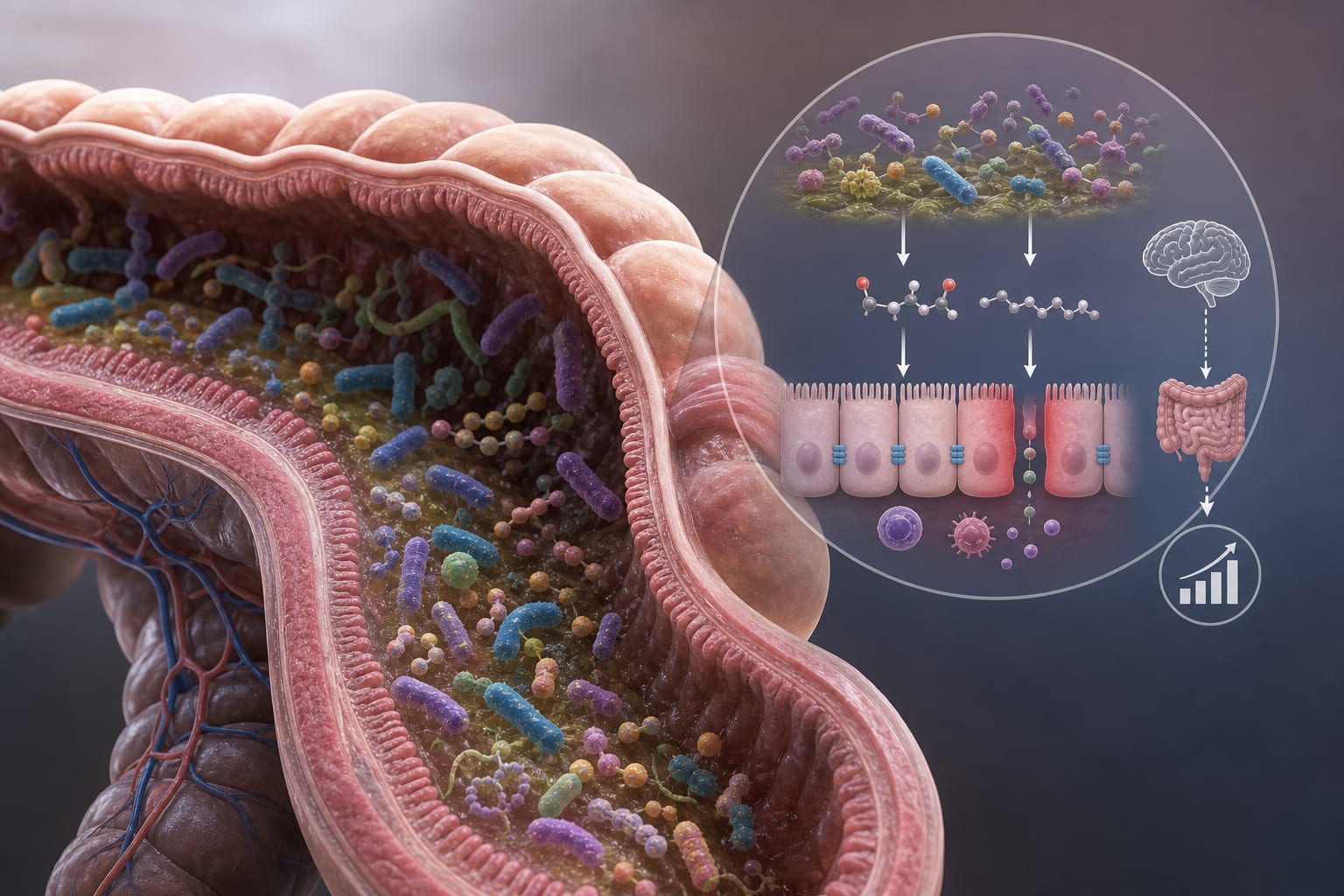
The Role of Gut Microbiota in Influencing Responses to GLP-1 Receptor Agonists: A Comprehensive Review
-
By
-
Luigi Regenburgh De La Motte
-
Francesca Carreras
-
Lorenzo Drago
-
July 6, 2026
Clinical Report: The Role of Gut Microbiota in Influencing Responses to GLP-1 RAs
Overview
This review highlights the significant interindividual variability in responses to GLP-1 receptor agonists (GLP-1 RAs) in obesity and type 2 diabetes. Evidence suggests that GLP-1 RAs can alter gut microbial communities and that baseline microbiota composition may correlate with metabolic responses.
Background
The management of obesity and type 2 diabetes is complicated by the variability in patient responses to GLP-1 RAs. Understanding the interactions between GLP-1 RAs and gut microbiota is an emerging area of research.
Data Highlights
No specific numerical data or trial results were provided in the source material.
Key Findings
- GLP-1 RAs can remodel gut microbial communities and influence metabolite profiles.
- Human studies show GLP-1 RA therapy is associated with changes in microbial diversity and enrichment of specific taxa.
- Baseline microbiota composition may correlate with differential metabolic responses to GLP-1 RAs.
- Microbiota changes during GLP-1 RA therapy may be influenced by weight loss, dietary changes, and concomitant treatments.
- Current evidence supports the hypothesis that host-microbiome interactions contribute to therapeutic heterogeneity.
Clinical Implications
Clinicians should consider the potential impact of microbiota composition on treatment efficacy and patient outcomes.
Conclusion
The interactions between GLP-1 RAs and gut microbiota require further research to understand their implications in metabolic disease management.
Related Resources & Content
- JAMA Network Open, 2023 -- Patient Experiences With GLP-1 Receptor Agonists
- conexiant, 2023 -- GLP-1 Drugs Linked to GI Effects, Uncertain Signals
- Journal of Crohn's and Colitis, 2023 -- Glucagon-like peptide-1 (GLP-1) receptor agonists in inflammatory bowel disease: mechanisms, clinical implications, and therapeutic potential
- Journal of Crohn's and Colitis, 2023 -- Glucagon-like peptide 1 receptor agonists and the clinical outcomes of inflammatory bowel disease: a systematic review and meta-analysis
- Diabetes Care, 2026 -- Summary of Revisions: Standards of Care in Diabetes—2026
- New England Journal of Medicine, 2023 -- Semaglutide and Cardiovascular Outcomes in Obesity without Diabetes
- New England Journal of Medicine, 2023 -- Effects of Semaglutide on Chronic Kidney Disease in Patients with Type 2 Diabetes
- PMC, 2023 -- Effects of GLP-1 Analogues and Agonists on the Gut Microbiota: A Systematic Review
- PMC, 2023 -- Fecal microbiome predicts treatment response after the initiation of semaglutide or empagliflozin uptake
- Frontiers, 2026 -- The Gut Microbiota as a Potential Determinant of Response to GLP-1 Receptor Agonists: A Narrative Review
- Summary of Revisions: Standards of Care in Diabetes—2026 | Diabetes Care | American Diabetes Association
- Semaglutide and Cardiovascular Outcomes in Obesity without Diabetes | New England Journal of Medicine
- Effects of Semaglutide on Chronic Kidney Disease in Patients with Type 2 Diabetes | New England Journal of Medicine
- Effects of GLP-1 Analogues and Agonists on the Gut Microbiota: A Systematic Review - PMC
- Fecal microbiome predicts treatment response after the initiation of semaglutide or empagliflozin uptake - PMC
- Frontiers | The Gut Microbiota as a Potential Determinant of Response to GLP-1 Receptor Agonists: A Narrative Review
Based on findings from:
The gut microbiota as a potential determinant of response to GLP-1 receptor agonists: a narrative review
Luigi Regenburgh De La Motte, Francesca Carreras, Lorenzo Drago. Frontiers In Endocrinology, 2026.
https://www.frontiersin.org/journals/endocrinology/articles/10.3389/fendo.2026.1858420/full
This content is an AI-generated, fully rewritten summary based on a published scholarly article. It does not reproduce the original text and is not a substitute for the original publication. Readers are encouraged to consult the source for full context, data, and methodology.