Intracardiac thrombus formations despite continuous oral anticoagulation in atrial fibrillation patients undergoing catheter ablation procedures: pilot development of a machine learning prediction model - Report - MDSpire

Intracardiac thrombus formations despite continuous oral anticoagulation in atrial fibrillation patients undergoing catheter ablation procedures: pilot development of a machine learning prediction model

  • By

  • F. Ratajczak

  • F. Hohendanner

  • S. Haack

  • L. Boldt

  • A. S. Parwani

  • F. Blaschke

  • M. Schneider-Reigbert

  • F. Spinka

  • M. Bock

  • A. Meyer

  • E. Heil

  • G. Hindricks

  • D. Schoeppenthau

  • June 4, 2026

  • 0 min

Share

Formation of Intracardiac Thrombi Despite Ongoing Oral Anticoagulation in Atrial Fibrillation Patients Undergoing Catheter Ablation

Overview

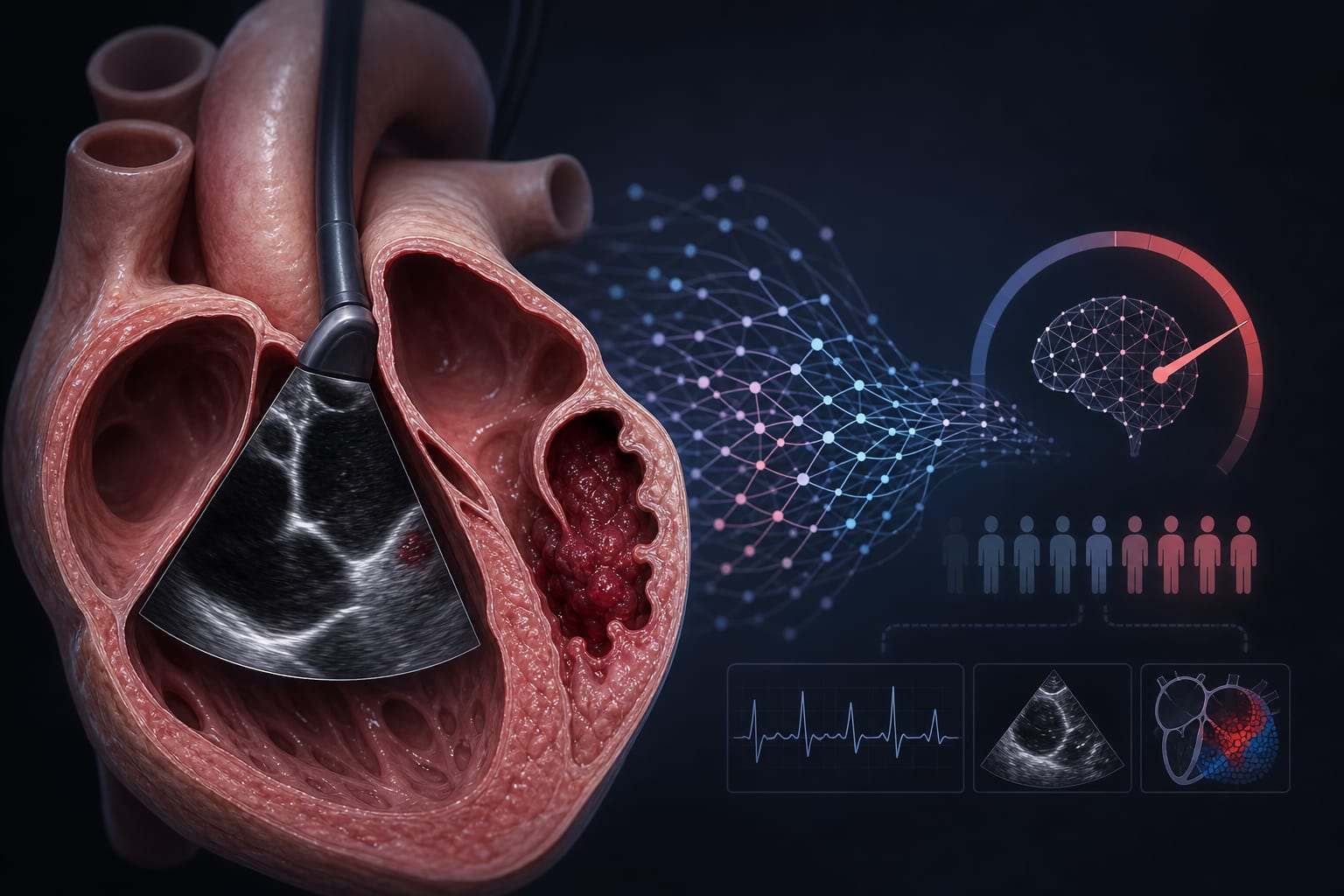
This study develops a machine learning model to predict thrombus formation in atrial fibrillation patients undergoing catheter ablation while on oral anticoagulation.

Background

Atrial fibrillation (AF) significantly increases the risk of stroke due to thrombus formation in the left atrium, particularly in patients with advanced atrial disease. Despite the use of oral anticoagulation, thrombi can still occur.

Data Highlights

ParameterValue
Patients analyzed149
Thrombus positive patients65
Thrombus negative patients84
CHA₂DS₂-VASc mean score3.89
ROC AUC for ML model0.886
ROC AUC for CHA₂DS₂-VASc0.641

Key Findings

  • Machine learning models achieved a ROC AUC of 0.886 for predicting thrombus formation.
  • Thrombus positive patients had a mean CHA₂DS₂-VASc score of 3.89.
  • 96.9% of thrombus positive patients were in clinical arrhythmias at the time of thrombus detection.
  • P-wave characteristics in sinus rhythm were among the top features for the ML model.
  • The study included 149 patients undergoing left atrial catheter ablation, with 96% on direct oral anticoagulants.

Clinical Implications

The development of a machine learning model for predicting thrombus formation may enhance preprocedural evaluations.

Conclusion

The study highlights the potential of machine learning algorithms to improve thrombus detection in anticoagulated atrial fibrillation patients.

Related Resources & Content

  1. Frontiers in Cardiovascular Medicine, 2026 -- Atrial Fibrillation Type-Specific Prediction of Recurrence After Catheter Ablation: The Pivotal Role of Right Atrial Remodeling Revealed by Explainable Machine Learning
  2. npj Digital Medicine, 2026 -- A deep learning model integrating structured data and clinical text for predicting atrial fibrillation recurrence
  3. Clinical Research in Cardiology, 2026 -- Predicting atrial fibrillation after an acute coronary syndrome: insights from the BACS & BAMI study
  4. 2024 ESC Guidelines for the management of atrial fibrillation developed in collaboration with the European Association for Cardio-Thoracic Surgery (EACTS)
  5. Clinical Research in Cardiology (Springer) — Comparison of therapeutic strategies in patients presenting with left atrial thrombus despite oral anticoagulation
  6. Uninterrupted Dabigatran versus Warfarin for Ablation in Atrial Fibrillation
  7. Apixaban in patients at risk of stroke undergoing atrial fibrillation ablation
  8. Comparison of therapeutic strategies in patients presenting with left atrial thrombus despite oral anticoagulation
  9. 2024 ESC Guidelines for the management of atrial fibrillation developed in collaboration with the European Association for Cardio-Thoracic Surgery (EACTS)
  10. https://academic.oup.com/europace/article/doi/10.1093/europace/euaf115/8294206
  11. A Prospective, Randomized, Open-Label, Blinded Endpoint Evaluation Parallel Group Study Comparing Edoxaban vs. VKA in Subjects Undergoing Catheter Ablation of Non-valvular Atrial Fibrillation - American College of Cardiology
  12. Overcoming barriers for left atrial appendage thrombus: a systematic review of left atrial appendage closure | BMC Cardiovascular Disorders | Springer Nature Link
  13. Outcomes of Patients With vs. Without Pre-Ablation Transesophageal Echocardiogram - American College of Cardiology
  14. Evidence-Based Imaging Pathway for Atrial Fibrillation Ablation | JAMA Cardiology | JAMA Network
  15. Checking your browser - reCAPTCHA

Original Source(s)

Related Content