Explainable residual ensemble modelling for EuroQol-5 dimensions-based quality-of-life assessment and stratification in patients with knee osteoarthritis - Report - MDSpire
Advertisement
Explainable residual ensemble modelling for EuroQol-5 dimensions-based quality-of-life assessment and stratification in patients with knee osteoarthritis
Clinical Report: Utilizing Explainable Residual Ensemble Modeling for QoL Evaluation
Overview
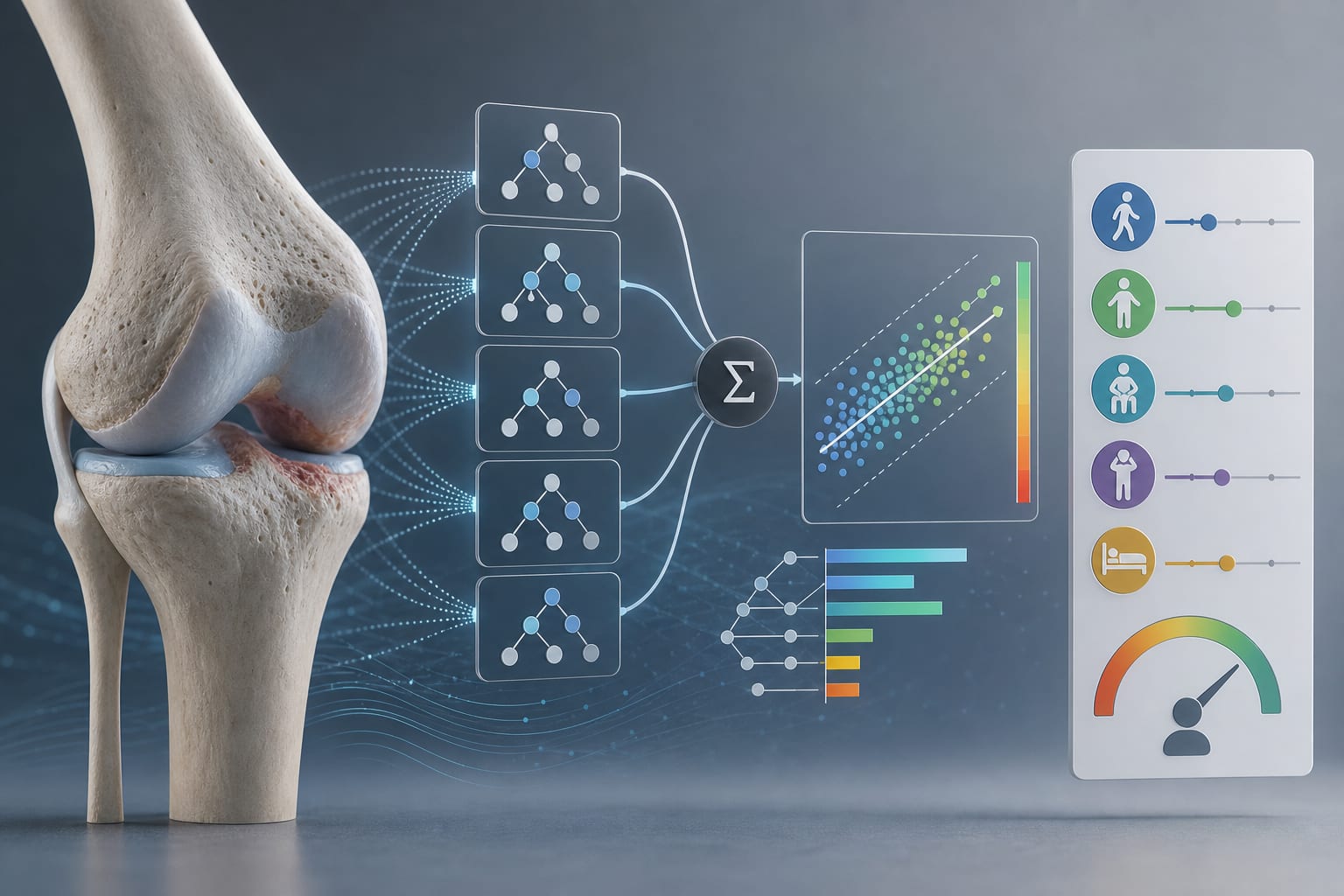
This study develops an explainable residual ensemble framework to evaluate quality of life (QoL) in knee osteoarthritis (OA) patients using the EuroQol-5 Dimensions (EQ-5D). The framework integrates logistic regression with a Random Forest model.
Background
Knee osteoarthritis is a prevalent condition that significantly impacts the quality of life of older adults, contributing to chronic pain and functional limitations. Accurate assessment of QoL is essential for effective rehabilitation planning. Traditional statistical models often fail to capture the complex interactions among various factors affecting QoL.
Data Highlights
Variable
Details
Study Population
1,102 patients with knee OA
Data Collection Period
September 2013 - January 2022
Target Variable
EQ-5D index score
Clinical Variables
29 variables including demographics, pain scales, and physical performance
Key Findings
The study utilized a dataset of 1,102 knee OA patients to develop the residual ensemble framework.
Integration of logistic regression with Random Forest enhances model interpretability.
The EQ-5D index score was used as the primary measure of health-related QoL.
Explainable AI techniques, such as SHAP, were employed to interpret model contributions.
Clinical Implications
The proposed framework offers a novel approach to assess QoL in knee OA patients.
Conclusion
This study presents a framework for the assessment of QoL in knee OA patients through an explainable residual ensemble modeling approach.
A Geneva registry study points surgeons toward residual pain over functional limitation as the outcome that tracks patient satisfaction one year after hip or knee replacement.