Selective vagus–recurrent laryngeal nerve anastomosis guided by intraoperative neuromonitoring: evidence of lateral motor fiber clustering in the vagus nerve - Report - MDSpire

Selective vagus–recurrent laryngeal nerve anastomosis guided by intraoperative neuromonitoring: evidence of lateral motor fiber clustering in the vagus nerve

  • By

  • Jiedong Kou

  • Daqi Zhang

  • Le Zhou

  • Shijie Li

  • Tie Wang

  • Peiyao Wang

  • Zihan Zhao

  • Gianlorenzo Dionigi

  • Carla Colombo

  • Yishen Zhao

  • Hui Sun

  • June 17, 2026

  • 0 min

Share

Clinical Report: Intraoperative Neuromonitoring-Guided Selective Anastomosis

Overview

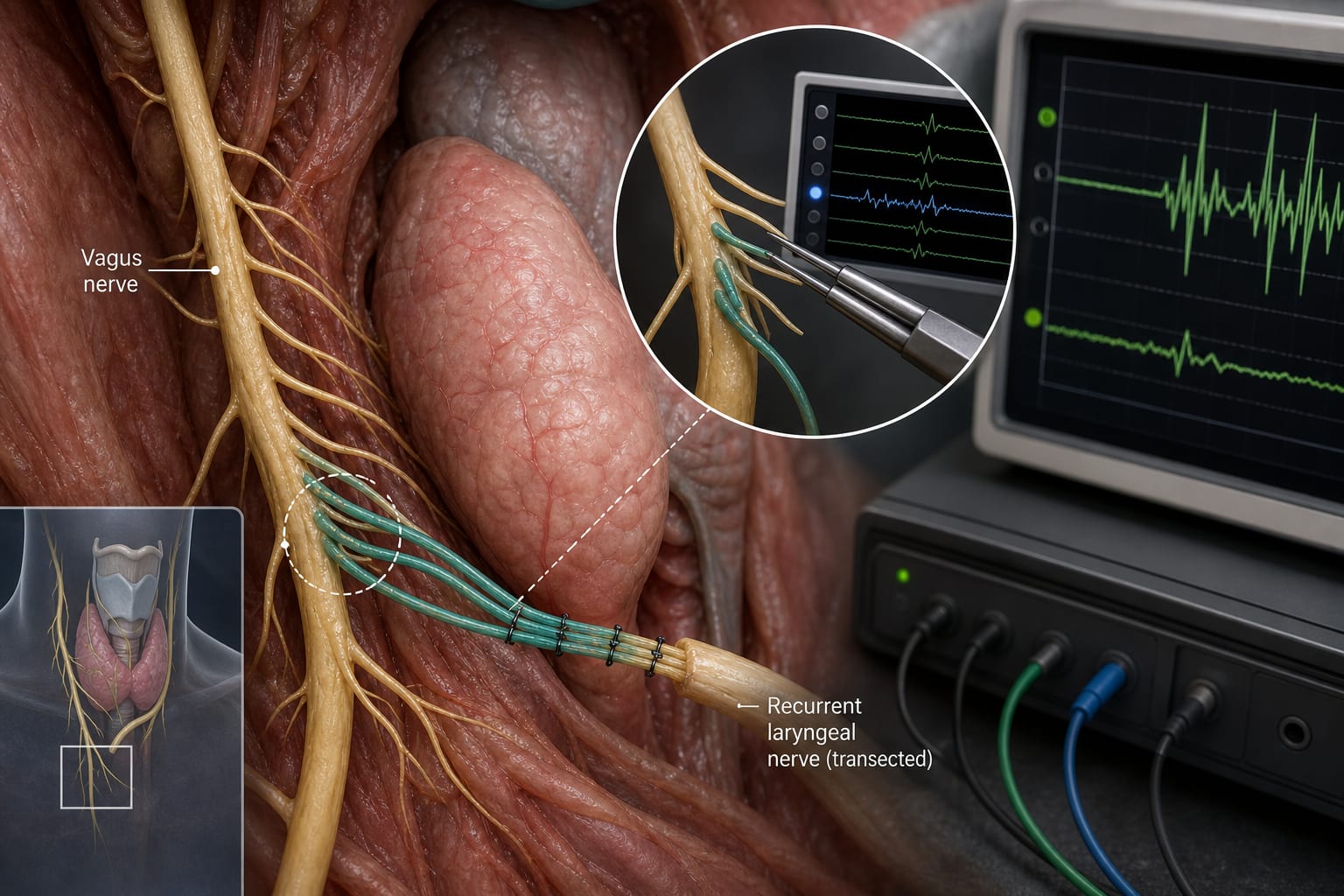
This study evaluates a novel intraoperative neuromonitoring-guided selective vagus-recurrent laryngeal nerve anastomosis (SVRA) technique, demonstrating its potential for immediate electrophysiologic recovery compared to direct anastomosis (DA) in a porcine model. The findings suggest that SVRA may serve as a function-preserving alternative in cases where DA is not feasible due to tension.

Background

Recurrent laryngeal nerve (RLN) transection can lead to significant vocal fold paralysis and impaired phonation, necessitating effective reconstructive strategies. Traditional methods like direct anastomosis often face limitations due to excessive tension, while other techniques may compromise nerve integrity. This study explores a selective approach using intraoperative neuromonitoring to enhance nerve repair outcomes.

Data Highlights

GroupEMG Amplitude (% of Baseline)Response Type
SVRAExceeds 50%Immediate recovery
DASimilar resultsImmediate recovery

Key Findings

  • Low-current IONM effectively maps a consistent cluster of laryngeal motor fibers in the cervical vagus nerve.
  • SVRA achieves immediate EMG recovery comparable to DA.
  • SVRA preserves most vagal trunk fibers, making it a potential function-preserving alternative.
  • Electromyographic responses indicate that nerve positioning affects recovery outcomes.
  • Manipulation of the vagus nerve during SVRA does not significantly alter hemodynamic parameters.

Clinical Implications

The SVRA technique may provide a viable option for RLN reconstruction in situations where direct anastomosis is not possible, potentially improving patient outcomes. Surgeons should consider the use of intraoperative neuromonitoring to enhance the precision and effectiveness of nerve repair strategies.

Conclusion

The findings support the use of IONM-guided SVRA as a promising technique for RLN reconstruction, with the potential for acute electrophysiological recovery while preserving vagus nerve integrity. Further studies are needed to assess long-term functional outcomes.
Related Resources & Content

  1. A Randomized Controlled Study Comparing Visualization and Neuromonitoring Techniques for the External Branch of the Superior Laryngeal Nerve in Thyroid Surgery, Surgical Endoscopy, 2012 -- https://link.springer.com/article/10.1007/s00268-012-1547-7
  2. In Vivo Identification of the Vagal Nerve in Upper Gastrointestinal Surgery Using Laparoscopic Hyperspectral Imaging, Surgical Endoscopy, 2025 -- https://link.springer.com/article/10.1007/s00464-025-12028-1
  3. Assessing the Prognostic Significance of Intraoperative Neural Monitoring for the Recurrent Laryngeal Nerve During Thyroid Surgery, Updates in Surgery, 2016 -- https://link.springer.com/article/10.1007/s00423-016-1441-0
  4. The American Thyroid Association Multidisciplinary Consensus Statement on Ambulatory Thyroid Surgery, 2026 -- https://journals.sagepub.com/doi/10.1177/10507256261442596
  5. Updates in Surgery — Intraoperative Signal Recovery Correlates with Normal Postoperative Vocal Cord Function in Patients Experiencing Signal Loss During Surgery
  6. Intraoperative Nerve Monitoring Parameters and Risk of Recurrent Laryngeal Nerve Injury in Thyroidectomy: A Systematic Review and Meta-Analysis - PMC
  7. Intraoperative Recurrent Laryngeal Nerve Monitoring for Esophagectomy: A National Cohort Study - ScienceDirect
  8. The American Thyroid Association Multidisciplinary Consensus Statement on Ambulatory Thyroid Surgery - Salem I. Noureldine, Carolyn D. Seib, Erin J. Buczek, Marianne David, Jagdish K. Dhingra, Ian Ganly, Benjamin C. James, Nadia Khoury, Biren P. Modi, Sareh Parangi, Susan C. Pitt, Jonathon O. Russell, Merry E. Sebelik, Pinar J. Smith, Meredith J. Sorensen, Michael R. Starks, Mark E. Zafereo, J. Pieter Noordzij, , for The American Thyroid Association Surgical Affairs Committee Writing Task Force, for The American Thyroid Association Surgical Affairs Committee Writing Task Force, 2026
  9. Intraoperative Nerve Monitoring Parameters and Risk of Recurrent Laryngeal Nerve Injury in Thyroidectomy: A Systematic Review and Meta-Analysis - PMC
  10. Risk factors for recurrent laryngeal nerve injury following thyroid surgery: a systematic review and meta-analysis
  11. Long-term phonation status after recurrent laryngeal nerve reconstruction - ScienceDirect
  12. Laryngeal Reinnervation vs Type I Thyroplasty in Unilateral Vocal Fold Paralysis (VOCALIST): A Randomized Feasibility Study - Birchall - 2025 - The Laryngoscope - Wiley Online Library
  13. Frontiers | Selective vagus–recurrent laryngeal nerve anastomosis guided by intraoperative neuromonitoring: evidence of lateral motor fiber clustering in the vagus nerve
  14. J Neuromonit Neurophysiol 2025;5(2):175-183

Original Source(s)

Related Content