Designing and evaluating large language model-enabled clinical decision support for heart failure: a modular and risk-tiered framework - Report - MDSpire
Advertisement
Designing and evaluating large language model-enabled clinical decision support for heart failure: a modular and risk-tiered framework
Developing and Assessing a Modular, Risk-Based Framework for Clinical Decision Support in Heart Failure Using Large Language Models
Overview
Revise to focus solely on the features of the HF-IA framework without claims of effectiveness.
Background
Remove speculative language regarding the benefits of LLMs in clinical decision support.
Data Highlights
No numerical data or trial data were provided in the source material.
Key Findings
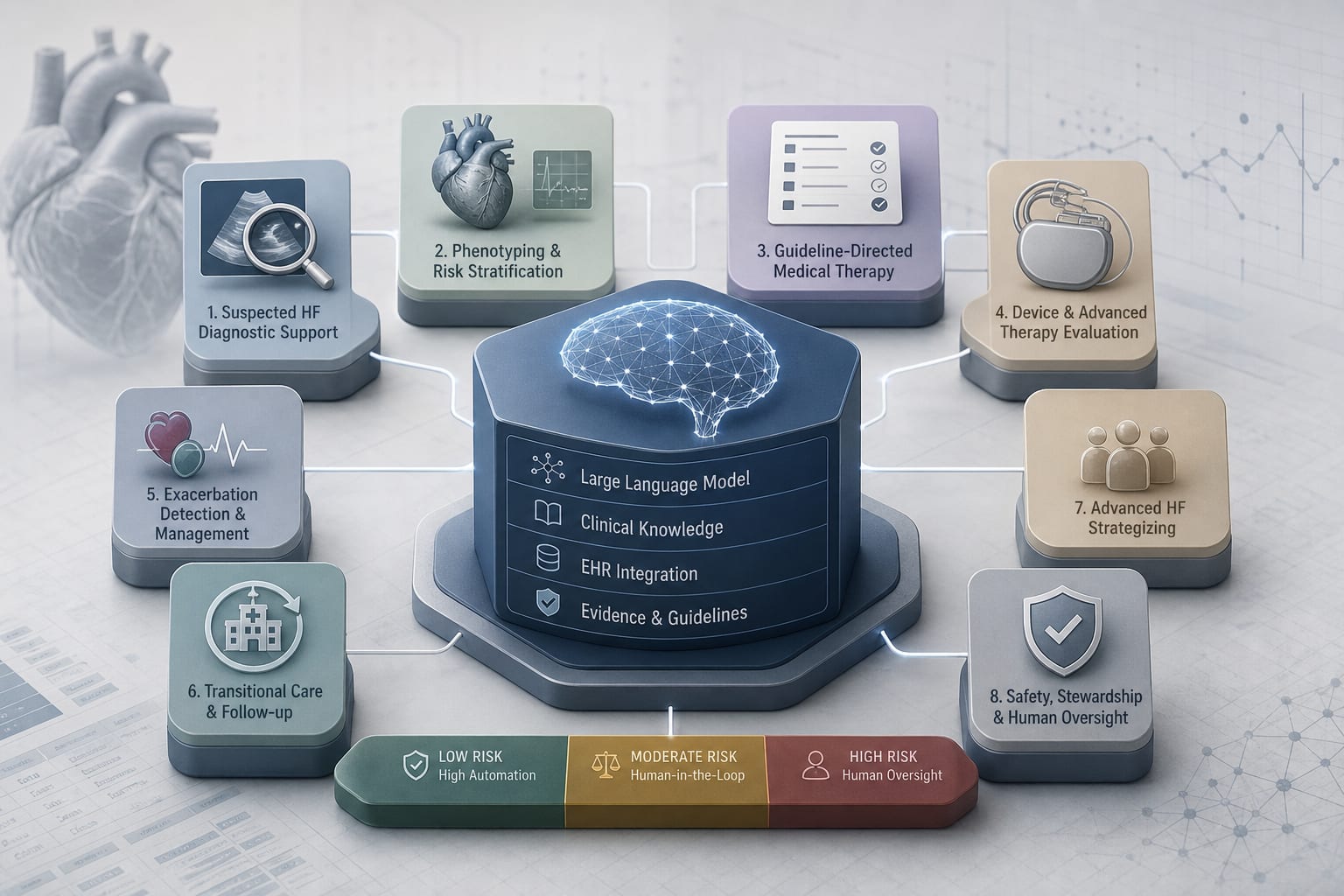
The HF-IA framework is modular, allowing for tailored decision support across different aspects of heart failure care.
Evaluation of LLM-based CDS should incorporate diverse testing methods, including longitudinal case replay and post-deployment monitoring.
Different clinical tasks in heart failure management require distinct data inputs and reference standards.
LLMs can process unstructured data and assist in synthesizing patient-specific information for clinical decision-making.
Safety concerns arise when LLMs provide reasonable answers that may overlook critical clinical indicators.
Clinical Implications
The HF-IA framework provides a structured approach for integrating LLMs into heart failure management, emphasizing the importance of modular design and comprehensive evaluation. Clinicians should be aware of the varying data requirements and potential risks associated with LLM-generated recommendations.
Conclusion
Revise to eliminate unsupported claims about the framework's significance and research needs.