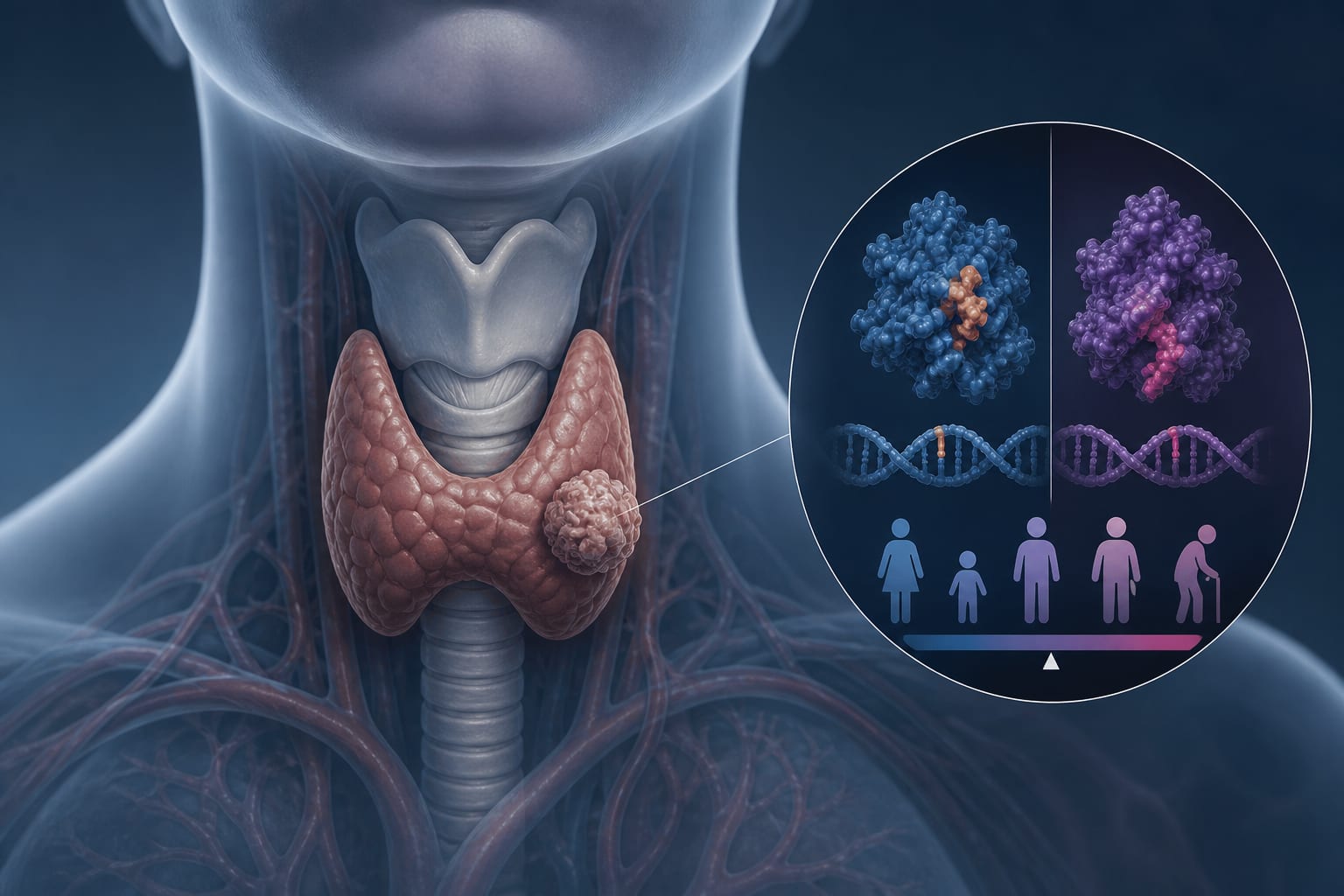
Clinical Report: Reading Skin Cancer’s Molecular Fingerprint
Overview
A handheld Raman spectroscopy system combined with machine learning demonstrated up to 84% accuracy in distinguishing normal skin, basal cell carcinoma (BCC), and squamous cell carcinoma (SCC).
Background
Skin cancers such as BCC and SCC can mimic benign or precancerous lesions, making accurate diagnosis challenging. Traditional biopsy and microscopic examination remain the gold standard for diagnosis, but there is a growing interest in noninvasive methods that could streamline the assessment process. The development of technologies like Raman spectroscopy may provide valuable biochemical insights for more accurate tissue classification.
Data Highlights
| Model | Accuracy | Sensitivity | Specificity |
|---|---|---|---|
| K-nearest neighbors | 84% | 78.7% | 88.6% |
| Support vector machine | 84% | 78.7% | 88.6% |
| Shallow neural network | 80.8% | N/A | N/A |
| Partial least squares discriminant analysis | N/A | 66.5% | 95.5% |
| Principal component analysis with quadratic discriminant analysis | N/A | 77.8% | 77.7% |
Key Findings
- The handheld Raman spectroscopy system achieved up to 84% accuracy in classifying skin tissue types.
- K-nearest neighbors and support vector machine models provided the highest accuracy, with a sensitivity of 78.7% and specificity of 88.6%.
- Partial least squares discriminant analysis had high specificity (95.5%) but lower sensitivity (66.5%).
- Normal skin and cancerous tissues showed distinct biochemical signals, aiding in classification.
- Classification errors were more frequent between BCC and SCC due to overlapping molecular patterns.
Clinical Implications
Further validation in clinical settings is necessary to establish the effectiveness of Raman spectroscopy compared to traditional biopsy methods.
Conclusion
This study indicates that Raman spectroscopy can classify skin tissue types noninvasively, though its clinical diagnostic accuracy requires further investigation.
Related Resources & Content
- Author(s)/Org, Source, Year -- Title
- ASCO Publications, 2016 -- Deep sequencing of metastatic cutaneous basal cell and squamous cell carcinomas to reveal distinctive genomic profiles and new routes to targeted therapies.
- ASCO Publications, 2025 -- Prognostic insights in skin melanoma: A study of differential diagnostic tissue markers.
- Stages and Risk Groups of Basal Cell Carcinoma | American Cancer Society
- Comparison of optical coherence tomography and in vivo reflectance confocal microscopy with dermoscopy for the diagnosis and management of nonmelanoma skin cancer: A randomized controlled trial - Hobelsberger - 2024 - JEADV Clinical Practice - Wiley Online Library
- Accuracy of Raman spectroscopy for differentiating skin cancer from normal tissue - PMC
- ASCO Publications — Comparative analysis of metabolic signature from malignant melanoma and uninvolved skin.
- Stages and Risk Groups of Basal Cell Carcinoma | American Cancer Society
- Comparison of optical coherence tomography and in vivo reflectance confocal microscopy with dermoscopy for the diagnosis and management of nonmelanoma skin cancer: A randomized controlled trial - Hobelsberger - 2024 - JEADV Clinical Practice - Wiley Online Library
- Accuracy of Raman spectroscopy for differentiating skin cancer from normal tissue - PMC
Based on findings from:
Reading Skin Cancer’s Molecular Fingerprint
The Analytical Scientist, 2026.
https://theanalyticalscientist.com/issues/2026/articles/october/reading-skin-cancers-molecular-fingerprint/
This content is an AI-generated, fully rewritten summary based on a published scholarly article. It does not reproduce the original text and is not a substitute for the original publication. Readers are encouraged to consult the source for full context, data, and methodology.