Glycemic variability and the short-term mortality of hospitalized patients with COVID-19: a meta-analysis - Report - MDSpire

Glycemic variability and the short-term mortality of hospitalized patients with COVID-19: a meta-analysis

  • By

  • Zixuan Wang

  • Jingyi Wang

  • Qiao Wu

  • Baozeng Wang

  • June 16, 2026

  • 0 min

Share

Clinical Report: Association of Glycemic Variability with Short-Term Mortality in Hospitalized COVID-19 Patients

Overview

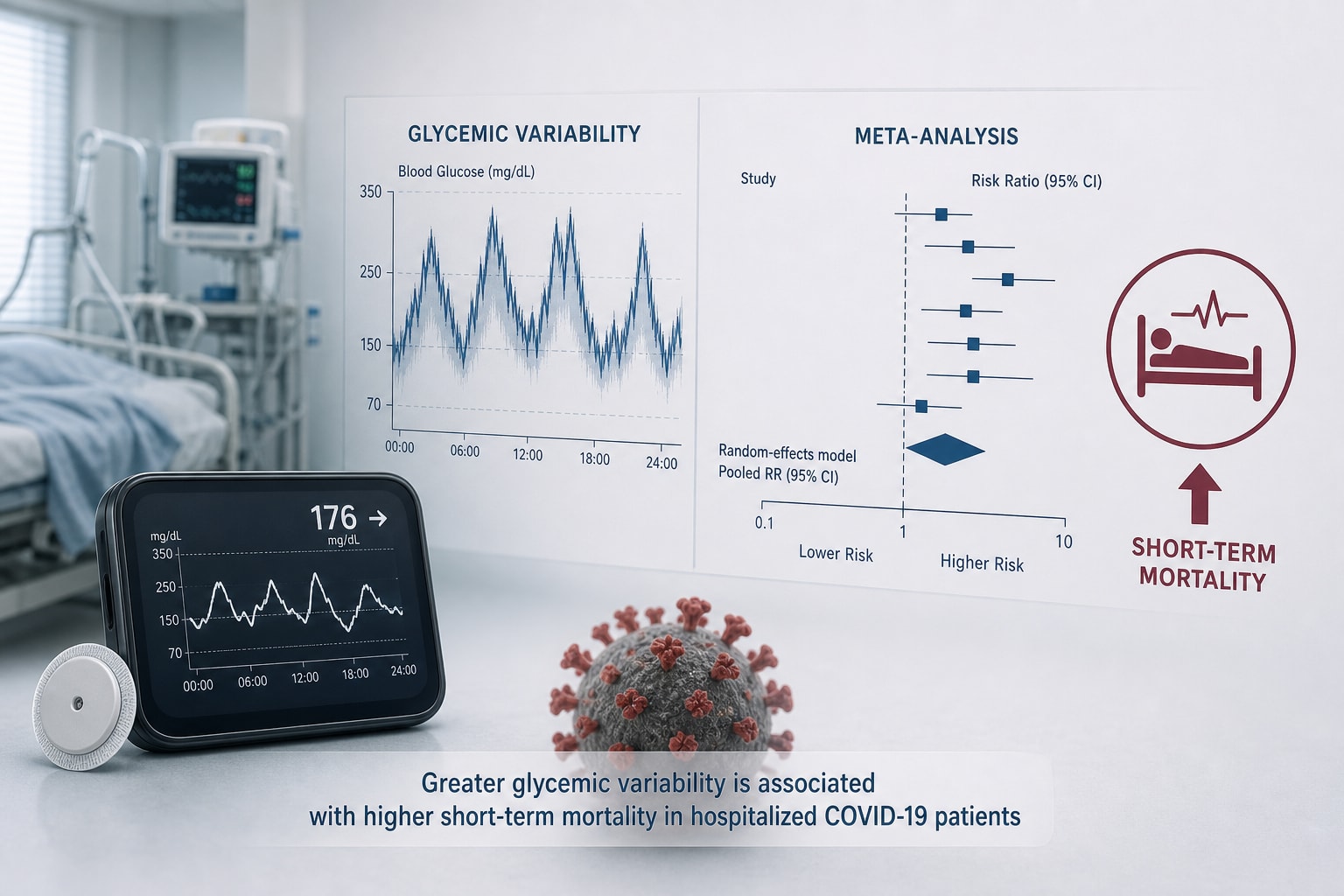
This meta-analysis evaluates the association between glycemic variability (GV) and short-term mortality in hospitalized COVID-19 patients. It finds that higher GV significantly increases the risk of all-cause mortality, particularly in older patients.

Background

Glycemic variability reflects fluctuations in blood glucose levels and may indicate metabolic instability in critically ill patients. Understanding its impact on mortality is crucial, especially in the context of COVID-19, where metabolic disturbances can exacerbate disease severity and outcomes. Identifying reliable prognostic markers like GV can enhance risk stratification and clinical management in hospitalized patients.

Data Highlights

Study CharacteristicsFindings
Number of Studies10 cohort studies
Total Patients77,395
Total Deaths8,189
Risk Ratio for High GV2.10 (95% CI: 1.69–2.59)
Mean Age Subgroup RR≥ 62 years: 2.79; < 62 years: 1.78

Key Findings

  • High glycemic variability is associated with a significantly increased risk of all-cause mortality (RR = 2.10).
  • The association is stronger in older patients (mean age ≥ 62 years, RR = 2.79).
  • Results were consistent across different GV metrics and analytic models.
  • Meta-regression analysis suggested mean age contributed to heterogeneity in findings.
  • GV may provide prognostic information beyond static glycemic measures.

Clinical Implications

Healthcare professionals should consider glycemic variability as a potential prognostic marker in hospitalized COVID-19 patients. Monitoring and managing GV could be integral to improving patient outcomes, particularly in older adults.

Conclusion

Higher glycemic variability is linked to increased short-term mortality in hospitalized COVID-19 patients, highlighting its importance as a prognostic factor. Further research may solidify its role in clinical practice.

Related Resources & Content

  1. Frontiers | Glycemic variability and the short-term mortality of hospitalized patients with COVID-19: a meta-analysis
  2. Diabetes Care in the Hospital: Standards of Care in Diabetes—2026 | Diabetes Care | American Diabetes Association
  3. Surviving Sepsis Campaign Adult Guidelines | SCCM
  4. Intensive Care Medicine — Impact of Glucose Variability on Mortality: A Comprehensive Review
  5. Frontiers in Neurology — Acute glycemic variability and short-term mortality of patients with subarachnoid hemorrhage: a meta-analysis
  6. Frontiers in Neurology — Prognostic Significance and Temporal Patterns of Glycemic Variability in Critically Ill Non-Diabetic Patients with Ischemic Stroke: A Retrospective Multicenter Cohort Study
  7. The Journal of Clinical Endocrinology & Metabolism — Associations of Glycemic Measures in the Normal Range With All-Cause Mortality in the Absence of Traditional Risk Factors
  8. 16. Diabetes Care in the Hospital: Standards of Care in Diabetes—2026 | Diabetes Care | American Diabetes Association
  9. Surviving Sepsis Campaign Adult Guidelines | SCCM
  10. Frontiers | Glycemic variability and the short-term mortality of hospitalized patients with COVID-19: a meta-analysis
  11. Association of Chronic Hyperglycemia and Glycemic Variability with Mortality in COVID-19: Meta-Analysis of Cohort Studies - PMC
  12. Coefficient of variation–defined glycemic variability is associated with ICU mortality in critically ill influenza patients | BMC Infectious Diseases | Springer Nature Link
  13. Association of glycemic variability with short- and long-term mortality in critically ill patients with trauma | Scientific Reports

Original Source(s)

Related Content