Collateral circulation after revascularization in moyamoya disease: influencing factors and underlying mechanisms - Report - MDSpire

Collateral circulation after revascularization in moyamoya disease: influencing factors and underlying mechanisms

  • By

  • Zhenwei Li

  • Liming Zhao

  • Pengpeng Yan

  • Shangyu Jin

  • Hao Liang

  • Ziqiang Liu

  • Yang Liu

  • Yuxue Sun

  • Tao Gao

  • Chaoyue Li

  • Gaochao Guo

  • July 6, 2026

  • 0 min

Share

Factors Influencing Collateral Circulation Development Following Revascularization in Moyamoya Disease

Background

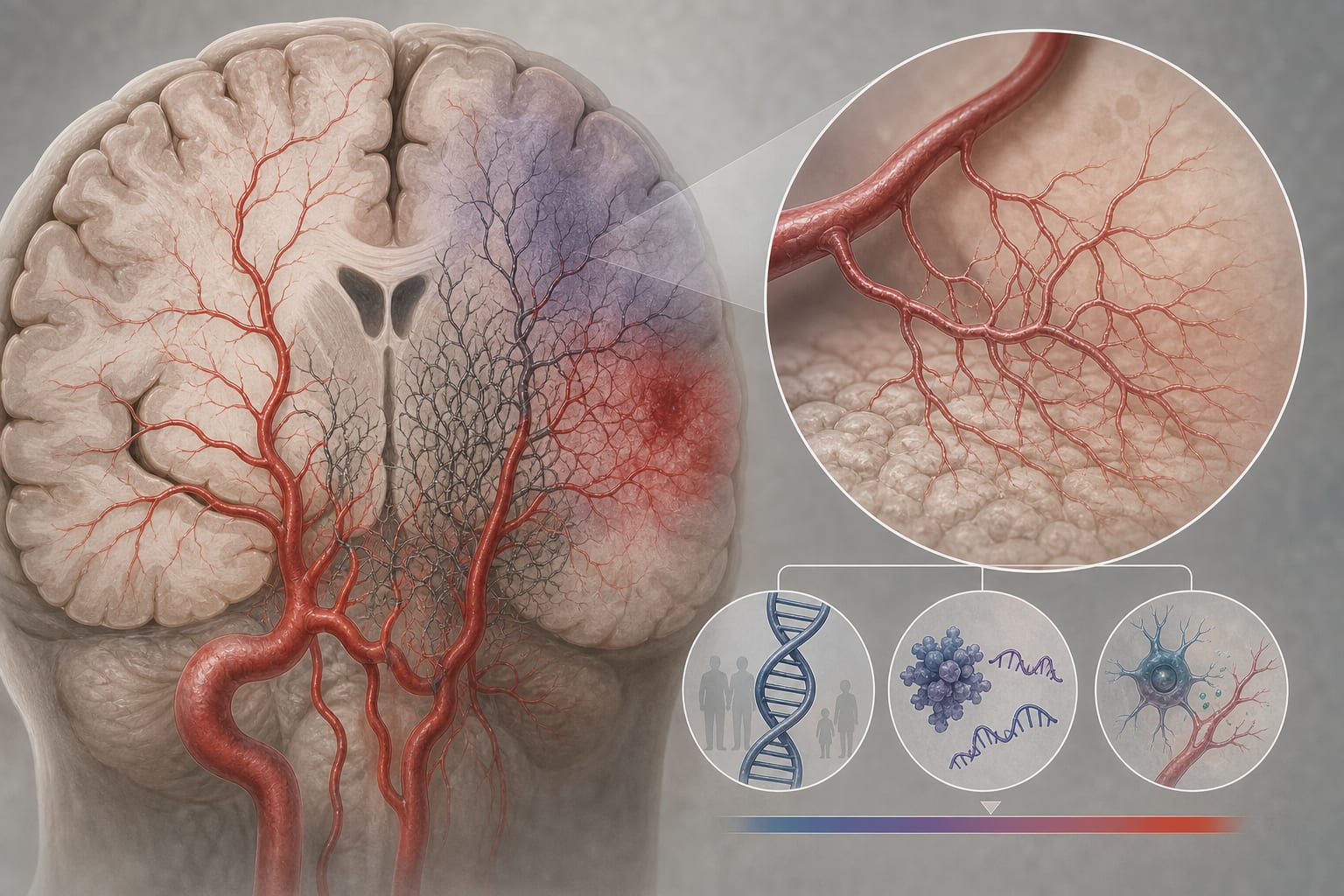
Moyamoya disease is a progressive cerebrovascular disorder characterized by stenosis or occlusion of major cerebral arteries, leading to ischemic and hemorrhagic events. Cerebral revascularization is the primary treatment, aimed at improving blood flow and reducing stroke risk.

Data Highlights

No numerical or trial data provided in the source material.

Key Findings

  • Multiple factors influence postoperative collateral vessel formation, including genetic susceptibility and angiogenic growth factors.
  • Direct revascularization may lead to improved angiographic outcomes and lower risks of recurrent stroke compared to indirect methods.
  • Variability in collateral neovascularization efficiency is observed among patients after revascularization.
  • Clinical variables such as patient age and superficial temporal artery blood flow impact collateral circulation development.
  • Some patients experience poor collateral circulation formation, leading to recurrent ischemia or hemorrhage.

Clinical Implications

Clinicians should consider genetic and clinical factors when evaluating patients for cerebral revascularization in moyamoya disease.

Conclusion

Identifying the factors affecting collateral circulation formation is vital for understanding treatment strategies in moyamoya disease.

Related Resources & Content

  1. European Stroke Organisation (ESO) Guidelines on Moyamoya angiopathy Endorsed by Vascular European Reference Network (VASCERN), 2023 -- Guidelines on Moyamoya angiopathy
  2. Chinese expert consensus on the treatment and diagnosis of moyamoya disease and moyamoya syndrome, 2024 -- Expert consensus on moyamoya disease
  3. European Radiology — Collateral Mapping: Forecasting Lesion Expansion and Penumbral Area Following Acute Anterior Circulation Ischemic Stroke
  4. Basic Research in Cardiology — Alternative Pathways of Blood Flow in Coronary Circulation
  5. Frontiers in Neurology — Editorial: Emerging trends in moyamoya disease: diagnostic and therapeutic innovations
  6. Surgical Clipping of a Hypothalamic Aneurysm via Transcallosal and Transchoroidal Approaches in Moyamoya Disease
  7. Collateral Mapping: Forecasting Lesion Expansion and Penumbral Area Following Acute Anterior Circulation Ischemic Stroke
  8. Editorial: Emerging trends in moyamoya disease: diagnostic and therapeutic innovations
  9. European Stroke Organisation (ESO) Guidelines on Moyamoya angiopathy Endorsed by Vascular European Reference Network (VASCERN)
  10. Chinese expert consensus on the treatment and diagnosis of moyamoya disease and moyamoya syndrome (2024) - PubMed
  11. Presence of Collaterals from the Contralateral Hemisphere on Preoperative Angiogram Predicts Failure of Encephalo-Duro Arterio-Synangiosis (EDAS) in Adult Moyamoya Patients - PubMed
  12. Factors affecting the collateral ingrowth from the superficial temporal artery after Encephalo-Duro-Arterio-Synangiosis in adult patients with Moyamoya disease - ScienceDirect
  13. Ultrasonographic assessment of bypass capacity after revascularization surgery in moyamoya disease: a systematic review and single-arm meta-analysis | Acta Neurochirurgica | Springer Nature Link

Original Source(s)

Related Content