Utilizing conditional generative adversarial network to generate head MRA based on nonvascular sequences: comparative study of single-modality and multi-modality methods - Report - MDSpire
Advertisement
Utilizing conditional generative adversarial network to generate head MRA based on nonvascular sequences: comparative study of single-modality and multi-modality methods
Clinical Report: Conditional GANs for Head MRA Generation from Nonvascular Sequences
Overview
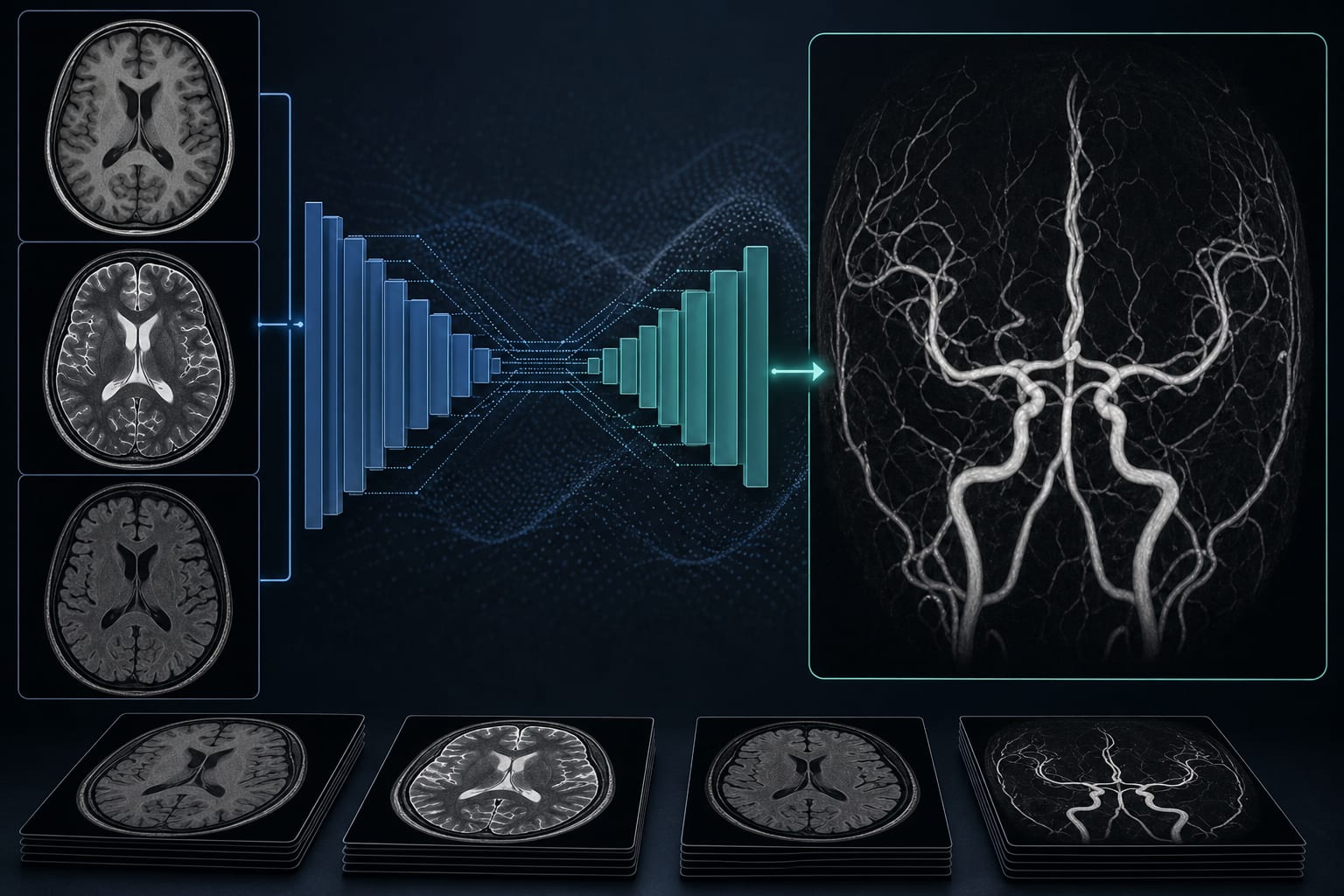
This study developed a deep learning model to synthesize head MRA images from nonvascular MRI sequences, demonstrating that the multi-modality approach outperformed single-modality models.
Background
Time-of-flight magnetic resonance angiography (TOF-MRA) is essential for cerebrovascular imaging but often requires prolonged acquisition times, which can lead to missed vascular pathologies. The integration of generative adversarial networks (GANs) in medical imaging presents a promising avenue for synthesizing MRA images from readily available nonvascular sequences. This study addresses the gap in comparative analysis between single and multi-modality approaches for MRA synthesis.
Data Highlights
Model
Structural Similarity Index
Peak Signal-to-Noise Ratio (dB)
Root Mean Squared Error
Diagnostic Accuracy (%)
MIX Model
0.880
33.18
0.022
92.2
Key Findings
The MIX model outperformed single-modality models in image quality metrics.
All models demonstrated significantly higher signal-to-noise and contrast-to-noise ratios compared to real MRA (p < 0.001).
MIX model syn-MRA showed comparable overall image quality and diagnostic confidence to real MRA (p > 0.05).
Venous contamination was more pronounced in synthetic MRA compared to real MRA (p < 0.001).
The study included a cohort of 140 patients for model training, validation, and testing.
Clinical Implications
The findings indicate that synthetic MRA generated from nonvascular sequences can achieve diagnostic performance similar to traditional MRA.
Conclusion
The study presents findings on multi-modality GAN approaches in synthesizing high-quality MRA images.