Engineering allogeneic type 1 regulatory T cells: a scalable, off-the-shelf platform for restoring immune tolerance - Report - MDSpire

Engineering allogeneic type 1 regulatory T cells: a scalable, off-the-shelf platform for restoring immune tolerance

  • By

  • Molly Javier Uyeda

  • Audrey Re

  • Chunyi Tang

  • Melissa McLaughlin

  • Daryl Humes

  • Steven Sexton

  • Robert Freeborn

  • Isaura Villalba

  • Kevin Nugent

  • James Adams

  • Jie Wei

  • Matt Breton

  • Xavier Paliard

  • Maximilian Richter

  • Maria Grazia Roncarolo

  • Ryan Bjordahl

  • July 9, 2026

  • 0 min

Share

Clinical Report: Development of Allogeneic Type 1 Regulatory T Cells

Overview

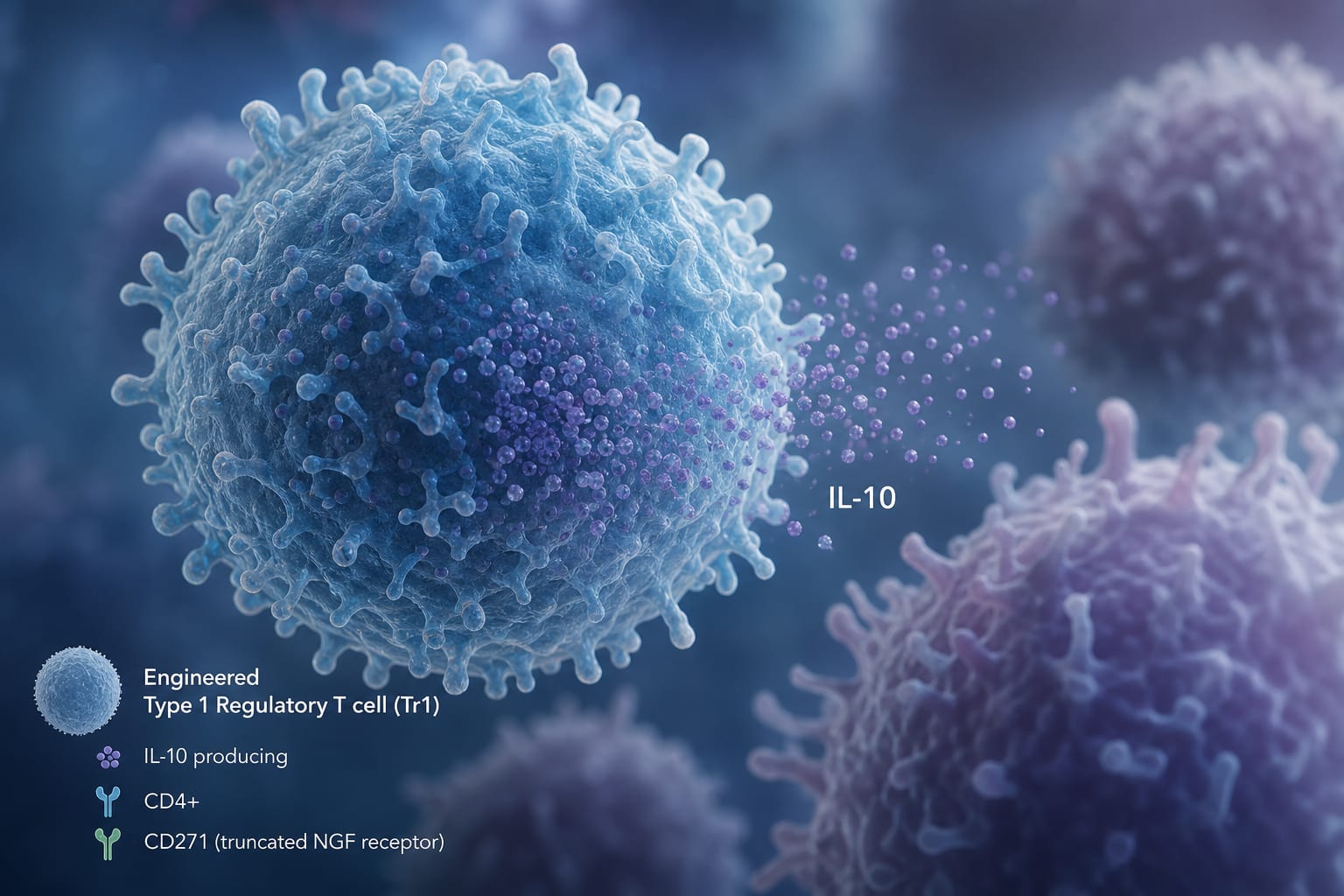
TRX103, an engineered allogeneic Tr1 cell therapy, is designed to restore immune tolerance and prevent disease in models of graft-versus-host disease (GvHD) and Crohn's disease. Its production method addresses previous limitations in Tr1 cell therapies.

Background

Type 1 regulatory T (Tr1) cells are crucial for maintaining immune tolerance and controlling inflammatory responses. Autologous Tr1 cell therapies have shown potential in treating conditions like graft-versus-host disease (GvHD), but scaling production has been challenging.

Data Highlights

TRX103 demonstrated the following in preclinical studies:

  • Suppressed effector T cell proliferation.
  • Inhibited pro-inflammatory cytokine production by monocytes from healthy donors and Crohn’s disease patients.
  • Homed to intestinal tissues in vivo.
  • Prevented disease development in a xenogeneic GvHD model.

Key Findings

  • TRX103 is generated from pooled engineered CD4+ T cells from three healthy donors.
  • It is transduced with a lentiviral vector encoding human IL-10 and CD271.
  • TRX103 has a distinct immunomodulatory profile with reduced activation marker expression.
  • It exhibits minimal allogeneic stimulatory capacity.
  • Currently evaluated in Phase 1/2a and Phase I clinical studies for Crohn’s disease and GvHD prevention.

Clinical Implications

The scalable production of TRX103 may facilitate clinical applications for Tr1 cell therapies in treating immune-mediated diseases.

Conclusion

TRX103 represents a development in the field of allogeneic Tr1 cell therapies, with applications in immune-mediated disorders.

Related Resources & Content

  1. Frontiers in Immunology, 2026 -- CD25+CD27+CD70− alloantigen-specific Tregs: promising stable immunotherapy for transplantation
  2. Bone Marrow Transplantation, 2025 -- Treg Cell Therapy as a Treatment for Graft-versus-Host Disease
  3. Bone Marrow Transplantation, 2025 -- Advancements in Haploidentical Stem Cell Transplantation Techniques
  4. Bone Marrow Transplantation, 2021 -- Depletion of CD276+ Cells from Haploidentical Memory T-Cell Grafts Reduces GVHD Risk
  5. Icahn School of Medicine at Mount Sinai -- Clinical Management of Acute Graft-Versus-Host Disease: An Evidence-Based Review from the ASTCT Committee on Practice Guidelines
  6. NCI Drug Dictionary - Definition of allogeneic regulatory T cells TRX103
  7. Transplantation and Cellular Therapy, 2025 -- Off-the-Shelf Engineered Tr1 Cells (TRX103) in Patients with Hematological Malignancies
  8. Clinical Management of Acute Graft-Versus-Host Disease: An Evidence-Based Review from the ASTCT Committee on Practice Guidelines - Icahn School of Medicine at Mount Sinai
  9. Hematopoietic Cell Transplantation, Version 3.2025, NCCN Clinical Practice Guidelines In Oncology - PubMed
  10. Indications for haematopoietic cell transplantation and CAR-T for haematological diseases, solid tumours and immune disorders: 2025 EBMT practice recommendations | Bone Marrow Transplantation
  11. Tr1X Presents First Clinical Data Demonstrating Proof of Safety and Proof of Mechanism With Allogeneic Off-the-Shelf Tr1 Regulatory T Cell Therapy TRX103
  12. Frontiers | Engineering Allogeneic Type 1 Regulatory T Cells: A Scalable, Off-the-Shelf Platform for Restoring Immune Tolerance
  13. NIH Chronic Graft-Versus-Host Disease Consensus Conference 2025 Update - PubMed

Original Source(s)

Related Content