AI-Enabled Acute Kidney Injury Prediction and the Challenge of Prevention
-
By
-
Charat Thongprayoon
-
Francesco Pesce
-
Wisit Cheungpasitporn
-
July 10, 2026
Clinical Report: Predicting Acute Kidney Injury with AI: Addressing the Prevention Challenge
Overview
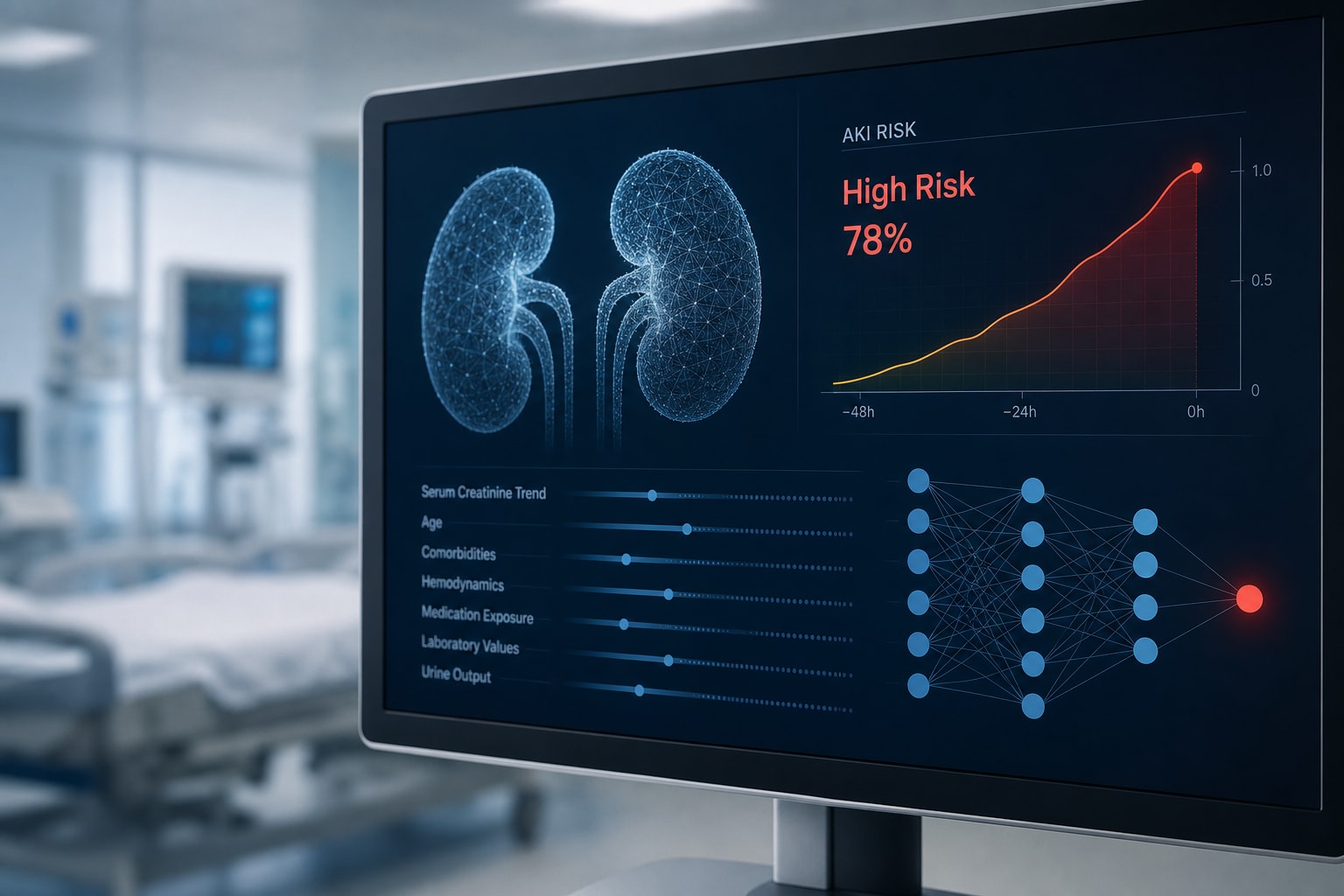
A randomized clinical trial evaluated the effectiveness of a structured early nephrology consultation, triggered by an AI risk score, in preventing acute kidney injury (AKI) among hospitalized patients. The trial found no significant reduction in AKI incidence or related outcomes, highlighting challenges in translating predictive analytics into effective preventive measures. The study utilized the ESTOP-AKI model to identify patients at increased risk of stage 2 AKI and randomized them to early nephrology consultation or usual care.
Background
Acute kidney injury (AKI) is a prevalent complication in hospitalized patients, associated with increased morbidity and mortality. Despite advancements in predictive analytics and decision support systems, preventing AKI remains a significant challenge due to the timing of intervention and the complexities of clinical management. Understanding the limitations of current predictive models is crucial for improving patient outcomes.
Data Highlights
- No significant differences were observed in peak serum creatinine change, incident AKI, severe AKI, kidney replacement therapy, mortality, readmission, or 90-day outcomes between the early consultation and usual care groups.
Key Findings
- The early nephrology consultation did not reduce peak serum creatinine change over 7 days.
- Consult recommendations in the early consultation arm were often not followed, which may have contributed to the lack of improved outcomes.
- Primary teams may perceive preventive recommendations as less urgent, impacting adherence to consult advice.
- Alerts and risk scores alone have often failed to improve AKI outcomes without proper implementation.
- Future trials may need to consider alternative primary endpoints beyond peak serum creatinine to assess AKI prevention effectively.
Clinical Implications
The findings suggest that while predictive models can identify at-risk patients, translating this information into effective preventive strategies requires systematic implementation and adherence to recommendations.
Conclusion
The trial underscores the importance of identifying at-risk patients and ensuring that actionable recommendations are effectively integrated into clinical workflows.
Related Resources & Content
- Churpek et al., JAMA Network Open, 2023 -- Predicting Acute Kidney Injury with AI: Addressing the Prevention Challenge
- Intensive Care Medicine — Updated Insights on Pathophysiology and Management of Acute Kidney Injury in Critically Ill Patients
- Frontiers in Pediatrics — Machine learning early risk assessment model for acute kidney injury in critically ill children: a retrospective cohort study
- DIGITAL HEALTH — Artificial intelligence in chronic kidney disease: Bibliometric and visual analysis of trends and future directions
- BMJ Health & Care Informatics — Machine learning-based prediction of a high-risk kidney function trajectory class after acute kidney injury
- KDIGO 2026 AKI Guidelines
- NICE Guidelines on AKI
- Acute Kidney Injury (AKI) and Acute Kidney Disease (AKD) – KDIGO
- Acute kidney injury: prevention, detection and management - NCBI Bookshelf
- ACR Manual on Contrast Media
- Timing of Initiation of Renal-Replacement Therapy in Acute Kidney Injury | New England Journal of Medicine
- Initiation Strategies for Renal-Replacement Therapy in the Intensive Care Unit | New England Journal of Medicine
- Timing of Renal-Replacement Therapy in Patients with Acute Kidney Injury and Sepsis | New England Journal of Medicine
- Early vs Delayed RRT in Critically Ill Patients With AKI
- Prevention of cardiac surgery-associated AKI by implementing the KDIGO guidelines in high risk patients identified by biomarkers: the PrevAKI randomized controlled trial - PMC
- Biomarker-guided implementation of the KDIGO guidelines to reduce the occurrence of acute kidney injury in patients after cardiac surgery (PrevAKI-multicentre): protocol for a multicentre, observational study followed by randomised controlled feasibility trial - PMC
- Biomarker-guided intervention to prevent acute kidney injury after major surgery (BigpAK-2 trial): study protocol for an international, prospective, randomised controlled multicentre trial - PMC
- Systematic Review and Meta-Analysis of Machine Learning Models for Acute Kidney Injury Risk Classification - PubMed
- Machine learning for the prediction of acute kidney injury post cardiac surgery: a systematic review and meta-analysis - PubMed
- Artificial intelligence for predicting paediatric acute kidney injury: a systematic review and meta-analysis
- Artificial intelligence models for predicting acute kidney injury in the intensive care unit: a systematic review of modeling methods, data utilization, and clinical applicability - PubMed
- Automated Electronic Alert for the Care and Outcomes of Adults With Acute Kidney Injury: A Randomized Clinical Trial - PubMed
- The influence of electronic AKI alert on prognosis of adult hospitalized patients: a systematic review and meta-analysis | Critical Care | Springer Nature Link
- Digital health and acute kidney injury: consensus report of the 27th Acute Disease Quality Initiative workgroup - PMC
This content is an AI-generated, fully rewritten summary based on a published scholarly article. It does not reproduce the original text and is not a substitute for the original publication. Readers are encouraged to consult the source for full context, data, and methodology.