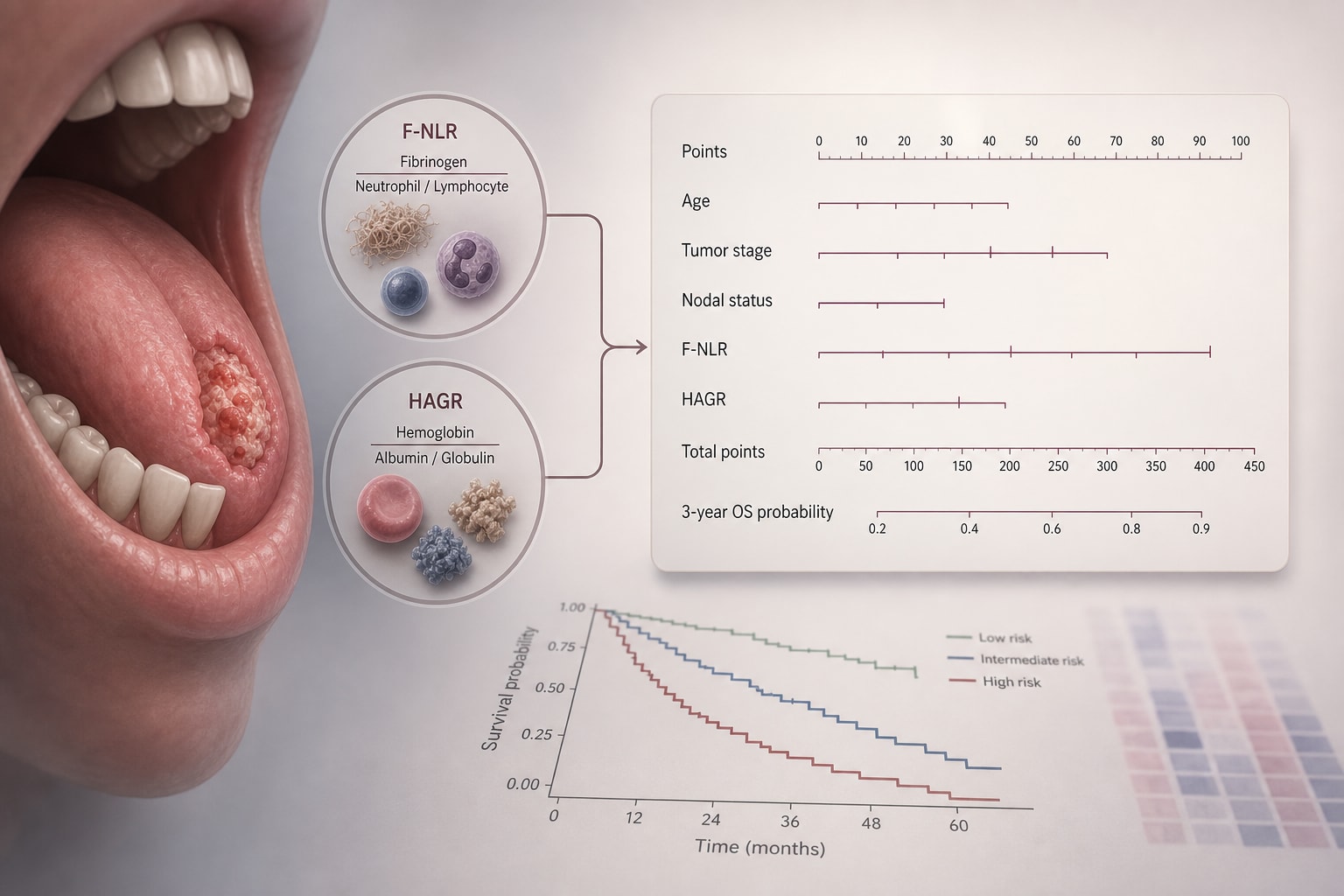
Development and internal validation of a prognostic nomogram incorporating F-NLR and HAGR scores in patients with oral squamous cell carcinoma: a single-center retrospective cohort study - Report - MDSpire
Conexiant’s news site is now MDSpire News. Learn more
Advertisement
Creation and internal validation of a prognostic nomogram utilizing F-NLR and HAGR scores for patients diagnosed with oral squamous cell carcinoma: a retrospective cohort analysis from a single center
Clinical Report: Prognostic Nomogram for Oral Squamous Cell Carcinoma
Overview
This study developed a prognostic nomogram for oral squamous cell carcinoma (OSCC) that integrates traditional clinical parameters with the fibrinogen-to-neutrophil-lymphocyte ratio (F-NLR) and the hemoglobin-albumin-globulin ratio (HAGR).
Background
Oral squamous cell carcinoma (OSCC) is the most common malignancy of the head and neck, characterized by aggressive behavior and poor long-term survival rates. Traditional prognostic evaluations primarily rely on the TNM staging system, which does not adequately account for biological variability among patients. This study aims to enhance prognostic accuracy by incorporating systemic inflammatory and nutritional markers into a novel nomogram.
Data Highlights
Parameter
Value
C-index
0.73
AUC for 1-year CSS
0.798
AUC for 3-year CSS
0.754
AUC for 5-year CSS
0.836
Median follow-up
41 months
Cancer-related deaths
119
Key Findings
Age, history of precancerous lesions, N classification, postoperative adjuvant therapy, F-NLR, and HAGR scores were identified as independent prognostic factors.
The nomogram showed a C-index of 0.73.
Calibration plots indicated high consistency between predicted and actual survival probabilities.
The AUC values for predicting 1-, 3-, and 5-year cancer-specific survival were 0.798, 0.754, and 0.836, respectively.
Internal validation suggests potential utility for the nomogram in risk stratification.
Clinical Implications
The integration of F-NLR and HAGR scores into a prognostic nomogram may provide a more individualized approach to risk stratification in OSCC patients. This model could assist clinicians in making more informed decisions regarding treatment strategies.
Conclusion
The proposed nomogram demonstrates predictive accuracy for OSCC survival outcomes, warranting further external validation in multi-center studies.
An updated clinical practice guideline from the American Society for Radiation Oncology substantially expands and modernizes recommendations for the use of radiation therapy in pancreatic cancer.