Depth Buffer-Based Multi-Volume Rendering for Enhanced Surgical Planning in VR
Overview
This study introduces a novel multi-volume rendering technique using a depth buffer to visualize multiple intersecting volumetric datasets simultaneously in virtual reality (VR). Developed with input from experienced spine and neurosurgeons, the method achieves high-quality, real-time rendering performance suitable for complex surgical planning scenarios.
Background
Direct volume rendering (DVR) offers superior image quality and direct manipulation of raw volumetric data compared to rasterization-based methods, making it valuable for surgical planning. However, extending DVR to support multiple overlapping volumes in VR is challenging due to performance constraints and occlusion handling. Existing approaches either resample volumes into a single dataset, which reduces quality and interactivity, or render all volumes in a single pass, which is computationally expensive and inefficient for VR. This work addresses these limitations by leveraging a depth buffer-based approach to correctly handle occlusion across multiple volumes.
Data Highlights
The renderer was developed as an extension to Unity Engine 2022.1.21, utilizing compute shaders with optimizations such as early ray termination, empty space skipping, and foveated rendering to maintain interactive frame rates. The method was evaluated on datasets including spinal fusion for scoliosis surgery, aneurysm clipping, and zygomatic arch fracture reduction, demonstrating the ability to render dozens of independent volume fragments with accurate occlusion and high image quality. Five spine and neurosurgeons with an average of 17.6 years of experience provided qualitative feedback guiding development.
Key Findings
The proposed depth buffer-based multi-volume renderer enables simultaneous visualization of multiple intersecting volumes with correct occlusion handling in VR.
Performance optimizations allow real-time interaction suitable for surgical planning despite the computational demands of ray marching.
Close collaboration with experienced surgeons ensured clinical relevance and applicability across diverse surgical scenarios.
The method preserves fine anatomical details without the quality loss associated with volume resampling techniques.
Compared to mesh-based rendering, this approach offers more accurate volumetric visualization and easier direct manipulation of raw data.
Clinical Implications
This multi-volume rendering technique facilitates enhanced surgical planning by allowing clinicians to interactively explore complex anatomical structures in VR with high fidelity and accurate depth perception. It supports realistic simulation of tissue manipulation and implant positioning, potentially improving preoperative decision-making and training. The method's real-time performance and quality make it suitable for integration into clinical workflows requiring detailed volumetric visualization.
Conclusion
The depth buffer-based multi-volume rendering approach successfully overcomes previous limitations in VR surgical planning by enabling high-quality, real-time visualization of multiple overlapping volumes. This advancement holds promise for improving surgical preparation, education, and intraoperative guidance.
References
Author/Source/Year -- Direct Volume Rendering Benefits and Techniques
Author/Source/Year -- Multi-Volume Rendering Challenges and Solutions
Author/Source/Year -- Neural Networks and 3D Gaussian Splatting in Medical Visualization
Author/Source/Year -- Unity Engine and Compute Shader Implementation
Author/Source/Year -- Clinical Feedback from Spine and Neurosurgeons
by Balázs Faludi, Marek Żelechowski, Maria Licci, Norbert Zentai, Attill Saemann, Daniel Studer, Georg Rauter, Raphael Guzman, Carol Hasler, Gregory F. Jost, Philippe C. Cattin
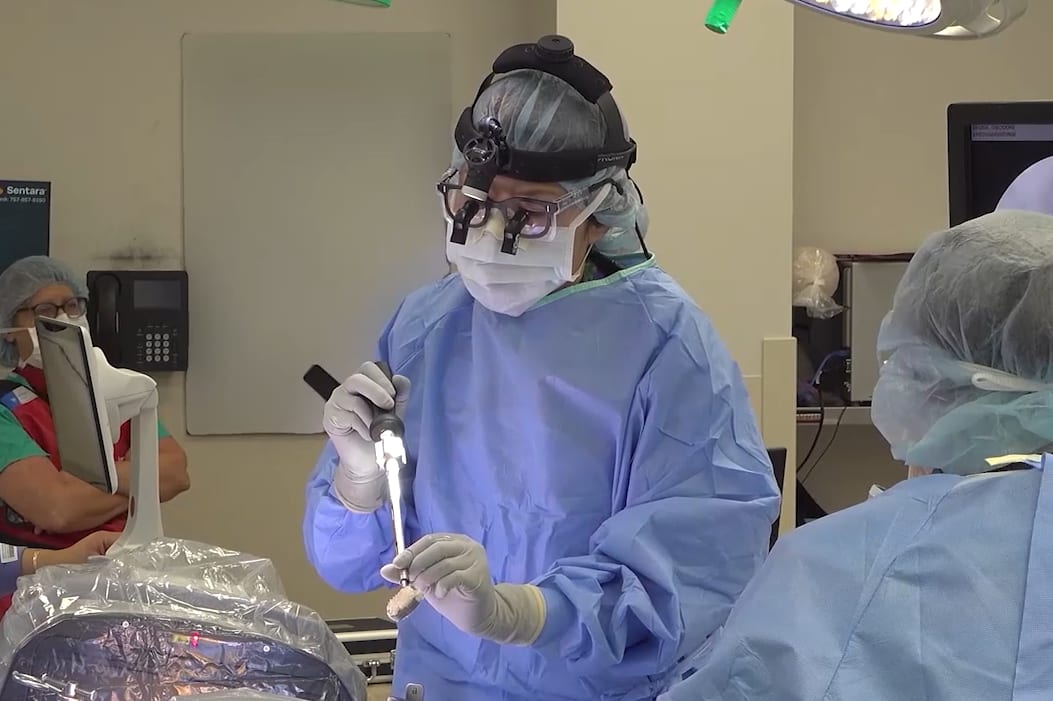
In this procedural case review, vascular surgeon Dr. Samuel Steerman and neurosurgeon Dr. Shannon Clark collaborate to perform an anterior lumbar interbody fusion (ALIF).