From AI-based image analysis to surgical decision support in prostate cancer: interdisciplinary application of the international radiomics platform - Report - MDSpire
Advertisement
From AI-based image analysis to surgical decision support in prostate cancer: interdisciplinary application of the international radiomics platform
Clinical Report: Integrating AI Image Analysis with Surgical Decision Support for Prostate Cancer
Overview
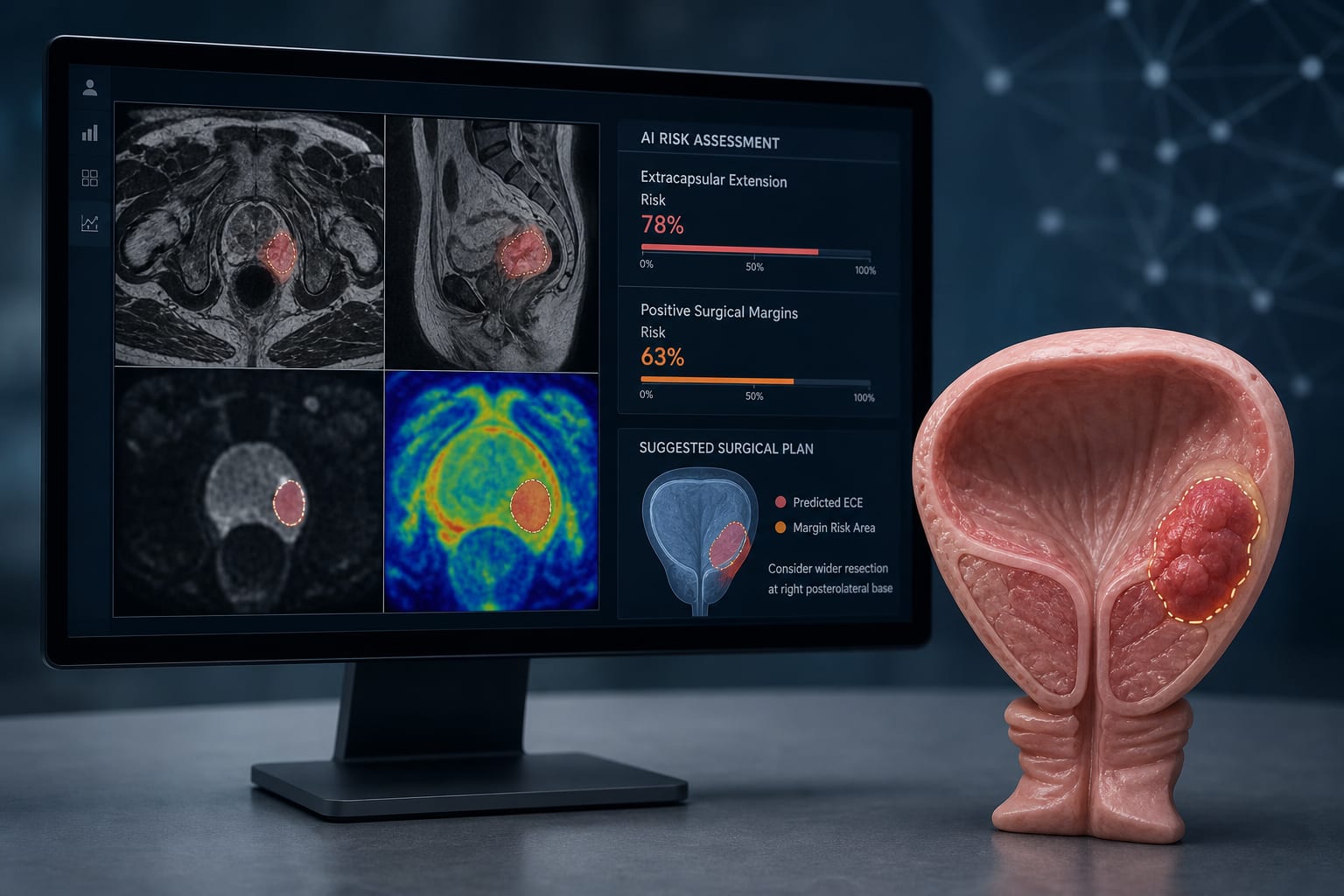
This study explores the integration of AI-driven image analysis into surgical decision-making for prostate cancer, demonstrating improved prediction of extracapsular extension (ECE) when combining imaging-derived parameters with conventional clinical data. However, the addition of radiomics features did not enhance predictions for positive surgical margins (PSM) or nerve-sparing approaches.
Background
Prostate cancer is a leading cause of cancer-related mortality in men, making accurate diagnosis and surgical planning crucial. The integration of multiparametric MRI (mpMRI) into clinical workflows has the potential to enhance the detection and characterization of prostate lesions. Despite advancements, fragmented workflows and lack of data integration remain significant barriers to effective machine learning applications in clinical decision support.
No significant improvement in PSM prediction with the addition of radiomics features (AUC 0.60).
Nerve-sparing approach decisions were not enhanced by imaging-derived features (AUC 0.79).
Performance of the models was consistent across internal and external validation.
Clinical Implications
The findings suggest that incorporating AI-driven imaging analysis can enhance the predictive accuracy for ECE in prostate cancer surgical planning. However, clinicians should be aware that radiomics features may not provide additional benefits for all predictive outcomes, particularly for PSM and nerve-sparing decisions.
Conclusion
This study highlights the potential of a multimodal data analysis workflow in prostate cancer management, emphasizing the need for further exploration of AI integration in clinical practice while acknowledging current limitations.
by Fabian Tollens, Niklas Westhoff, Jan Moltz, Tim Hartenstein, Anne Sophie Michel, Mahnoosh Naeimi, Johannes Ludwig, Peter Kohlmann, Judith Herrmann, Konstantin Nikolaou, Stefan O. Schoenberg, Dominik Nörenberg