Development of a BM7G(TKO/hCD46/hCD55/hTHBD/hEPCR) donor pig with endogenous promoter-driven transgenes for xenotransplantation - Report - MDSpire

Development of a BM7G(TKO/hCD46/hCD55/hTHBD/hEPCR) donor pig with endogenous promoter-driven transgenes for xenotransplantation

  • By

  • Cong Xia

  • Meng Lian

  • Bingxiu Ma

  • Hongliang Yu

  • Renquan Zhang

  • Lijia Wen

  • Xueliang Wang

  • Yu Zhao

  • Zhen Ouyang

  • Yinghua Ye

  • Xiner Feng

  • Han Wu

  • Liangxue Lai

  • June 23, 2026

  • 0 min

Share

Clinical Report: Creation of a BM7G(TKO/hCD46/hCD55/hTHBD/hEPCR) Genetically Modified Donor Pig

Overview

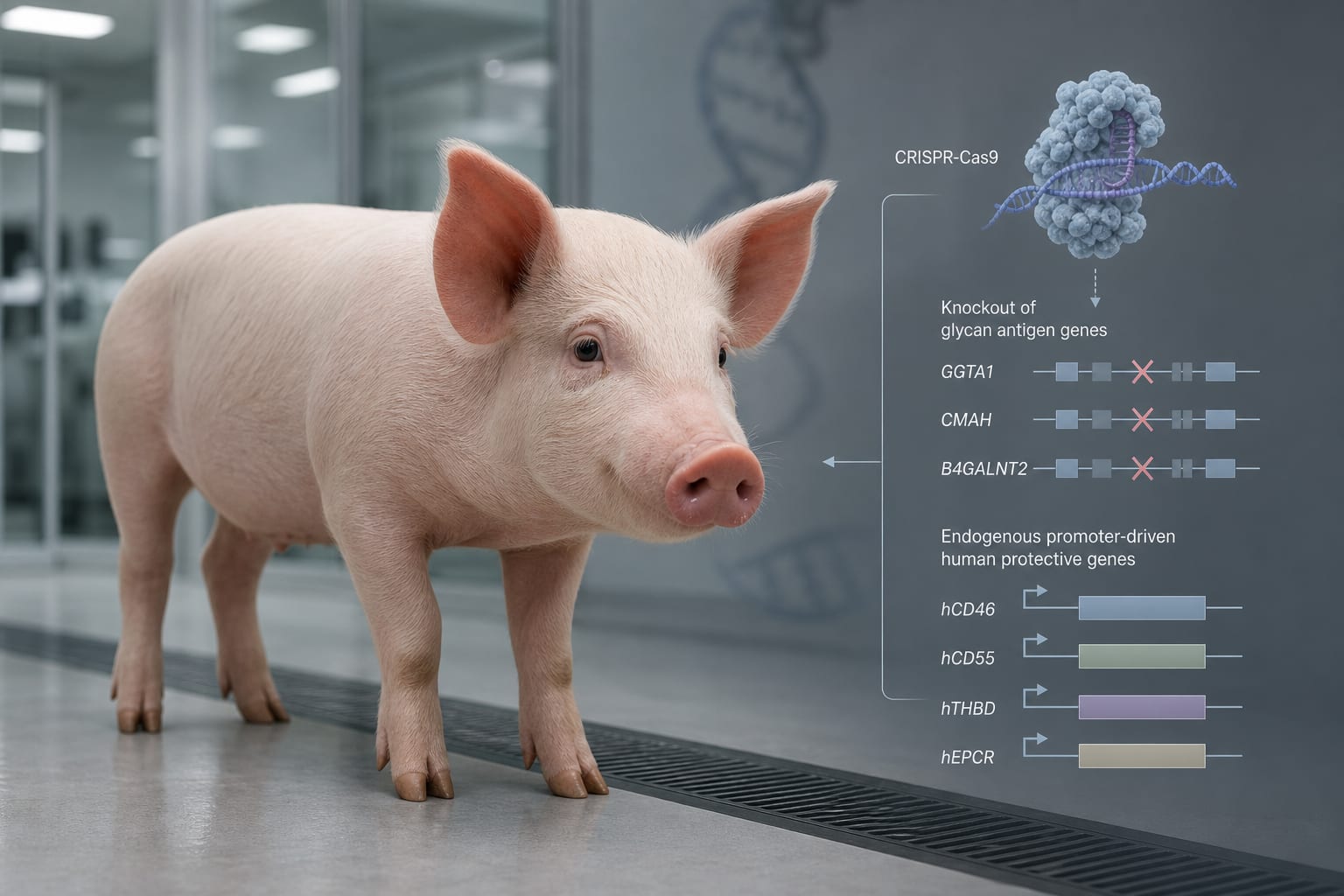
This study presents the development of a genetically modified pig model by eliminating key xenoantigens and expressing protective human proteins. The resulting BM7G pig model demonstrates stable expression of transgenes.

Background

Xenotransplantation faces challenges due to immune rejection. Multi-gene modifications in donor pigs are essential to mitigate these issues, particularly through the knockout of carbohydrate antigens and the introduction of human protective genes. This study addresses the need for stable gene expression in genetically modified pigs.

Data Highlights

Gene ModificationOutcome
GGTA1, CMAH, β4GalNT2 KnockoutComplete absence of glycan antigens
hCD55, hCD46, hTHBD, hEPCR ExpressionStable expression in vascular endothelial cells and major organs
In-vitro Functional AssaysReduced binding of human antibodies and inhibited complement-dependent cytotoxicity

Key Findings

  • Three glycan antigens were completely absent in BM7G genetically modified pigs.
  • Four human protective proteins were stably expressed in vascular endothelial cells and major organs.
  • hCD55 and hCD46 were widely expressed, while hTHBD and hEPCR were specifically expressed in the vascular region.
  • In-vitro assays showed reduced binding of human antibodies and decreased thrombin-antithrombin complex formation.
  • The study successfully combined knockout of xenoantigens with expression of protective genes.

Clinical Implications

The BM7G genetically modified pig model provides a resource for preclinical research in xenotransplantation.

Conclusion

The creation of the BM7G pig model represents a step in xenotransplantation research.

Related Resources & Content

  1. Frontiers in Immunology, 2026 -- Porcine xenotransplantation in the clinical era: converging advances and unresolved barriers on the path to clinical translation
  2. New England Journal of Medicine, 2025 -- Xenotransplantation of a Porcine Kidney for End-Stage Kidney Disease
  3. Xenotransplantation | FDA -- Regulatory and consensus frameworks
  4. Bone Marrow Transplantation — Depletion of CD276+ Cells from Haploidentical Memory T-Cell Grafts Reduces GVHD Risk
  5. Acta Neuropathologica — A mouse model with HSPB8 gene modifications for studying distal hereditary motor neuropathy and myopathy demonstrates the harmful effects of mutant Hspb8.
  6. Archives of Toxicology — A novel dual reporter embryonic stem cell line for evaluating teratogen-induced disruptions in anterior-posterior heart patterning
  7. Xenotransplantation | FDA
  8. Xenotransplantation of a Porcine Kidney for End-Stage Kidney Disease | New England Journal of Medicine
  9. Specific pathogen free ten gene-edited donor pigs for xenotransplantation | Protein & Cell | Oxford Academic

Original Source(s)

Related Content