Clinical and Refractive Results After Bilateral Enhanced Monofocal IOL Implantation Using Targeted Mini-Monovision
-
By
-
Işıl Kefeli Kırcalı
-
Üzeyir Günenç
-
Canan Aslı Utine
-
Gül Arıkan
-
October 13, 2026
Clinical Report: Bilateral Enhanced Monofocal IOLs With Targeted Mini-Monovision
Overview
This retrospective observational study assessed bilateral RayOne EMV enhanced monofocal IOL implantation using a planned mini-monovision target: emmetropia in the dominant eye and approximately −0.50 D in the non-dominant eye. The supplied article excerpt reports that 25 consecutive patients (50 eyes) were included and that Month 6 outcome data were complete, but it does not provide the study’s outcome results.
Background
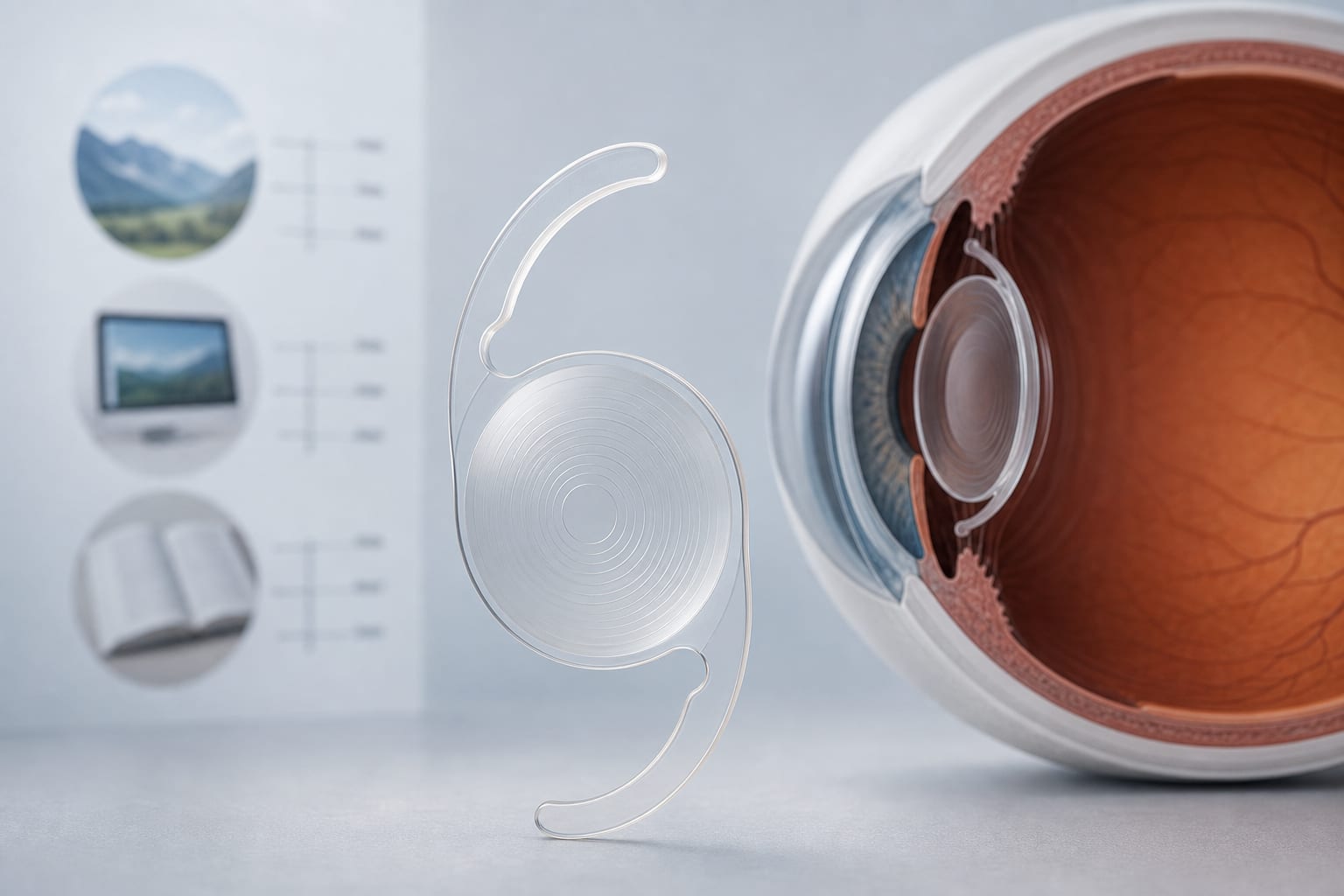
Conventional monofocal IOLs generally provide strong distance vision, while intermediate and near vision may remain limited. Diffractive multifocal and EDOF lenses can extend functional vision, but their light-splitting optics have been associated with reduced contrast sensitivity and photic phenomena such as glare and halos. Enhanced monofocal IOLs are designed to modestly extend depth of focus while retaining characteristics of conventional monofocal lenses. Mini-monovision targets emmetropia in the dominant eye and mild myopia in the fellow eye; the article identifies limited evidence for this strategy with bilateral RayOne EMV implantation.
Data Highlights
| Study characteristic | Reported information |
|---|---|
| Design | Retrospective observational study |
| Setting | Department of Ophthalmology, Dokuz Eylül University Faculty of Medicine |
| Patients and eyes | 25 consecutive patients; 50 eyes |
| Treatment period | December 2022 to April 2024 |
| IOL and refractive targets | Bilateral RayOne EMV; emmetropia in the dominant eye and approximately −0.50 D in the non-dominant eye |
| Follow-up completeness | Month 6 outcome data were complete for the cohort |
| Clinical outcome values | Not included in the supplied article excerpt |
Key Findings
- The study reviewed records for 25 consecutive patients who underwent bilateral RayOne EMV implantation under a planned mini-monovision protocol.
- The intended refractive target was emmetropia in the dominant eye and approximately −0.50 D in the non-dominant eye.
- All patients met eligibility criteria; none were excluded or lost during follow-up, and Month 6 data were complete for all 25 patients.
- The article describes enhanced monofocal IOLs as non-diffractive lenses intended to modestly increase depth of focus while retaining distance visual acuity and optical quality associated with conventional monofocal lenses.
- The article states that prior evidence suggests enhanced monofocals improve intermediate acuity and, to a lesser degree, near acuity compared with conventional monofocals, without clinically significant reduction in distance acuity.
- The supplied excerpt does not report this cohort’s visual acuity, refractive, contrast-sensitivity, dysphotopsia, or patient-reported outcome results; therefore, the study’s clinical outcomes cannot be summarized from the provided material.
Clinical Implications
The study design and refractive targets may inform discussion of bilateral RayOne EMV implantation with mild mini-monovision, but the supplied excerpt does not provide outcome data to assess effectiveness or safety in this cohort. The article frames IOL selection and mini-monovision as relevant to patients’ visual priorities and spectacle-use expectations.
Conclusion
The supplied material describes a complete six-month cohort of 25 patients treated with bilateral RayOne EMV and targeted mini-monovision. Because study outcome results are absent from the excerpt, no conclusion about the cohort’s clinical or refractive results can be drawn here.
Related Resources & Content
- ESCRS, ESCRS Recommendations for Cataract Surgery, year not stated -- ESCRS Recommendations for Cataract Surgery
- Systematic review and meta-analysis, year not stated -- Visual and patient-reported outcomes of an enhanced versus monofocal intraocular lenses in cataract surgery
- Presbyopia Physician, 2022 -- Modernizing Monovision
- BMC Ophthalmology, 2026 -- Expanding visual horizons: comparative outcomes of bilateral implantation of an extended depth-of-focus versus enhanced and standard monofocal intraocular lenses
- Ophthalmology Management — Viewpoint
- Contact Lens Spectrum — Reader and Industry Forum
- ESCRS Recommendations for Cataract Surgery
- Visual and patient-reported outcomes of an enhanced versus monofocal intraocular lenses in cataract surgery: a systematic review and meta-analysis
- Modernizing Monovision
- Expanding visual horizons: comparative outcomes of bilateral implantation of an extended depth-of-focus versus enhanced and standard monofocal intraocular lenses
- Visual Performance Comparison Between Enhanced Monofocal and Extended Depth of Focus Intraocular Lenses: A Systematic Review and Meta-Analysis - PubMed
Based on findings from:
Clinical and refractive outcomes of bilateral enhanced monofocal intraocular lens implantation with targeted mini-monovision
Işıl Kefeli Kırcalı, Üzeyir Günenç, Canan Aslı Utine, Gül Arıkan. Bmc Ophthalmology, 2026.
https://link.springer.com/article/10.1186/s12886-026-05439-8
This content is an AI-generated, fully rewritten summary based on a published scholarly article. It does not reproduce the original text and is not a substitute for the original publication. Readers are encouraged to consult the source for full context, data, and methodology.