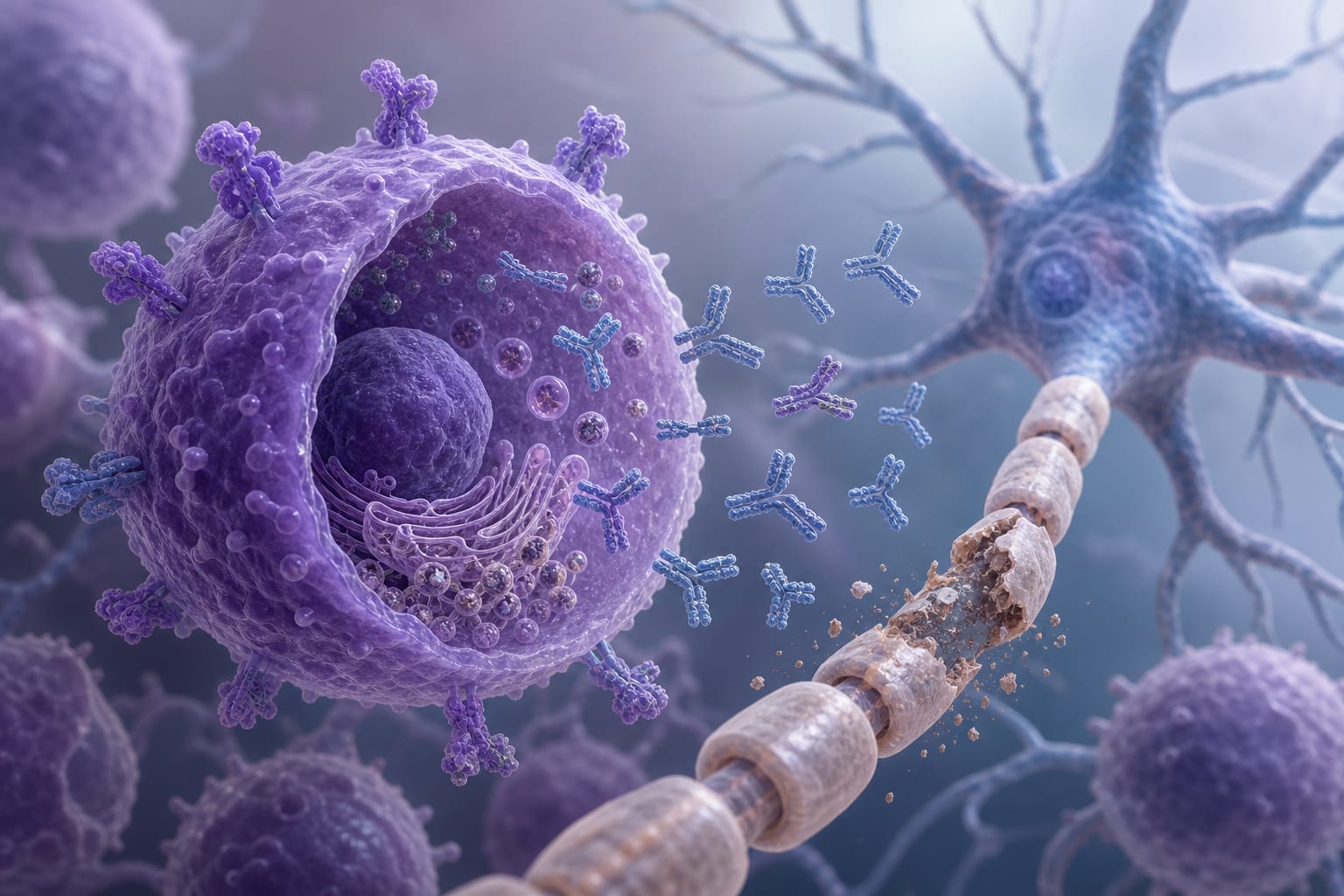
Clinical Report: Transitioning from Marginal to Central in MS Treatment
Overview
This study investigates the role of marginal zone-like B cells in multiple sclerosis (MS) patients treated with cladribine, highlighting their proinflammatory capacity and slow reconstitution post-treatment. The findings suggest that targeting these B cell subsets may be crucial for enhancing treatment efficacy.
Background
Multiple sclerosis (MS) is a chronic autoimmune disease characterized by demyelination and neurodegeneration, with B cells playing a significant role in its pathogenesis. The advent of B cell-targeted therapies has transformed MS management, emphasizing the need to understand the dynamics of B cell subsets in response to treatment. Cladribine, a disease-modifying therapy, specifically affects memory B cells, which are implicated in MS immunopathology.
Data Highlights
Parameter
Value
Number of patients
36
Median age
39 (18–57)
Female patients
25
Male patients
11
Key Findings
Marginal zone-like (MZ-like) memory B cells are preferentially depleted by cladribine and have a significant proinflammatory capacity.
DN B cells exhibit an activated phenotype and recover more rapidly than MZ-like B cells after cladribine treatment.
The study involved a longitudinal cohort of 36 MS patients to assess B cell subset dynamics over time.
Cladribine treatment reshapes the B cell repertoire, favoring naïve B cells while depleting memory subsets.
OCBs persist despite treatment, indicating ongoing antibody production from plasma cells.
Clinical Implications
Understanding the specific effects of cladribine on B cell subsets can inform treatment strategies for MS. Targeting MZ-like memory B cells may enhance therapeutic outcomes and reduce disease activity in MS patients.
Conclusion
The findings underscore the importance of marginal zone-like B cells in MS pathology and their potential as therapeutic targets in cladribine treatment.
by Marta Pirronello, Mario Picozza, Gisella Guerrera, Silvia Corbisiero, Andrea Misiti, Roberta C. Placido, Alice Verdiani, Lorenzo de Marco, Manolo Sambucci, Elena Olivieri, Daniela F. Angelini, Esmeralda Quartuccio, Luca Prosperini, Carla Tortorella, Maria C. Buscarinu, Valeria Zancan, Francesca de Masi, Marco Salvetti, Claudio Gasperini, Giovanna Borsellino, Luca Battistini