Ultra-widefield swept-source OCT angiography assessment of choroidal changes in Chinese myopic adults - Report - MDSpire
Coming Soon: Introducing MDSpire News. Learn more
Conexiant’s news site is now MDSpire News. Learn more

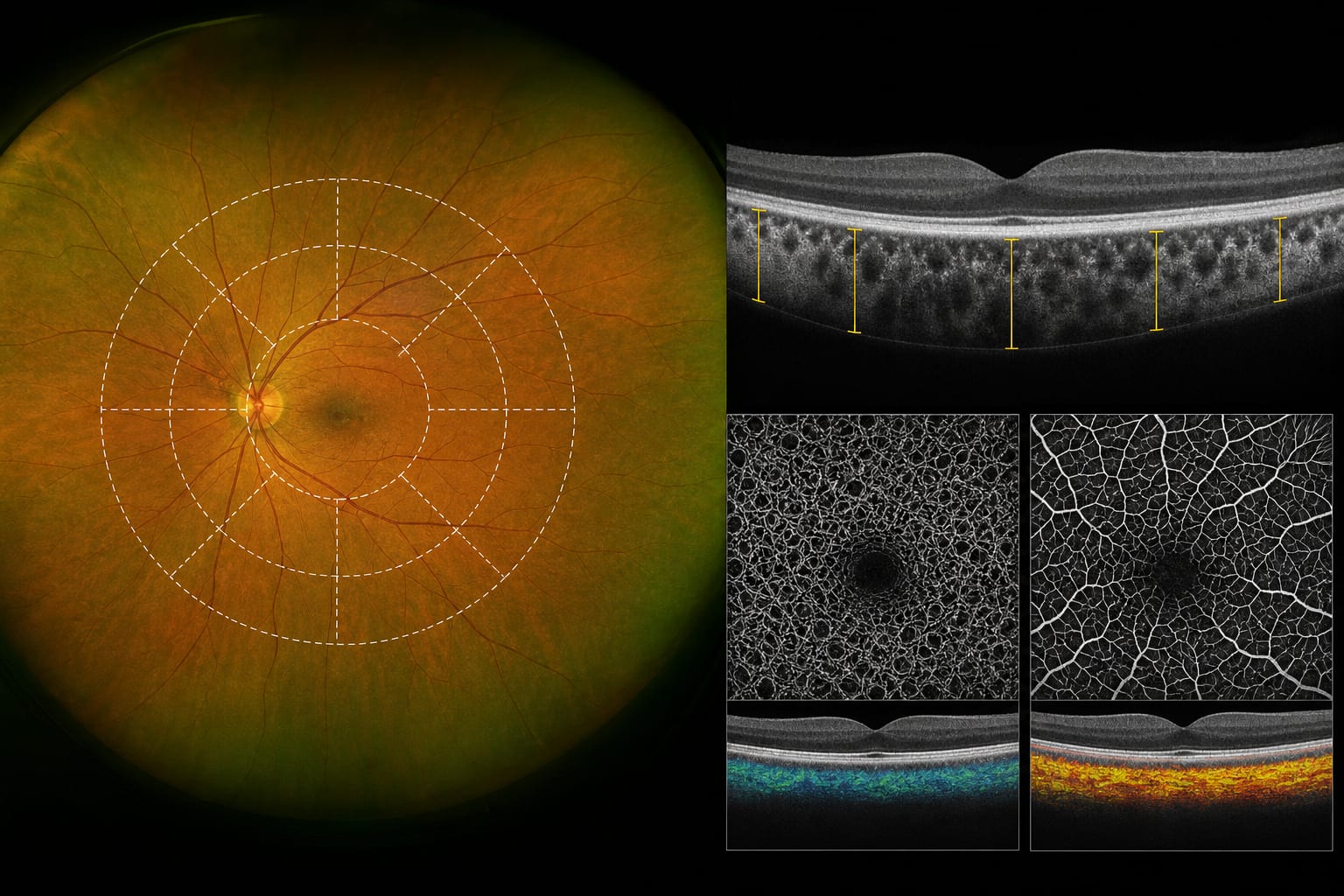
Assessment of Choroidal Alterations in Chinese Myopic Young Adults Using Ultra-Widefield Swept-Source OCT Angiography

  • By

  • Chao Wu

  • Tianwei Liu

  • Fengjiao Li

  • Wanzhen Jiao

  • Bojun Zhao

  • July 1, 2026

Share

Clinical Report: Assessment of Choroidal Alterations in Myopic Young Adults

Overview

This study characterizes choroidal alterations in Chinese young adults with varying myopia using ultra-widefield SS-OCTA. Significant reductions in choroidal thickness and Sattler-Haller layer vessel density were observed with increasing axial length.

Background

Myopia is a prevalent refractive disorder, particularly in Asian populations, with projections indicating a significant increase in cases by 2050. High myopia is associated with severe ocular complications, necessitating a better understanding of its structural and vascular implications. Recent advancements in imaging technology, such as ultra-widefield SS-OCTA, allow for detailed assessments of choroidal changes in myopic eyes.

Data Highlights

ParameterLow Myopia (n=80)Moderate Myopia (n=84)High Myopia (n=54)
Choroidal Thickness (CT)Thickest centrallyThinnest inferonasallySignificant reductions across all subfields
Sattler-Haller Layer Vessel Density (SHVD)Not specifiedNot specifiedReduced in six subfields

Key Findings

  • High myopia eyes exhibited significant reductions in choroidal thickness across all subfields.
  • Sattler-Haller layer vessel density was reduced in six subfields in high myopia.
  • Choroidal thickness correlated negatively with axial length in eight subfields.
  • SHVD correlated negatively with axial length in seven subfields.
  • Choroidal thickness was thickest centrally and thinnest inferonasally.
  • Central choroidal vascular density was lowest, while SHVD peaked superotemporally.

Clinical Implications

Understanding the relationship between myopia severity and choroidal alterations can inform monitoring and management strategies for myopic patients. The use of ultra-widefield SS-OCTA provides valuable insights into the structural changes associated with myopia.

Conclusion

This study highlights significant regional variations in choroidal thickness and vessel density in myopic young adults.

Related Resources & Content

  1. Frontiers in Medicine, 2026 -- Choroidal structural and perfusion characteristics across refractive groups in children
  2. Ophthalmology Management, 2021 -- Expanding applications of OCT-A
  3. Ophthalmology Management, 2015 -- Learning to read retinal OCT
  4. IMI—Interventions for Controlling Myopia Onset and Progression 2025 - PMC
  5. Retinal Physician — Evolving Technology and New Terminology in Swept-Source OCT Angiography for Diabetic Retinopathy
  6. IMI—Interventions for Controlling Myopia Onset and Progression 2025 - PMC
  7. UWF-SS-OCTA evaluation of changes of choroidal microvasculature and microstructure in adult patients with high myopia and relationship with age and axial length - PMC
  8. Choroidal vascularity index is independent of ocular and image-based factors in healthy eyes: a systematic review and meta-analysis - PMC

Original Source(s)

Related Content