Comparative predictive performance of different eGFR equations for 1-year major adverse cardiovascular events after percutaneous coronary intervention in patients with acute coronary syndrome - Report - MDSpire
Coming Soon: Introducing MDSpire News. Learn more
Conexiant’s news site is now MDSpire News. Learn more

Evaluation of Various eGFR Formulas in Predicting 1-Year Major Adverse Cardiovascular Events Following Percutaneous Coronary Intervention in Acute Coronary Syndrome Patients

  • By

  • Yicheng Wang

  • Fangming Liu

  • Ruoxi Qi

  • Xiaohan Wang

  • Jiajie Mei

  • Zhenzhu Liu

  • Lijiao Zhang

  • Wenli Xie

  • Ming Yu

  • Xiaodong Zhang

  • Hongyan Wang

  • Zhaohong Geng

  • September 9, 2026

Share

Clinical Report: Evaluation of Various eGFR Formulas in Predicting MACE

Overview

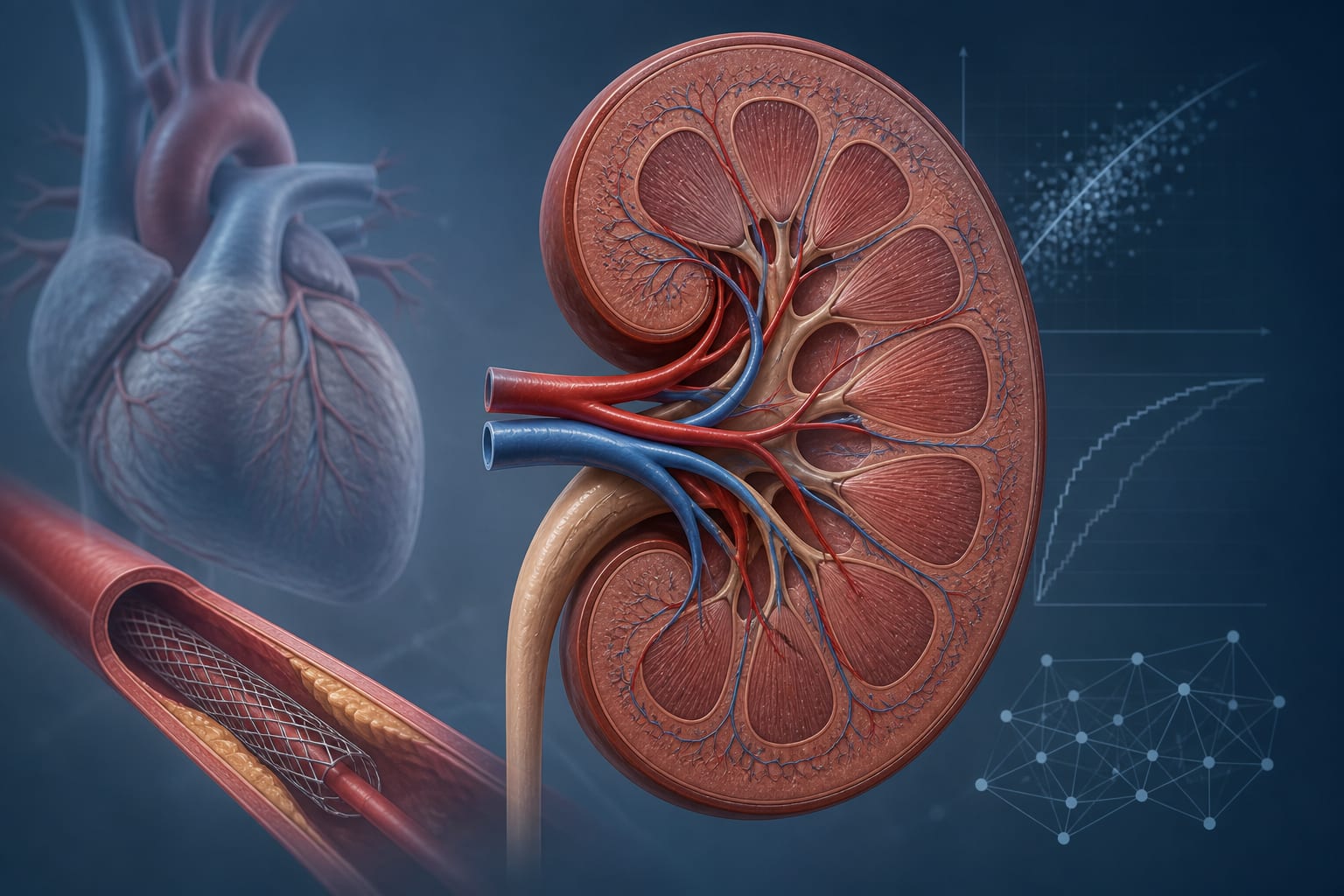
This study evaluates the predictive performance of creatinine-based versus cystatin C–based eGFR equations for 1-year major adverse cardiovascular events (MACE) in patients undergoing percutaneous coronary intervention (PCI) for acute coronary syndrome.

Background

Renal dysfunction is a significant risk factor for cardiovascular disease, particularly in patients with coronary artery disease. Accurate assessment of renal function is crucial for risk stratification in patients undergoing PCI, as it can influence clinical outcomes. This study aims to clarify the comparative effectiveness of different eGFR equations in predicting MACE following PCI.

Data Highlights

OutcomeNumber of Patients
MACE (total)72
Repeat PCI71
Cardiac Death1

Key Findings

  • Cystatin C–based eGFR equations classified more patients as having impaired renal function compared to creatinine-based formulas.
  • Moderate-to-severe renal dysfunction defined by creatinine-based eGFR was linked to increased 1-year MACE risk.
  • After multivariable adjustment, creatinine-based eGFR was not an independent predictor of MACE.
  • Logistic regression demonstrated the highest discriminative ability for predicting MACE among the models tested.
  • SHAP analysis highlighted cardiovascular functional parameters and metabolic markers as key contributors to risk prediction.

Clinical Implications

The findings indicate that both eGFR equations provide valuable information regarding renal function assessment in patients following PCI.

Conclusion

This study indicates that creatinine-based eGFR is associated with 1-year MACE following PCI compared to cystatin C–based eGFR. Further validation in larger cohorts is necessary.

Related Resources & Content

  1. Frontiers in Cardiovascular Medicine, 2026 -- Association of estimated glomerular filtration rate and in-hospital mortality in patients hospitalized for heart failure: a retrospective cohort study
  2. Clinical Research in Cardiology, 2024 -- Impact of Chronic Kidney Disease Severity and Cause on Heart Failure Patients with Mildly Reduced Ejection Fraction
  3. Clinical Research in Cardiology, 2023 -- Comparison of GRACE Risk Scores and High-Sensitivity Troponin for Determining Timing of Coronary Angiography in Non-ST-Elevation Acute Coronary Syndromes
  4. KDOQI US Commentary on the KDIGO 2024 Clinical Practice Guideline for the Evaluation and Management of CKD
  5. 2025 ACC/AHA/ACEP/NAEMSP/SCAI Guideline for the Management of Patients With Acute Coronary Syndromes
  6. Frontiers, 2026 -- Comparative predictive performance of different eGFR equations for 1-year major adverse cardiovascular events after percutaneous coronary intervention in patients with acute coronary syndrome
  7. Clinical Research in Cardiology — Assessing Patients with Suspected NSTE-ACS in the Observation Zone: A Study on the GRACE 1.0 Score and Biomarker Panel for Enhanced Risk Stratification and Management
  8. KDOQI US Commentary on the KDIGO 2024 Clinical Practice Guideline for the Evaluation and Management of CKD
  9. 2025 ACC/AHA/ACEP/NAEMSP/SCAI Guideline for the Management of Patients With Acute Coronary Syndromes: A Report of the American College of Cardiology/American Heart Association Joint Committee on Clinical Practice Guidelines | JACC
  10. Frontiers | Comparative predictive performance of different eGFR equations for 1-year major adverse cardiovascular events after percutaneous coronary intervention in patients with acute coronary syndrome

Original Source(s)

Related Content