Neurophysiological Links Between Functional Brain Connectivity and Pain Alleviation in Cancer Patients Using Virtual Reality
-
By
-
Somayeh B. Shafiei
-
Saeed Shadpour
-
Oscar de Leon-Casasola
-
July 15, 2026
Clinical Report: Neurophysiological Links Between Functional Brain Connectivity and Pain Alleviation in Cancer Patients Using Virtual Reality
Overview
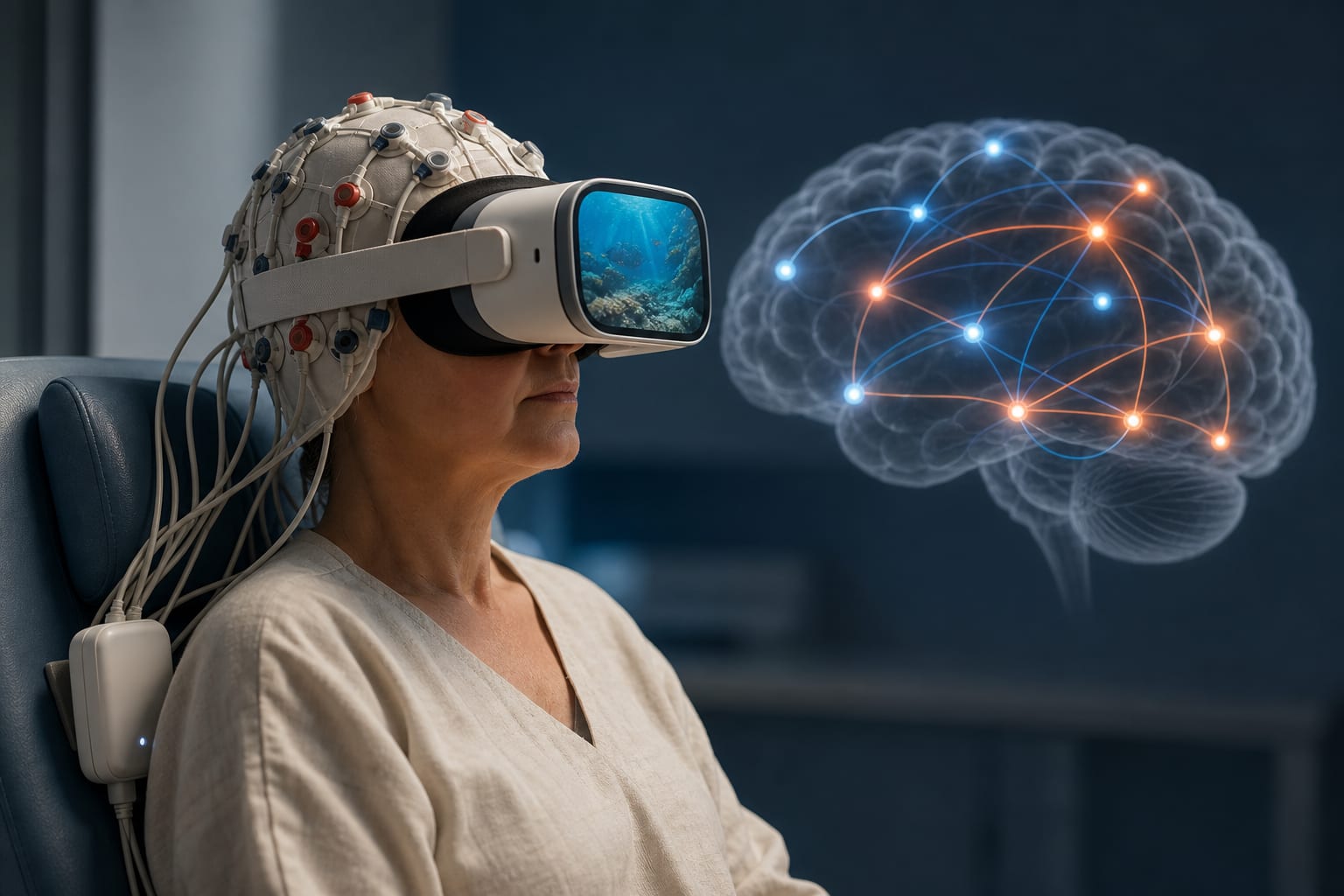
This study investigates the neurophysiological correlates of pain relief in cancer patients using virtual reality (VR). It finds significant negative correlations between functional connectivity in specific brain regions and pain reduction during VR exposure, as reported in the study.
Background
Cancer-related pain is a significant concern, affecting the quality of life for many patients. Virtual reality has emerged as a potential non-pharmacologic approach for pain relief.
Data Highlights
| Correlation | Region | p-value |
|---|---|---|
| -0.43 | PFC and SFG | 0.005 |
| -0.42 | Within SFG | 0.006 |
| -0.32 | HbO at PFC | 0.044 |
Key Findings
- 41 cancer patients participated in a VR distraction session using the Oceania application.
- Functional connectivity features showed significant negative correlations with pain reduction.
- Strongest associations were observed between the prefrontal cortex (PFC) and superior frontal gyrus (SFG).
- HbO activity at the PFC was significantly associated with pain reduction.
- Decreased functional connectivity in specific cortical regions was linked to short-term pain reduction during VR exposure.
Clinical Implications
The findings suggest that monitoring functional connectivity may provide insights into the effectiveness of VR as a pain management strategy in cancer patients. This could inform personalized approaches to pain relief in clinical settings.
Conclusion
The study highlights the potential of VR to modulate pain perception through changes in brain connectivity, warranting further investigation into its applications in pain management.
Related Resources & Content
- Roswell Park Comprehensive Cancer Center, Brain Imaging Plus Virtual Reality Shows Promise for Effectively Managing Cancer Pain, 2025
- The ASCO Post, Could Brain Imaging Plus VR Minimize Cancer-Related Pain?, 2025
- The ASCO Post, Virtual Reality Therapy May Improve Chemotherapy-Associated Side Effects, 2025
- Journal of Medical Internet Research (JMIR), Effects of Immersive Virtual Reality Interventions on Symptom Management in Patients With Gastrointestinal Cancer: Systematic Review and Meta-Analysis of Randomized Controlled Trials, 2026
- NCCN Clinical Practice Guidelines in Oncology for Adult Cancer Pain, Version 2.2025, 2025
- Society for Integrative Oncology–ASCO Guideline, Integrative Medicine for Pain Management in Oncology, 2022
- The effects of virtual reality on cancer-related pain and anxiety: A systematic review and meta-analysis of randomized controlled trials, 2026
- Effect of virtual reality on pain in oncology patients: A systematic review, 2026
- Adult Cancer Pain, Version 2.2025, NCCN Clinical Practice Guidelines In Oncology - PubMed
- Integrative Medicine for Pain Management in Oncology: Society for Integrative Oncology–ASCO Guideline | Journal of Clinical Oncology
- The effects of virtual reality on cancer-related pain and anxiety: A systematic review and meta-analysis of randomized controlled trials - ScienceDirect
- Effect of virtual reality on pain in oncology patients: A systematic review - PubMed
- Immersion in nature through virtual reality attenuates the development and spread of mechanical secondary hyperalgesia: a role for insulo-thalamic effective connectivity
Based on findings from:
Functional brain connectivity correlates of pain relief during virtual reality exposure in cancer patients
Somayeh B. Shafiei, Saeed Shadpour, Oscar de Leon-Casasola. Frontiers In Pain Research, 2026.
https://www.frontiersin.org/journals/pain-research/articles/10.3389/fpain.2026.1730496/full
This content is an AI-generated, fully rewritten summary based on a published scholarly article. It does not reproduce the original text and is not a substitute for the original publication. Readers are encouraged to consult the source for full context, data, and methodology.