Utilization of Wearable Technology for Screening, Monitoring, and Managing Atrial Fibrillation
-
By
-
Wen Chen
-
Xinyi Lin
-
Ping Jia
-
Zhenwei Liu
-
July 21, 2026
Clinical Report: Utilization of Wearable Technology for Screening Atrial Fibrillation
Overview
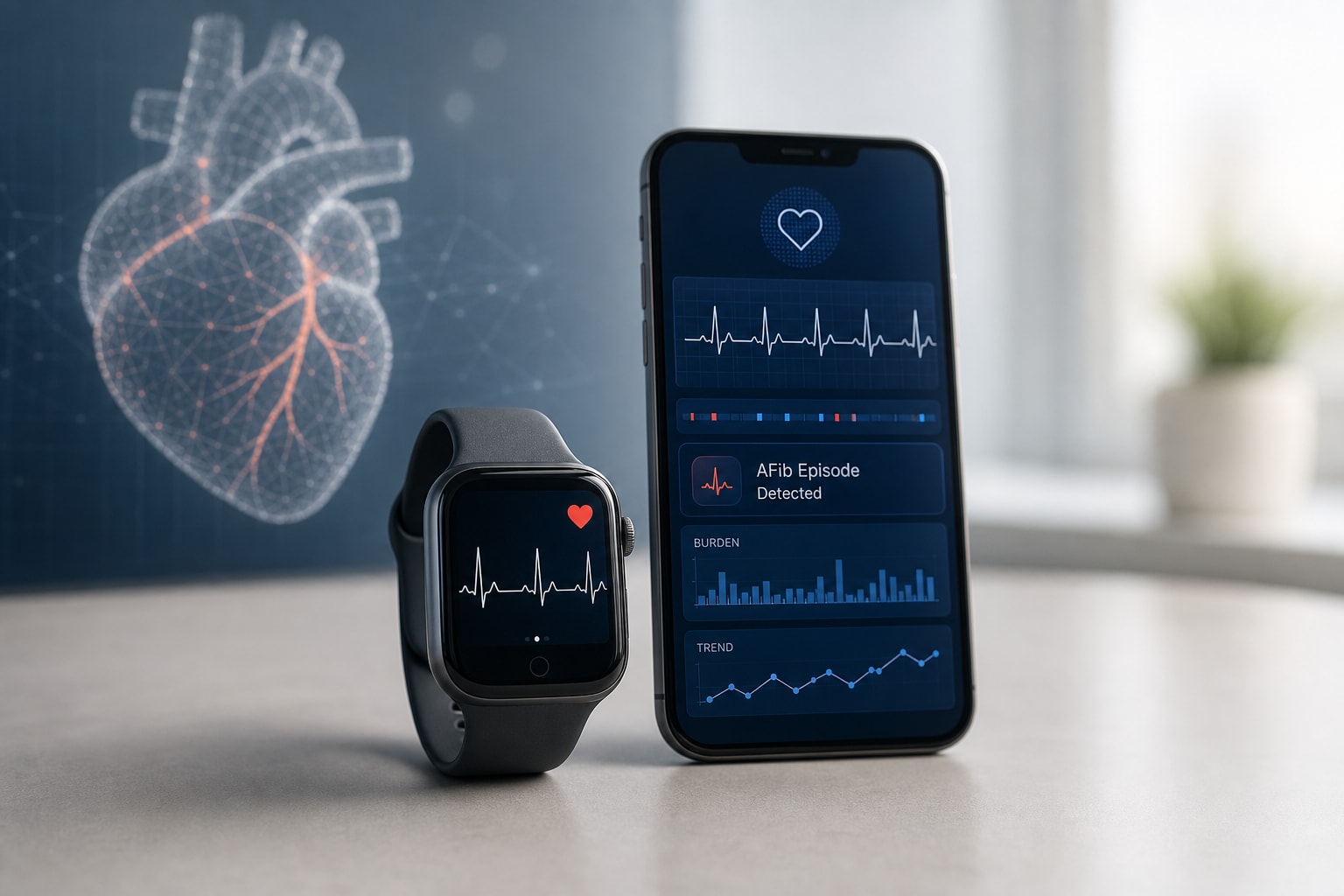
Wearable technology integrating multimodal sensors offers continuous monitoring for atrial fibrillation (AF). This review evaluates the clinical integration of these devices and the challenges posed by increased detection of subclinical AF.
Background
Atrial fibrillation is the most common cardiac arrhythmia, significantly increasing the risk of ischemic stroke and heart failure. Traditional screening methods often fail to detect paroxysmal or asymptomatic AF, leading to a need for continuous monitoring solutions. Wearable devices equipped with advanced sensors and artificial intelligence are being explored for AF detection and management.
Data Highlights
No numerical data provided in the source material.
Key Findings
- Wearable devices can automate AF identification through continuous physiological monitoring.
- Approximately one-third of AF cases remain subclinical, complicating early detection.
- Recent trials indicate that smartphone-based PPG screening increases AF detection rates.
- Standardized algorithms and validated hardware are essential for effective clinical integration of wearable technology.
- Emerging challenges include the detection-vs.-intervention paradox and the need for personalized antithrombotic therapy.
Clinical Implications
The integration of wearable technology in AF management presents challenges related to increased subclinical AF detection and implications for anticoagulation therapy.
Conclusion
Wearable technology has potential in the management of atrial fibrillation, though consideration of clinical guidelines and patient-specific factors is necessary for implementation.
Related Resources & Content
- DIGITAL HEALTH, Development of a semi–real-time electrocardiogram monitoring system integrating artificial intelligence and wearable devices for atrial fibrillation screening, 2022
- Clinical Research in Cardiology, Utilizing Machine Learning for Identifying and Managing Atrial Fibrillation, 2022
- Clinical Research in Cardiology, A Systematic Review of Mobile Health Technologies for the Detection and Management of Atrial Fibrillation, 2021
- Frontiers in Cardiovascular Medicine, Exploring nurse- and allied health professional-led opportunistic atrial fibrillation screening with artificial intelligence-enabled devices in community and primary care, 2026
- 2023 ACC/AHA/ACCP/HRS Guideline for the Diagnosis and Management of Atrial Fibrillation, 2023
- Final Recommendation Statement: Screening for Atrial Fibrillation | United States Preventive Services Taskforce, 2022
- 2024 ESC AF Guidelines
- Smartphone-based screening for atrial fibrillation: a pragmatic randomized clinical trial
- 2023 ACC/AHA/ACCP/HRS Guideline for the Diagnosis and Management of Atrial Fibrillation: A Report of the American College of Cardiology/American Heart Association Joint Committee on Clinical Practice Guidelines
- Final Recommendation Statement: Screening for Atrial Fibrillation | United States Preventive Services Taskforce
- Enhanced Detection and Prompt Diagnosis of Atrial Fibrillation Using Apple Watch: A Randomized Controlled Trial - PubMed
- Accuracy of Smartwatches in the Detection of Atrial Fibrillation: A Systematic Review and Diagnostic Meta-Analysis - PubMed
- Diagnostic accuracy of ECG smart chest patches versus PPG smartwatches for atrial fibrillation detection: a systematic review and meta-analysis - PubMed
Based on findings from:
Wearable devices in atrial fibrillation: screening, monitoring, and management
Wen Chen, Xinyi Lin, Ping Jia, Zhenwei Liu. Frontiers In Cardiovascular Medicine, 2026.
https://www.frontiersin.org/journals/cardiovascular-medicine/articles/10.3389/fcvm.2026.1887788/full
This content is an AI-generated, fully rewritten summary based on a published scholarly article. It does not reproduce the original text and is not a substitute for the original publication. Readers are encouraged to consult the source for full context, data, and methodology.