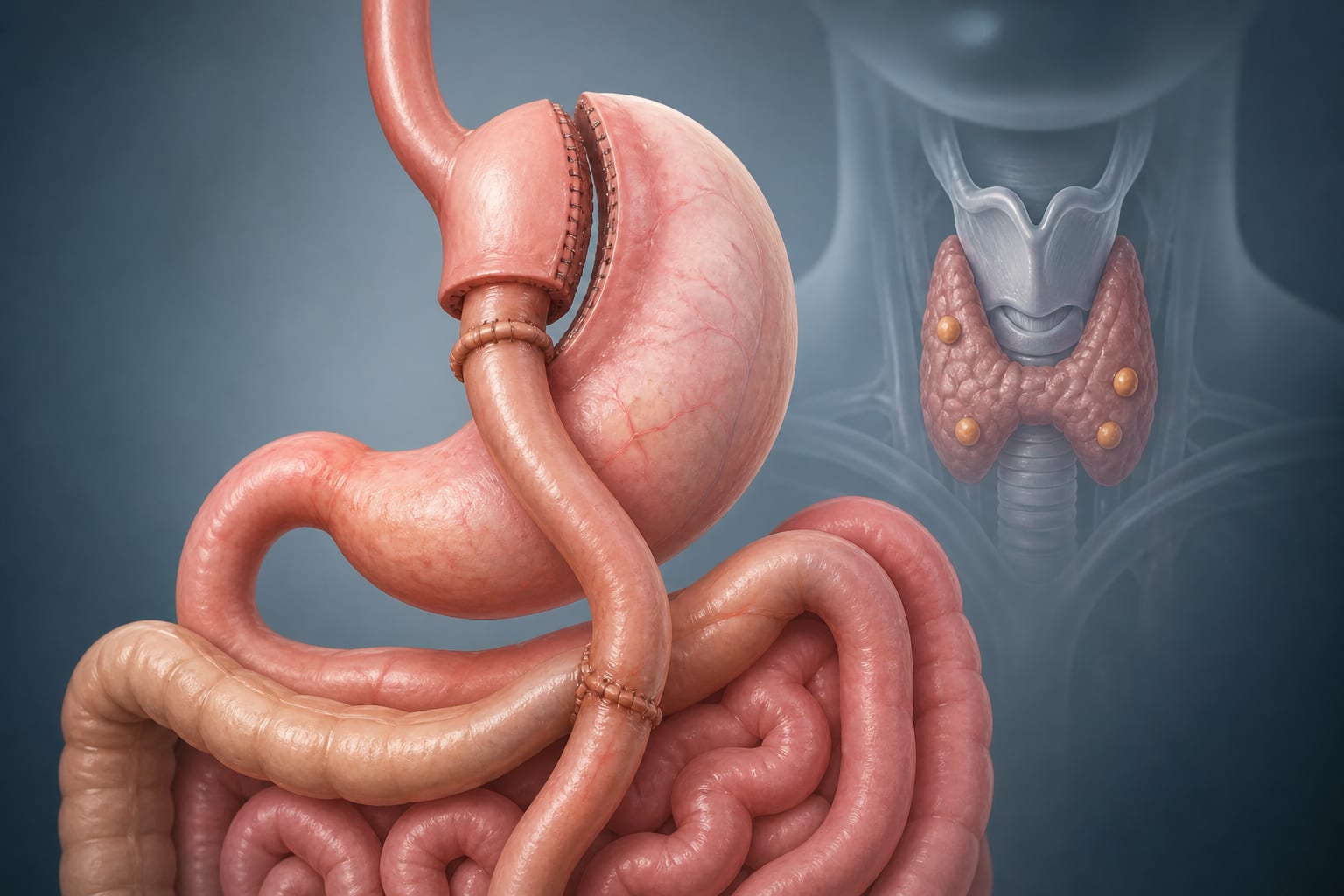
Clinical Report: RYGB and Hypocalcemia Risk After Total Thyroidectomy
Overview
Roux-en-Y gastric bypass (RYGB) reduces calcium absorption by bypassing the duodenum and jejunum, potentially compounding the risk of postoperative hypocalcemia after total thyroidectomy. The review identifies limited RYGB-specific evidence and notes that the 2026 American Thyroid Association Multidisciplinary Consensus Statement classifies this population as high risk. No standardized screening or management algorithm for patients with prior RYGB is described in the supplied article text.
Background
Obesity affects more than 40% of U.S. adults, and metabolic bariatric surgery is among the approaches used to reduce excess body weight. RYGB is associated with malabsorption and nutritional deficiencies, including deficiencies of calcium and vitamin D. Transient hypoparathyroidism is described as the most frequent complication after total thyroidectomy, while a systematic review cited in the article reported a median transient hypocalcemia rate of 28%. The article states that outcomes specifically among patients with prior RYGB remain insufficiently characterized.
Data Highlights
Measure or finding
Reported information
U.S. adults with obesity
More than 40%
Annual thyroidectomies
More than 70,000
Median transient hypocalcemia rate after total thyroidectomy
28%, as reported by a cited systematic review
Largest individual study of patients with prior RYGB
35 patients; statistically higher permanent hypocalcemia, but not transient hypocalcemia, versus controls
Patients undergoing total thyroidectomy with a history of metabolic bariatric surgery
Approximately 1%, according to a cited systematic review covering bariatric procedures generally
Key Findings
RYGB bypasses the duodenum and jejunum, identified in the article as the principal sites of calcium absorption, and is associated with reduced calcium uptake.
The article describes the combination of RYGB-related malabsorption and transient postoperative hypoparathyroidism as a potential “double-hit” for hypocalcemia risk.
A cited systematic review reported a median transient hypocalcemia rate of 28% after total thyroidectomy; the article notes that outcomes in patients with prior RYGB are less well characterized.
The largest individual study cited included 35 patients and found a statistically higher rate of permanent, but not transient, hypocalcemia compared with controls.
A cited systematic review estimated that approximately 1% of total thyroidectomy patients had a history of metabolic bariatric surgery, but it did not focus exclusively on RYGB.
The review states that the 2026 American Thyroid Association Multidisciplinary Consensus Statement on Ambulatory Thyroid Surgery formally identified this population as high risk; the supplied text reports no established RYGB-specific screening or management algorithm.
Clinical Implications
The review identifies prior RYGB as a high-risk context and notes that surgical indication, baseline laboratory values, and extent of resection are relevant when assessing postoperative calcium dysregulation. It also states that the applicability of general-population transient hypocalcemia pathways to patients with prior RYGB remains unclear, and that standardized pre- and postoperative algorithms for this group are not established.
Conclusion
The supplied review describes a plausible and clinically recognized concern for hypocalcemia after total thyroidectomy in patients with prior RYGB, while emphasizing that RYGB-specific outcome evidence remains limited. Further characterization of this population is needed to inform screening and management approaches.
Baptist Health has broken ground on the new home of Baptist Health Kenneth C. Griffin Neuroscience Institute, marking a major investment in the future of brain and spine care, neuroscience research and medical education in South Florida.
Optical analysis of resection-margin tissue identified tumor infiltration as the strongest contributor to predictions of where glioblastoma later recurred.