Cognitive-motor network integration as a behavioral marker of cognitive reserve in post-stroke rehabilitation - Report - MDSpire

Cognitive-motor network integration as a behavioral marker of cognitive reserve in post-stroke rehabilitation

  • By

  • Katharina Kreiger

  • Elisabeth Weiss

  • Felix Fluri

  • June 9, 2026

  • 0 min

Share

Clinical Report: Integration of Cognitive and Motor Networks as an Indicator of Cognitive Reserve in Rehabilitation Following Stroke

Overview

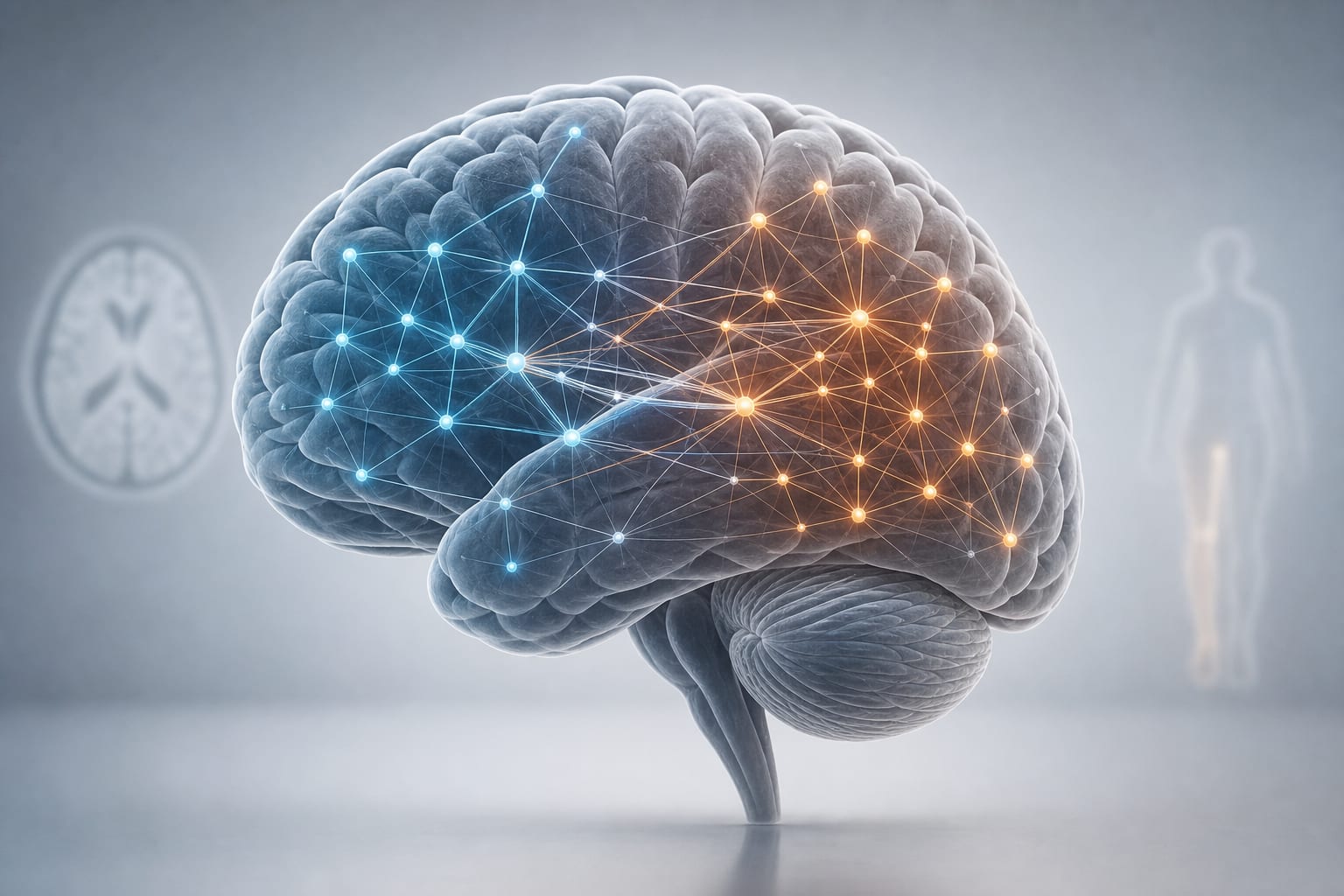
This study examines the role of cognitive reserve in predicting rehabilitation outcomes in stroke patients. It finds that cognitive leisure activities are a predictor of rehabilitation response, and that responders exhibit greater cognitive-motor network integration.

Background

Functional recovery after stroke is highly variable, with many survivors experiencing significant cognitive and motor deficits. Cognitive reserve, which reflects the brain's ability to optimize performance despite damage, is recognized as a factor influencing recovery.

Data Highlights

MeasureResult
Cognitive leisure activitiesOR = 4.84 (strongest predictor of responder status)
Baseline cognitive dimensionsMemory, Executive-Spatial
Network integration in respondersHigher density, lower sparsity

Key Findings

  • Cognitive leisure activities are the strongest predictor of rehabilitation response.
  • Responders did not show significantly higher baseline cognitive scores compared to non-responders.
  • Exploratory factor analysis revealed two cognitive dimensions: Memory and Executive-Spatial.
  • Responders exhibited a more integrated cognitive-motor architecture.
  • Centrality in the responder network was highest for dexterity and delayed verbal recall.

Clinical Implications

The findings indicate a need for further exploration of cognitive leisure activities in relation to recovery.

Conclusion

The study supports a network-based understanding of cognitive reserve in post-stroke rehabilitation.

Related Resources & Content

  1. Frontiers in Neurology, 2026 -- The effect of non-invasive brain stimulation combined with motor imagery on upper limb motor function and activities of daily living in stroke patients: A systematic review and Meta-analysis
  2. Brain, 2022 -- Motor learning after stroke: what we’ve learned and what lies ahead
  3. Brain, 2021 -- Adaptive Changes in Task-Related Network Interactions During Recovery from Post-Stroke Aphasia
  4. Cognitive Impairment After Ischemic and Hemorrhagic Stroke - Professional Heart Daily | American Heart Association
  5. European Stroke Organisation and European Academy of Neurology joint guidelines on post‐stroke cognitive impairment - Quinn - 2021 - European Journal of Neurology
  6. DIGITAL HEALTH — Unilateral and bilateral digital mirror visual feedback with different movement types modulate mu oscillations in individuals with stroke
  7. Biomarkers of stroke recovery: Consensus-based core recommendations from the Stroke Recovery and Rehabilitation Roundtable
  8. Cognitive Impairment After Ischemic and Hemorrhagic Stroke - Professional Heart Daily | American Heart Association
  9. European Stroke Organisation and European Academy of Neurology joint guidelines on post‐stroke cognitive impairment - Quinn - 2021 - European Journal of Neurology - Wiley Online Library
  10. 2016-05-04_Adult Stroke Rehab_slides
  11. Association of cognitive reserve with stroke outcome: A systematic review and meta-analysis - PubMed
  12. RNA gene expression and cognitive reserve as determinants of post-ischaemic stroke cognitive recovery | Scientific Reports
  13. Resting-state functional connectivity alterations in post-stroke cognitive impairment: a systematic review | Brain Imaging and Behavior | Springer Nature Link
  14. Exploring the interrelationship of intra- and inter-network alteration in motor recovery after stroke | Scientific Reports
  15. Efficacy of repetitive transcranial magnetic stimulation at different frequencies for post-stroke cognitive impairment: A network meta-analysis - PubMed
  16. Effectiveness of technology-assisted cognitive interventions for post-stroke cognitive impairment: a systematic review and meta-analysis | Systematic Reviews | Springer Nature Link

Original Source(s)

Related Content