A bibliometric analysis of neuroimaging studies on cognitive control in autism spectrum disorder (2000–2025) - Report - MDSpire

A bibliometric analysis of neuroimaging studies on cognitive control in autism spectrum disorder (2000–2025)

  • By

  • Jing Hu

  • Jiawei Zhao

  • Hao-Jie Chen

  • Xinyue Zhang

  • Junhua Dang

  • May 26, 2026

  • 0 min

Share

Clinical Report: A bibliometric evaluation of neuroimaging research focused on cognitive control in autism spectrum disorder from 2000 to 2025

Overview

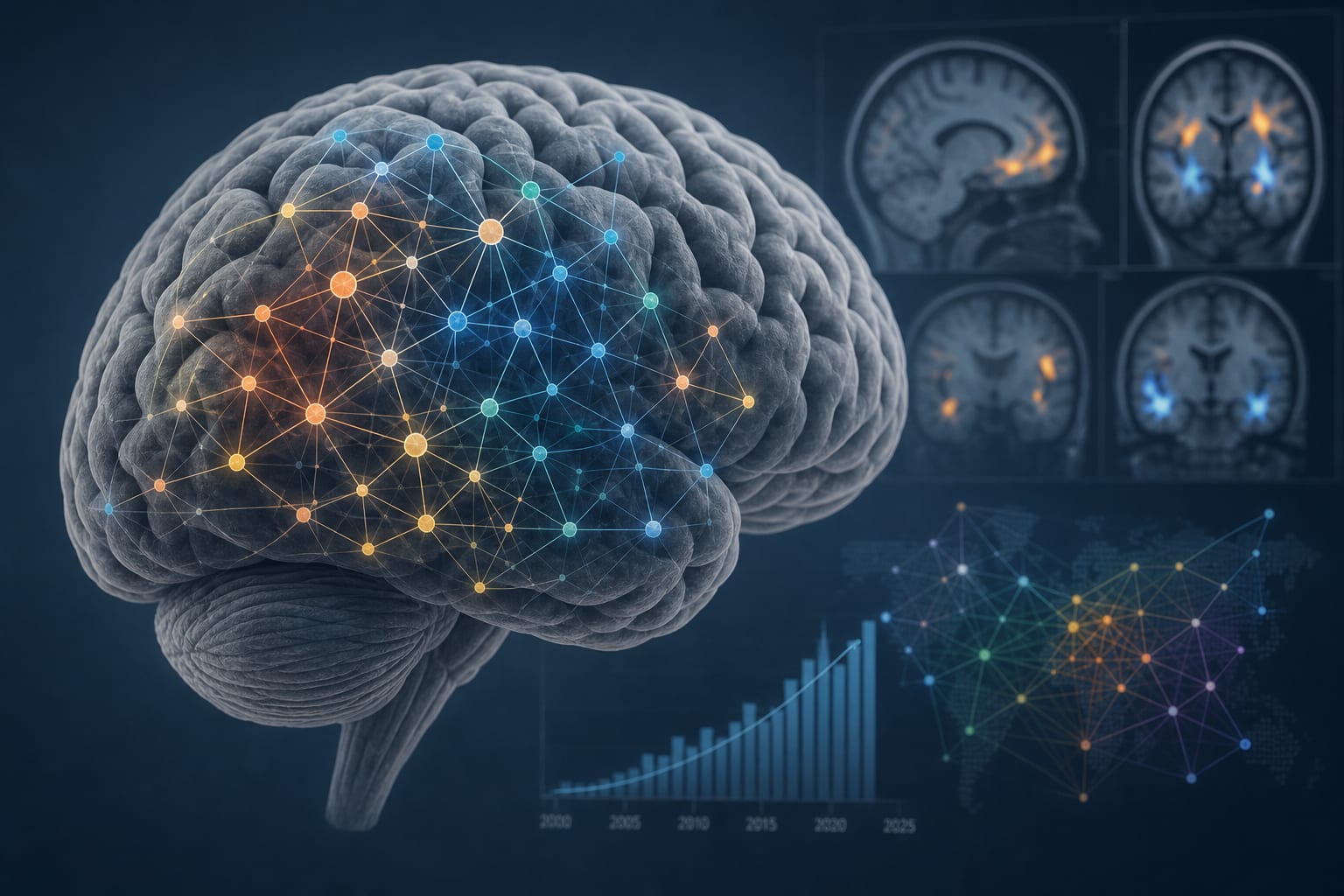
This study systematically analyzes neuroimaging research on cognitive control in Autism Spectrum Disorder (ASD) from 2000 to 2025, revealing significant growth and evolving research themes. Key findings include a shift from functional localization to brain network dysregulation and the emergence of transdiagnostic research.

Background

Autism Spectrum Disorder (ASD) is a prevalent neurodevelopmental disorder characterized by deficits in social communication and restricted behaviors. The increasing prevalence of ASD highlights the need for understanding its underlying mechanisms, particularly through neuroimaging techniques. Cognitive control deficits are common in ASD, impacting social interactions and behavior regulation.

Data Highlights

The analysis included 1,581 relevant articles, showing an annual growth rate of 21.61% in research literature.

Key Findings

  • Research literature on ASD and cognitive control has grown exponentially, particularly after 2012.
  • Key themes include 'functional connectivity', 'executive function', and 'default mode network'.
  • The 'Triple network model' by Menon is the most cited document in the field.
  • Transdiagnostic research has emerged as a new hotspot in ASD research.
  • Future directions include multimodal imaging, machine learning, and dynamic connectivity.

Clinical Implications

Neuroimaging research has shifted focus from isolated brain regions to large-scale brain network dysfunction in ASD. Understanding these changes may inform future research directions and clinical interventions.

Conclusion

The evolution of neuroimaging research in ASD reflects a significant paradigm shift towards understanding cognitive control through the lens of brain network dynamics. Continued exploration in this area is essential for advancing knowledge and potential clinical applications.

Related Resources & Content

  1. Frontiers in Neurology, 2026 -- Mapping fMRI research in disorders of consciousness: a bibliometric study
  2. Frontiers in Psychiatry, 2026 -- Utilizing Artificial Intelligence for Diagnosing Childhood Neurodevelopmental Disorders: A Comprehensive Review
  3. BMC Psychiatry, 2026 -- The Unseen Impacts of Screen Time: Changes in Brain Network Efficiency in Children Diagnosed with Autism Spectrum Disorder
  4. American Academy of Pediatrics, 2023 -- Identification, Evaluation, and Management of Children With Autism Spectrum Disorder
  5. CDC -- Screening for Autism Spectrum Disorder
  6. NICE -- Recommendations for autism spectrum disorder in under 19s: recognition, referral and diagnosis
  7. Recent Advances in Cognitive Monitoring Techniques During Awake Craniotomy Procedures
  8. Identification, Evaluation, and Management of Children With Autism Spectrum Disorder | Pediatrics | American Academy of Pediatrics
  9. Screening for Autism Spectrum Disorder | Autism Spectrum Disorder (ASD) | CDC
  10. Recommendations | Autism spectrum disorder in under 19s: recognition, referral and diagnosis | Guidance | NICE
  11. Cross-sectional mega-analysis of resting-state alterations associated with autism and attention-deficit/hyperactivity disorder in children and adolescents | Nature Mental Health
  12. Systematic review and meta-analysis: multimodal functional and anatomical neural alterations in autism spectrum disorder | Molecular Autism | Springer Nature Link
  13. Executive function deficits in attention-deficit/hyperactivity disorder and autism spectrum disorder | Nature Reviews Psychology
  14. The diagnosis of ASD with MRI: a systematic review and meta-analysis | Translational Psychiatry

Original Source(s)

Related Content