Clinical Report: Dana-Farber Research News 10.15.2026
Overview
The October 15, 2026 Dana-Farber Research News summarizes studies published September 16–30, including preclinical work identifying PKMYT1 as a potential target in del(17p) multiple myeloma and a phase 1 trial of venetoclax plus inotuzumab ozogamicin in relapsed or refractory B-cell ALL/LBL. In the trial, 21 of 22 evaluable patients achieved complete remission, while grade 3 thrombocytopenia and neutropenia and sinusoidal obstructive syndrome were reported. The newsletter also describes engineered CAR-NK research integrating spatially confined IL-12, but the supplied article text is truncated before its full results.
Background
The newsletter presents recently published research with Dana-Farber faculty as first or senior authors and identifies its coverage period as September 16–30, 2026. Deletion of chromosome 17p is described in the source as one of the most adverse cytogenetic abnormalities in multiple myeloma. In relapsed or refractory B-cell ALL/LBL, responses to inotuzumab ozogamicin are frequent but often short-lived, providing the rationale for the reported phase 1 combination study with venetoclax. The CAR-NK study addresses solid-tumor immunosuppressive microenvironments and the systemic toxicity that has constrained clinical use of IL-12.
Data Highlights
| Study | Design or model | Reported findings |
|---|---|---|
| PKMYT1 inhibition in del(17p) multiple myeloma | Integrated patient-cell RNA sequencing and cell-line genetic dependency data; preclinical xenograft and TP53-deficient syngeneic models | Genetic suppression or RP-6306 inhibition induced DNA damage, micronuclei, and mitotic catastrophe, with preferential cell death in del(17p) cells. In vivo treatment reduced tumor burden and extended survival. |
| Venetoclax plus inotuzumab ozogamicin in R/R CD22+ ALL/LBL | Phase 1 trial; 23 adults enrolled; median follow-up 25.3 months | Recommended venetoclax dose: 400 mg/day for 21 days per cycle. Complete remission: 21/22 evaluable patients (95.5%). Grade 3 thrombocytopenia: 43.5%; grade 3 neutropenia: 39.1%; sinusoidal obstructive syndrome: 4/23 (17.4%). |
| MRD and survival in the combination trial | Response and survival outcomes reported by the study | MRD clearance: 16/18 (88.9%) by flow cytometry and 14/19 (73.7%) by next-generation sequencing. Two-year DFS and OS were each reported as 48% (95% CI 24–72%); median DFS was 22.1 months, and median OS was not reached. |
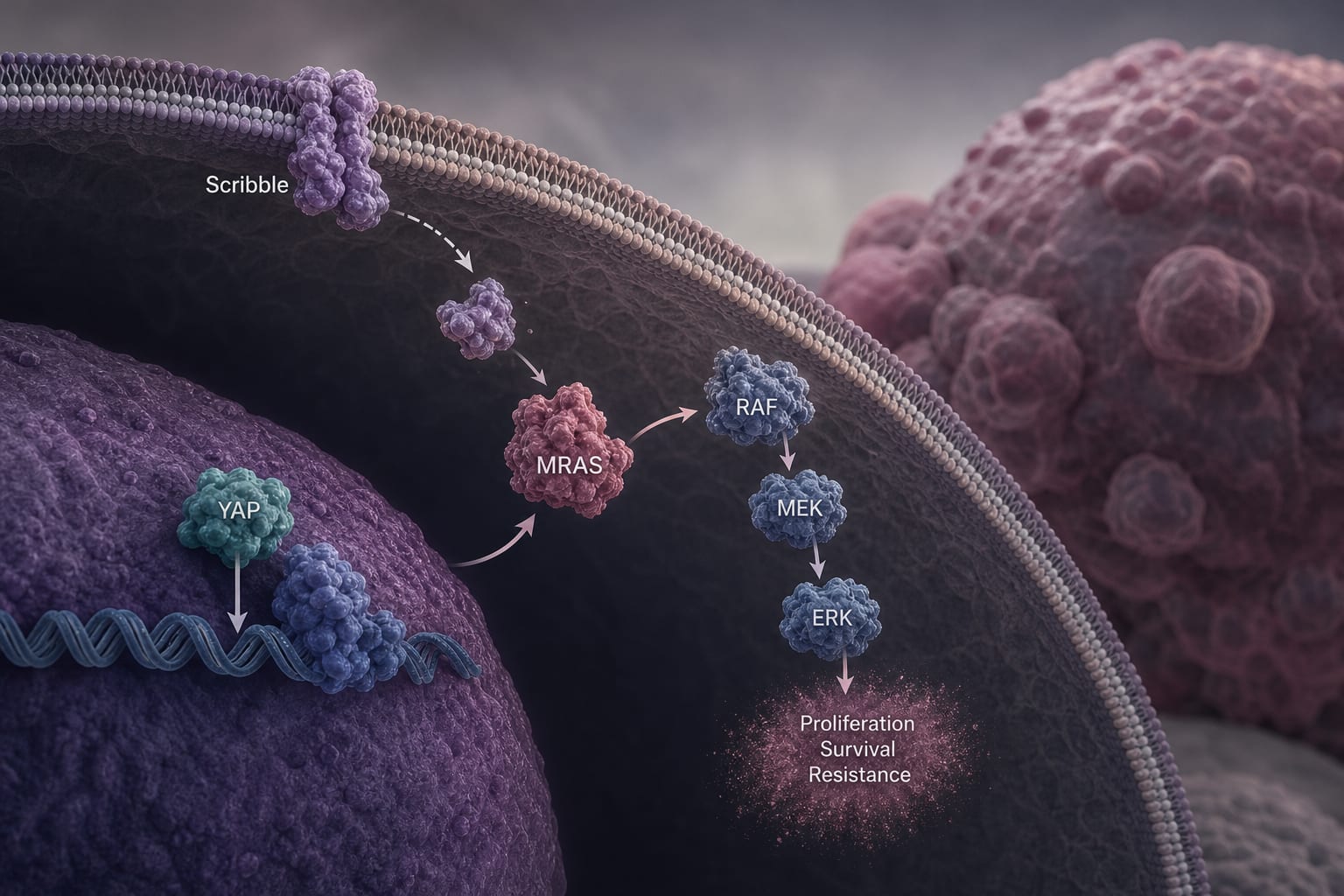
| Spatially confined IL-12 CAR-NK | Engineered CAR-NK platform; supplied article excerpt is incomplete | IL-12 signaling was reported to sustain mTORC1 activity through Ras-ERK and PI3K pathways and to promote metabolic fitness, autonomous expansion, and sustained effector function. IL-12 also activated bystander NK cells, T cells, and macrophages. |
Key Findings
- In del(17p) multiple myeloma models, PKMYT1 was identified as a potential therapeutic target; RP-6306 inhibition preferentially killed del(17p) cells while largely sparing del(17p)-negative cells and healthy cells.
- In xenograft and TP53-deficient syngeneic models, RP-6306 reduced tumor burden and extended survival.
- The phase 1 venetoclax–inotuzumab study enrolled 23 adults with relapsed or refractory CD22-positive ALL/LBL; 21 of 22 evaluable patients achieved complete remission, including 19 after one cycle.
- MRD cleared in 16 of 18 patients assessed by flow cytometry and 14 of 19 assessed by next-generation sequencing; 14 patients proceeded to hematopoietic stem-cell transplantation.
- Reported toxicities included grade 3 thrombocytopenia in 43.5%, grade 3 neutropenia in 39.1%, and sinusoidal obstructive syndrome in four patients (17.4%); no dose-limiting toxicities or early mortality occurred.
- The CAR-NK study reported that IL-12 signaling supported mTORC1 activity and activated bystander immune cells; the supplied excerpt does not include the complete study results or clinical outcomes.
Clinical Implications
The source describes PKMYT1 inhibition as a potential biomarker-driven strategy for del(17p) or TP53-deficient multiple myeloma, based on preclinical findings rather than reported clinical testing. The venetoclax–inotuzumab results are from a phase 1 trial and include both high remission rates and clinically relevant toxicities, including sinusoidal obstructive syndrome. The CAR-NK findings are mechanistic research, and the supplied excerpt does not establish clinical efficacy or safety.
Conclusion
The newsletter reports preclinical target-validation work in high-risk multiple myeloma, early clinical results for venetoclax plus inotuzumab in relapsed or refractory ALL/LBL, and engineered CAR-NK research. The available text supports describing these findings at their reported preclinical, phase 1, and mechanistic stages.
Related Resources & Content
- Dana-Farber Cancer Institute, Dana-Farber Research News, 2026 — October 15, 2026 issue (source text supplied)
- Luskin MR et al., Blood, 2026 — Venetoclax plus Inotuzumab Ozogamicin for Relapsed and Refractory Acute Lymphoblastic Leukemia
- Schavgoulidze A et al., Blood, 2026 — PKMYT1 is a Targetable Vulnerability in Del(17p) High-Risk Multiple Myeloma
- Tarannum M et al., Cancer Discovery, 2026 — Spatially Confined IL-12 Programs CAR-NK Through mTORC1 to Coordinate Antitumor Immune Networks
- dana-farber — Dana-Farber Research News 04.15.2026
- dana-farber — Dana-Farber Research News 02.15.2026
- dana-farber — Dana-Farber Research News 12.15.2025
- dana-farber — Dana-Farber Research News 07.01.2025
- ASCO Guidelines: Current
- Phase III TAISHAN-302 Trial Shows Tam-Peli Significantly Improves Survival in Relapsed Small-Cell Lung Cancer | IASLC
- High-Risk Melanoma Personalized mRNA Vaccine Plus Immunotherapy Reduces Risk of Recurrence After Surgery | The ASCO Post
- Oncology (Cancer)/Hematologic Malignancies Approval Notifications | FDA
Based on findings from:
Dana-Farber Research News 10.15.2026
Dana-Farber, 2026.
https://physicianresources.dana-farber.org/news/dana-farber-research-news-10-15-2026
This content is an AI-generated, fully rewritten summary based on a published scholarly article. It does not reproduce the original text and is not a substitute for the original publication. Readers are encouraged to consult the source for full context, data, and methodology.