Common and rare variants in complement genes as biomarkers of COVID-19 infection and severity. A lesson to learn for emerging pathogens - Report - MDSpire
Clinical Report: Genetic Variants in Complement Pathway Genes and COVID-19
Overview
Revise to include the significance of the genetic associations and their implications for understanding COVID-19 severity.
Background
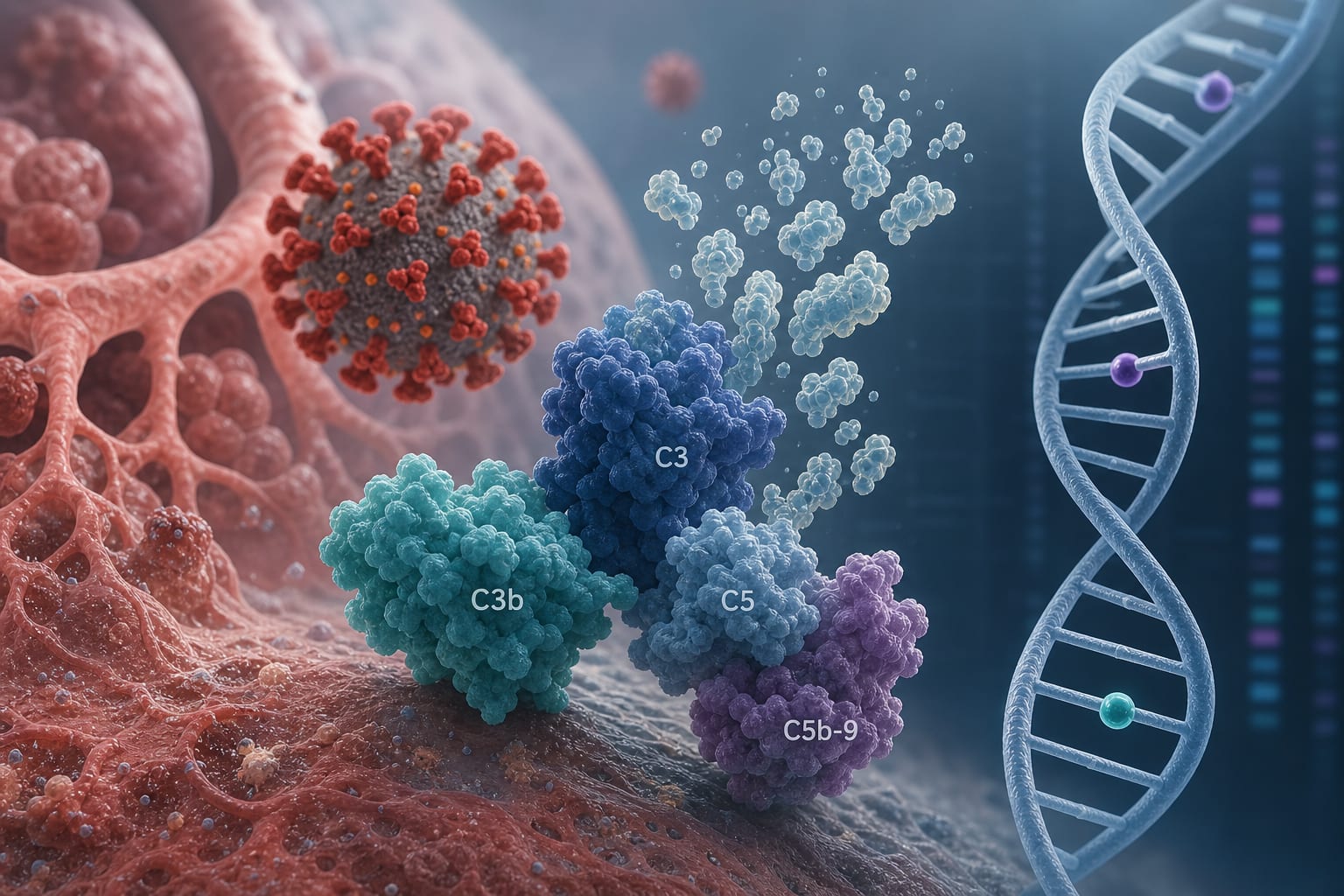
The COVID-19 pandemic has underscored the importance of understanding host factors that influence disease severity. Genetic variants affecting the complement system, a critical component of innate immunity, may play a significant role in modulating responses to SARS-CoV-2 infection. Investigating these variants could provide insights into susceptibility and inform future therapeutic strategies.
Data Highlights
Gene
Polymorphism
Association
CFHR4
rs7417769 (p.N209S)
Protection against ARDS
CFH
rs1061170 (p.Y402H)
Protection against ARDS
C3
rs2230199 (p.R102G)
Correlated with low C3 levels
MASP2
rs7255087 (p.D120G)
Correlated with high C3 levels
C1R
rs117402032
Over-represented in severe cases
C8A
rs143523574
Over-represented in severe cases
Key Findings
CFHR4 rs7417769 and CFH rs1061170 polymorphisms are associated with protection against ARDS.
C3 rs2230199 and MASP2 rs7255087 polymorphisms correlate with C3 levels.
Increased frequency of C1R and C8A polymorphisms suggests a link between defective complement activation and SARS-CoV-2 infection rates.
Common variants in complement genes may modulate susceptibility to severe COVID-19 and its complications.
Identified genetic biomarkers could aid in preparedness for future infectious threats.
Clinical Implications
Understanding the role of complement pathway genetic variants may help identify individuals at higher risk for severe COVID-19. This knowledge could inform targeted interventions and enhance preparedness for future pandemics by identifying potential biomarkers for susceptibility.
Conclusion
Strengthen the call for further research and clinical application of the findings.
by María Eugenia De La Morena-Barrio, Ana Van Den Rym, Olga Escorial Sanz, Fernando Corvillo, Rosario García-Sánchez, Laura González-Sánchez, Adrián Muñoz-Barrera, Rafaela González-Montelongo, José Miguel Lorenzo-Salazar, Carlos Flores, Ana de Andrés-Martín, Carlos Rodríguez-Gallego, Luis Allende, Laia Alsina, Silvia Sánchez-Ramón, Eduardo López-Collazo, Margarita López-Trascasa, Pilar Sánchez-Corral, Rebeca Pérez de Diego, Javier Corral de la Calle, Alberto López-Lera