Distribution of Big Tau Isoforms in the Human Central and Peripheral Nervous System - Report - MDSpire

Distribution Patterns of Big Tau Isoforms in Human Central and Peripheral Nervous Systems

  • By

  • Rama Krishna Koppisetti

  • Nicolas R. Barthélemy

  • Kanta Horie

  • Cindy V. Ly

  • Kaleigh F. Roberts

  • Srinivas Koutarapu

  • Richard J. Perrin

  • Erin E. Franklin

  • Chiara Pedicone

  • Joshua Orrick

  • Justin Melendez

  • Timothy M. Miller

  • Chihiro Sato

  • Nupur Ghoshal

  • Alison M. Goate

  • Celeste M. Karch

  • Randall J. Bateman

  • Soumya Mukherjee

  • July 19, 2026

Share

Distribution Patterns of Big Tau Isoforms in Human Central and Peripheral Nervous Systems

Background

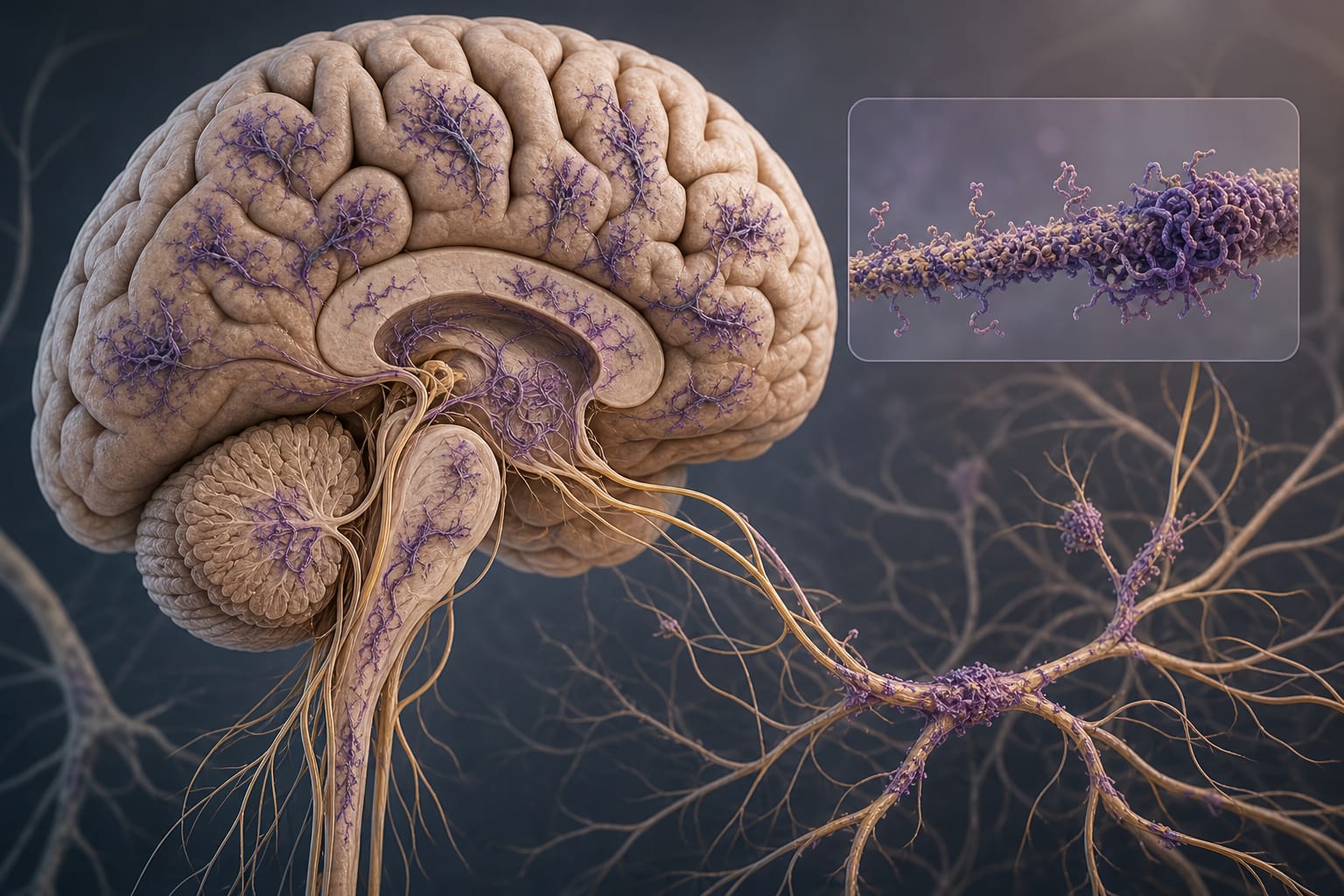
Neurofibrillary tangles composed of tau protein are key pathological features of Alzheimer's disease, closely linked to cognitive impairment. Understanding tau isoforms, particularly their distribution in the central and peripheral nervous systems, is crucial. The presence of tau in both cerebrospinal fluid and plasma complicates the interpretation of these biomarkers.

Data Highlights

No numerical data or trial data presented in the source material.

Key Findings

  • Big tau isoforms result from an exon insertion in tau transcripts, significantly increasing the length of the projection domain.
  • Big tau is expressed in both the peripheral nervous system and specific regions of the spinal cord and brain-stem.
  • Developmental regulation of big tau expression begins late in embryonic stages and increases postnatally.
  • Disruption of the normal tau isoform ratio is a hallmark of several tauopathies.
  • Characterizing PNS-specific tau isoforms may enhance the specificity of tau-based biomarkers for neurodegenerative disorders.

Clinical Implications

Distinguishing between CNS-derived and peripheral tau isoforms could improve the specificity of biomarkers used in diagnosing Alzheimer's disease and other neurodegenerative disorders.

Conclusion

Characterizing big tau isoforms is essential for understanding tau biology and its implications in neurodegenerative diseases.

Related Resources & Content

  1. Acta Neuropathologica, 2017 -- The Function of Tau Protein in Health and Disease States
  2. Acta Neuropathologica, 2020 -- Physiological Functions of Tau and Aβ: Insights into Alzheimer’s Disease Pathogenesis and Treatment Strategies
  3. Acta Neuropathologica, 2019 -- Transitioning from the Prion-Like Propagation Theory to Anti-Tau Immunotherapy Approaches
  4. Acta Neuropathologica, 2022 -- Classification of Pathogenic Forms of Tau, α-Synuclein, and TDP-43: An Ultrastructural and Biochemical Approach
  5. Alzheimer's Association Workgroup, PMC, 2024 -- Revised criteria for diagnosis and staging of Alzheimer's disease
  6. Alzheimer's Association, 2025 -- Clinical Practice Guideline on the use of blood‐based biomarkers in the diagnostic workup of suspected Alzheimer's disease
  7. Alzheimer's Association and SNMMI, 2025 -- Updated Appropriate Use Criteria for Amyloid and Tau PET
  8. ScienceDirect, 2025 -- Blood phosphorylated tau for the diagnosis of Alzheimer's disease: a systematic review and meta-analysis
  9. Revised criteria for diagnosis and staging of Alzheimer's disease: Alzheimer's Association Workgroup - PMC
  10. Alzheimer's Association Clinical Practice Guideline on the use of blood‐based biomarkers in the diagnostic workup of suspected Alzheimer's disease within specialized care settings - Palmqvist - 2025 - Alzheimer's & Dementia - Wiley Online Library
  11. Updated Appropriate Use Criteria for Amyloid and Tau PET: A Report from the Alzheimer’s Association and Society for Nuclear Medicine and Molecular Imaging Workgroup
  12. Blood phosphorylated tau for the diagnosis of Alzheimer's disease: a systematic review and meta-analysis - ScienceDirect
  13. Diagnostic performance of plasma p-Tau217, p-Tau181, and p-Tau231 across the Alzheimer's disease continuum: a network meta-analysis - PubMed
  14. Plasma phospho-tau217 for Alzheimer’s disease diagnosis in primary and secondary care using a fully automated platform | Nature Medicine
  15. Donanemab treatment effect by baseline tau burden and disease severity: Observations from the TRAILBLAZER-ALZ 2 trial - PubMed
  16. Updated Appropriate Use Criteria for Amyloid and Tau PET: A Report from the Alzheimer’s Association and Society for Nuclear Medicine and Molecular Imaging Workgroup | Journal of Nuclear Medicine

Original Source(s)

Related Content