Machine learning integration of routine inflammatory biomarkers for predicting remote punctate ischemic lesions following intracerebral hemorrhage: a single-center retrospective study - Report - MDSpire
Advertisement
Machine learning integration of routine inflammatory biomarkers for predicting remote punctate ischemic lesions following intracerebral hemorrhage: a single-center retrospective study
Clinical Report: Utilizing Machine Learning with Standard Inflammatory Biomarkers
Overview
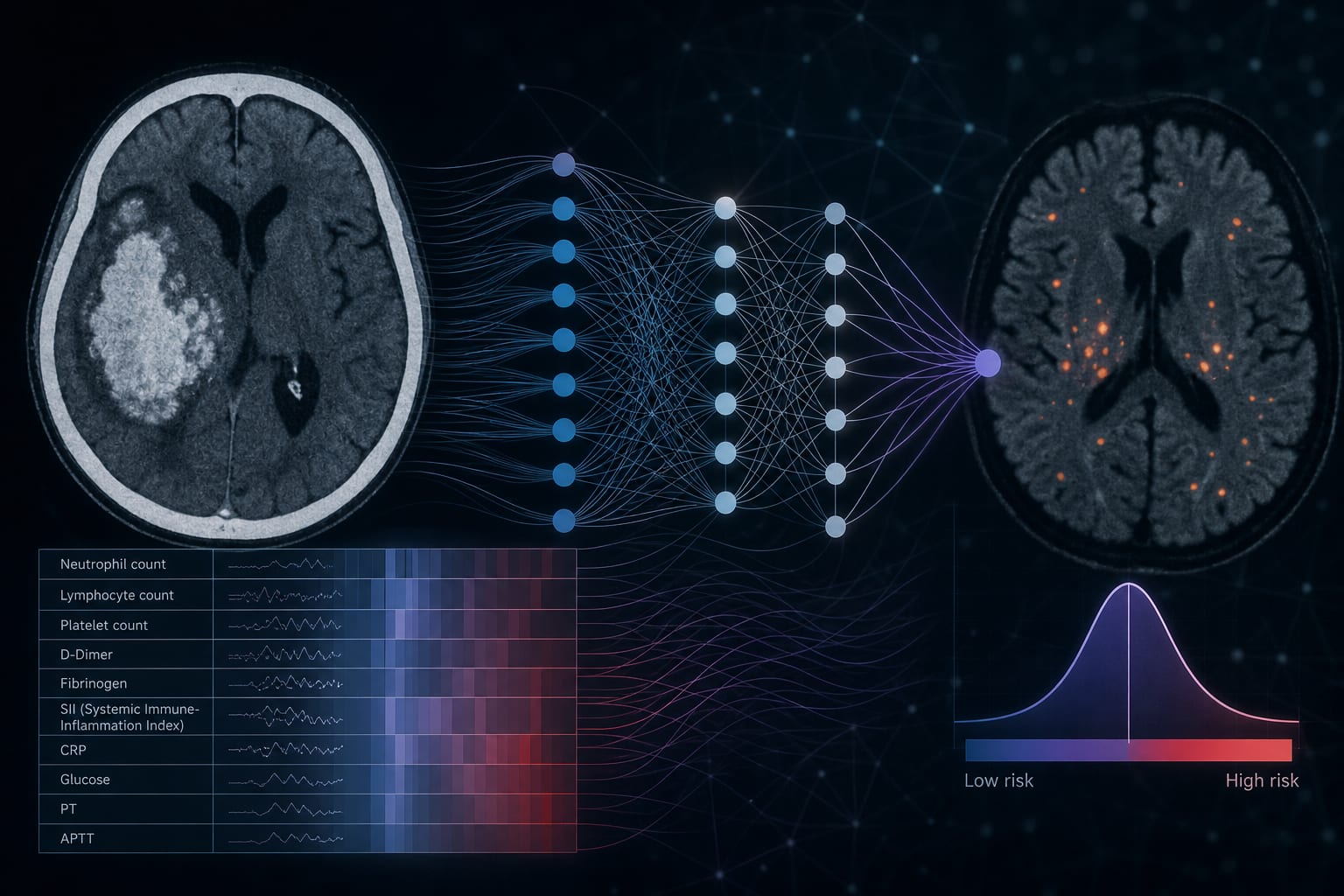
This study demonstrates the predictive utility of machine learning models, particularly XGBoost, in forecasting Remote Punctate Ischemic Lesions (RPIL) after intracerebral hemorrhage (ICH) using inflammatory biomarkers. Key predictors identified include the Systemic Immune-Inflammation Index (SII) and other clinical factors.
Background
Intracerebral hemorrhage (ICH) accounts for a significant proportion of strokes and is associated with high morbidity and mortality. The development of Remote Punctate Ischemic Lesions (RPIL) during ICH hospitalization complicates patient outcomes. Understanding the predictors of RPIL is crucial for improving patient management and outcomes.
Data Highlights
Model
AUC
XGBoost
0.799
Neural Network
0.798
Logistic Regression
0.770
Key Findings
Six key predictors for RPIL were identified: Age, History of Diabetes, SII, D-Dimer, Glucose, and Fibrinogen.
XGBoost achieved the highest discrimination with an AUC of 0.799.
The derived nomogram showed excellent calibration with a Mean Absolute Error of 0.034.
Inflammatory and coagulation markers were confirmed as top-tier predictors of post-ICH ischemia.
The study emphasizes the need for multicenter validation to confirm the generalizability of the findings.
Clinical Implications
The findings suggest that incorporating machine learning models can enhance the prediction of RPIL in ICH patients. Clinicians may consider using the identified biomarkers for risk stratification in acute care settings.
Conclusion
The study presents a machine learning framework that effectively predicts RPIL after ICH, highlighting the role of systemic inflammation and hypercoagulability.