Role of Insulin-like Growth Factor Binding Proteins in Metabolic Dysfunction-Related Steatotic Liver Disease
-
By
-
Kuo Fang
-
Ji Miao
-
Guobin Song
-
June 5, 2026
Clinical Report: Role of Insulin-like Growth Factor Binding Proteins in Metabolic Dysfunction-Related Steatotic Liver Disease
Overview
This report reviews the role of insulin-like growth factor binding proteins (IGFBPs) in metabolic dysfunction-associated steatotic liver disease (MASLD). It highlights their dual roles in metabolic protection and potential pathogenic effects, emphasizing their relevance as biomarkers and therapeutic targets.
Background
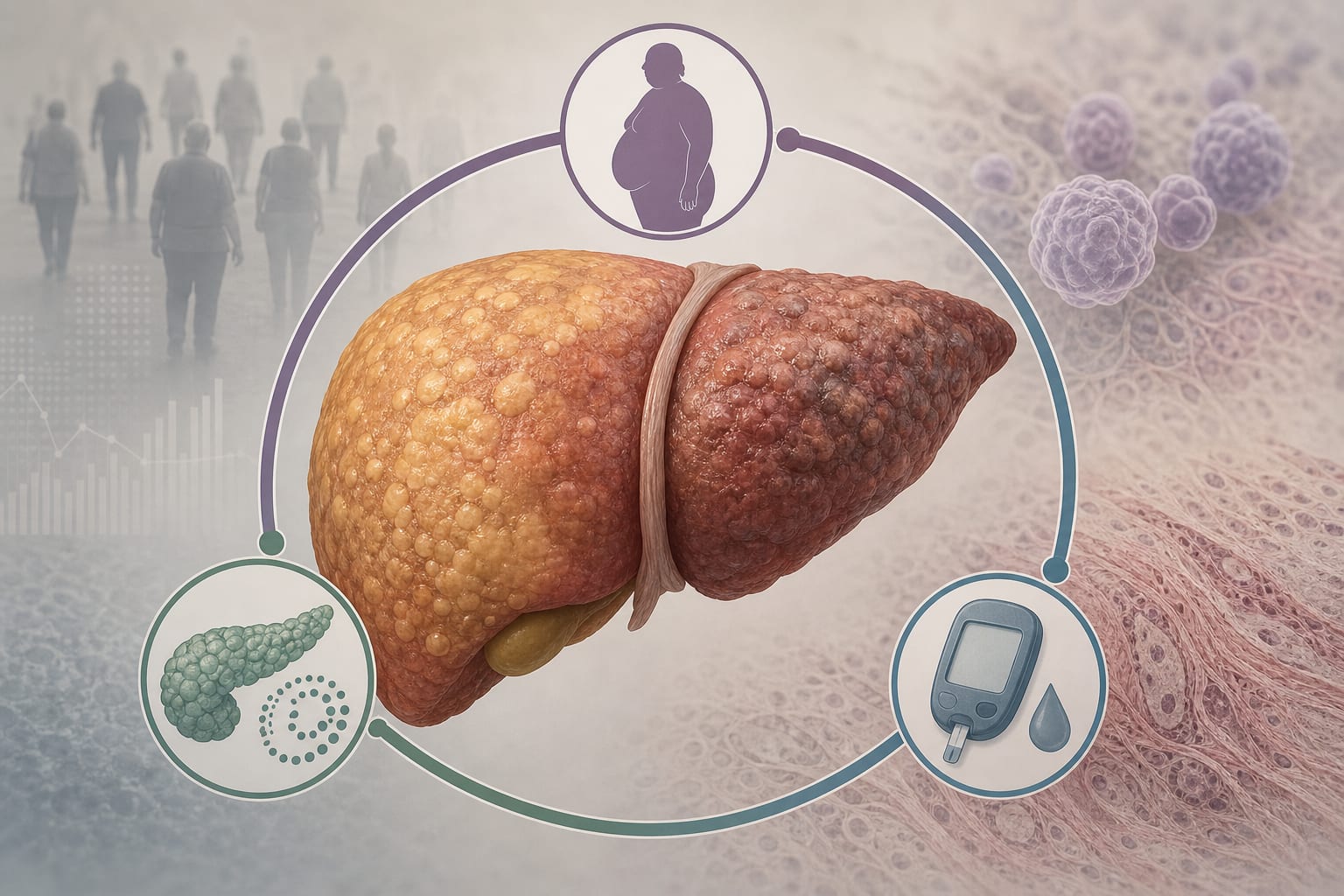
Metabolic dysfunction-associated steatotic liver disease (MASLD) is a prevalent condition that can progress to severe liver complications, including cirrhosis and hepatocellular carcinoma. The rising incidence of MASLD is closely linked to increasing rates of obesity and type 2 diabetes, making it a significant public health concern. Understanding the molecular mechanisms, including the role of IGFBPs, is crucial for developing effective interventions.
Data Highlights
No numerical data or trial data were provided in the source material.
Key Findings
- IGFBP1 and IGFBP2 promote lipid oxidation and increase insulin sensitivity.
- IGFBP3 and IGFBP5 restrain lipogenesis at early stages but promote hepatocellular injury during fibrosis.
- IGFBP7 impairs insulin signaling and drives fibrosis through ferroptosis.
- IGFBP4 and IGFBP6 are less characterized but may have roles in MASLD.
- IGFBPs can serve as potential biomarkers for disease staging and therapeutic targets.
Clinical Implications
The findings suggest that IGFBPs could be utilized as biomarkers for assessing the progression of MASLD. Additionally, targeting specific IGFBPs may offer new therapeutic strategies for managing this disease.
Conclusion
The review underscores the complex roles of IGFBPs in MASLD, highlighting their potential as both biomarkers and therapeutic targets in the management of this increasingly prevalent condition.
Related Resources & Content
- Frontiers | Insulin-like growth factor binding proteins in metabolic dysfunction-associated steatotic liver disease, 2026 -- Role of Insulin-like Growth Factor Binding Proteins in Metabolic Dysfunction-Related Steatotic Liver Disease
- Archives of Toxicology — Free Fatty acid-induced disruption of hepatic vitamin D metabolism impairs bone homeostasis in an in vitro 3D human liver–bone model
- Frontiers in Medicine — The role of mitochondrial dynamics in metabolic dysfunction–associated steatotic liver disease
- Frontiers in Pediatrics — Gut microbiota and pediatric metabolic dysfunction–associated steatotic liver disease: clinical evidence and therapeutic implications
- Frontiers in Medicine — The immunometabolic mechanisms and therapeutic targets of metabolic dysfunction-associated steatohepatitis
- Clinical care pathway for the risk stratification and management of patients with MASLD - American Gastroenterological Association
- Evidence-based clinical practice guidelines for metabolic dysfunction-associated steatotic liver disease (MASLD) 2026 | Journal of Gastroenterology | Springer Nature Link
- A Phase 3, Randomized, Controlled Trial of Resmetirom in NASH with Liver Fibrosis | New England Journal of Medicine
- Frontiers | Insulin-like growth factor binding proteins in metabolic dysfunction-associated steatotic liver disease
- Serum insulin-like growth factor binding protein 2 is associated with hepatic steatosis in adults with metabolic dysfunction-associated steatotic liver disease - ScienceDirect
This content is an AI-generated, fully rewritten summary based on a published scholarly article. It does not reproduce the original text and is not a substitute for the original publication. Readers are encouraged to consult the source for full context, data, and methodology.