Management of Percutaneous Cholecystostomy Drains: A Consensus Statement - Report - MDSpire

Management of Percutaneous Cholecystostomy Drains: A Consensus Statement

  • By

  • Mohammed Al Azzawi

  • Carolyn Cullinane

  • Michael Devine

  • Conor Toale

  • Stephen O’Brien

  • Matthew Davey

  • Czara Kennedy

  • Aine O’Neill

  • Nicola Raftery

  • Eanna James Ryan

  • Noel Donlon

  • Jessie A. Elliott

  • William B. Robb

  • Arnold D. K. Hill

  • Jarlath Bolger

  • Irish Surgical Research Collaborative Group—Percutaneous Drainage Delphi Expert Panel

  • Mahmoud Abdelmoeiti

  • Mohammed Al Kayal

  • Mayilone Arumugasamy

  • Chwanrow Baban

  • Kevin Barry

  • Ian Brennan

  • Abeeda Butt

  • Paul Caroll

  • Liam Devane

  • Claire Donohoe

  • Christina Fleming

  • Niamh Foley

  • Sean Johnston

  • Dara Kavanagh

  • David Kearney

  • Michael Kerin

  • Noel Lynch

  • Graeme MacAulay

  • Achille Mastrosimone

  • Niamh McCawley

  • Orla McCormack

  • Mcgrath Andrew

  • Etain McGuinness

  • Deborah McNamara

  • Dough Mullholland

  • Brenda Murphy

  • Thomas Murphy

  • Peter Neary

  • Damien O'Neill

  • Cristoir O’Sullibhean

  • Adrian O’Sullivan

  • Samir Pathak

  • Colin Peirce

  • Paul Ridgway

  • Andrew G Robertson

  • Kevin P Sheahan

  • Mark Sheehan

  • Bohdan Smajer

  • Anthony Stafford

  • Michael Sugrue

  • Shibojit Talukder

  • June 5, 2026

  • 0 min

Share

Clinical Report: Guidelines for the Management of Percutaneous Cholecystostomy Tubes

Overview

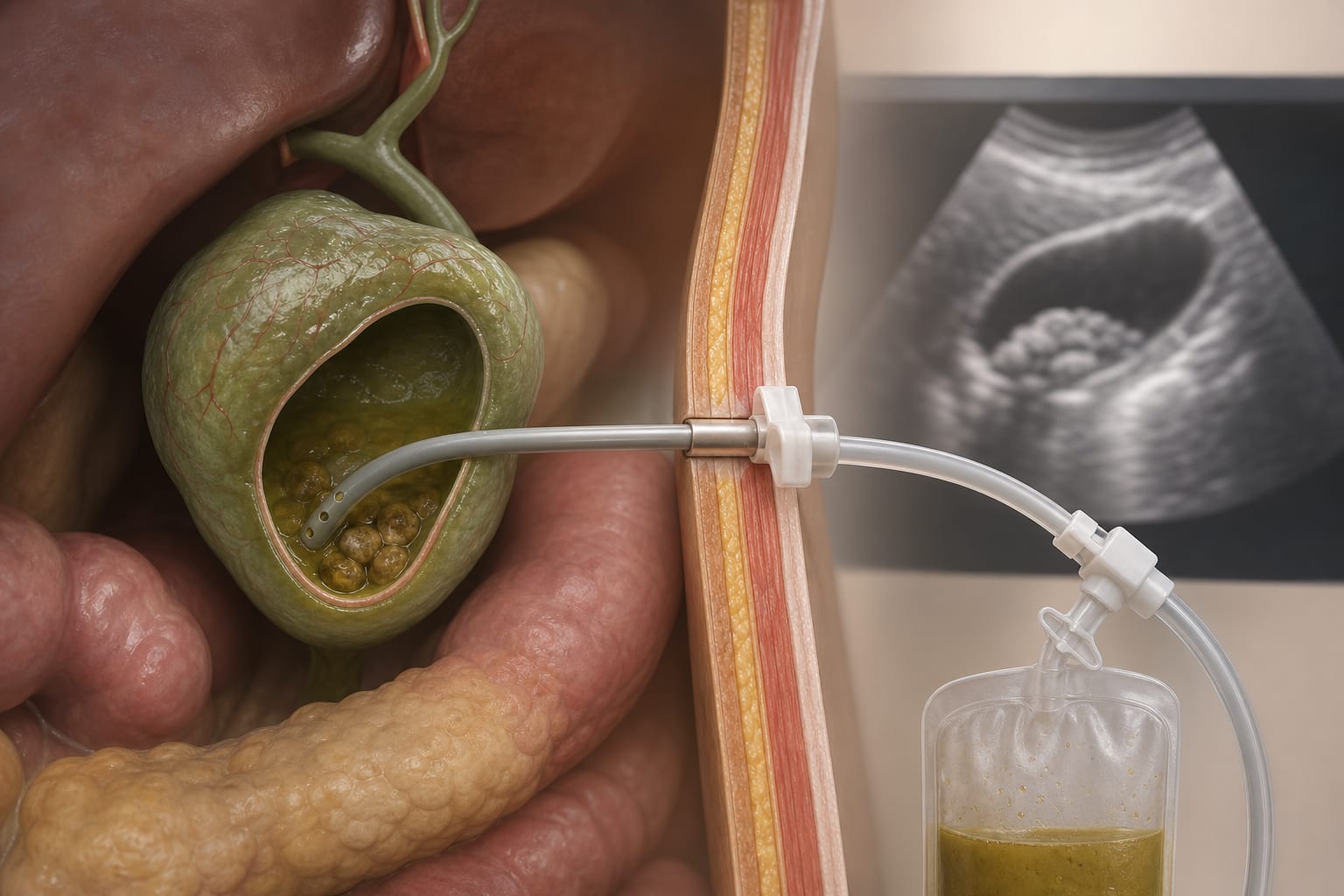
This report presents guidelines developed through a Delphi consensus process for the management of percutaneous cholecystostomy tubes (PCDs) in patients with acute cholecystitis. The guidelines address indications, management, and follow-up for PCDs.

Background

Acute cholecystitis is a prevalent surgical condition often requiring intervention. While laparoscopic cholecystectomy is the gold standard for stable patients, percutaneous cholecystostomy serves as an alternative for those unfit for surgery. The absence of established guidelines for PCD management has led to variability in clinical practice.

Data Highlights

No numerical data was provided in the article.

Key Findings

  • The Delphi consensus process involved experts from Ireland and the UK to develop guidelines for PCD management.
  • Consensus was achieved when agreement exceeded 80% on various statements regarding PCD use.
  • Three main categories were established: indications and initial management, follow-up imaging and duration of drainage, and timing of PCD removal.
  • PCDs are indicated for patients with severe cholecystitis who are not surgical candidates.

Clinical Implications

Clinicians should familiarize themselves with these guidelines to ensure consistent care for patients with acute cholecystitis.

Conclusion

The development of these guidelines through expert consensus provides a structured approach to managing PCDs.

Related Resources & Content

  1. Irish Surgical Research Collaborative, Surgical Endoscopy, 2024 -- Guidelines for the Management of Percutaneous Cholecystostomy Tubes: A Consensus Overview
  2. The New Gastroenterologist — Minimally Invasive Approaches to Treating Benign Gallbladder Disorders
  3. Identification of Risks and Surgical Adjustments Decrease the Rate of Bile Leakage After Laparoscopic Cholecystectomy: A Study of 5,675 Cases
  4. Journal of Gastroenterology (Springer) — Evolution of gallbladder drainage: a comprehensive review from percutaneous to endoscopic ultrasound-guided approaches
  5. Tokyo Guidelines 2018: management strategies for gallbladder drainage in patients with acute cholecystitis
  6. Laparoscopic cholecystectomy versus percutaneous catheter drainage for acute cholecystitis in high risk patients (CHOCOLATE)
  7. Postinsertion Management of Cholecystostomy Tubes for Acute Cholecystitis: A Systematic Review - PubMed

Original Source(s)

Related Content