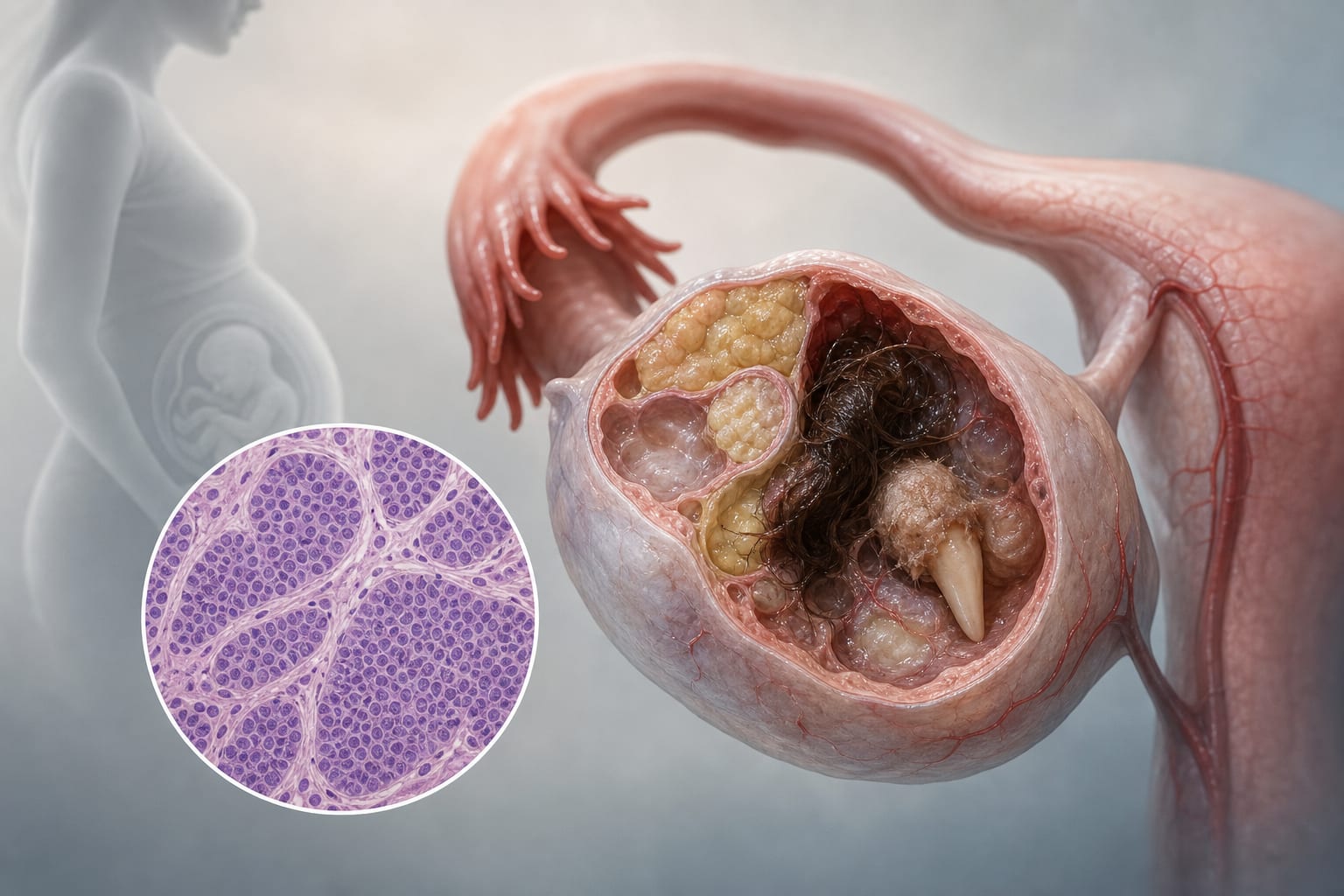
Clinical Report: Hidden Ovarian Carcinoid Tumor Detected During Pregnancy
Overview
This report presents a rare case of an ovarian carcinoid tumor discovered incidentally during a cesarean section in a pregnant woman. The patient underwent subsequent laparoscopic surgery with favorable maternal and neonatal outcomes, highlighting the diagnostic challenges and management strategies for such tumors during pregnancy.
Background
Ovarian carcinoid tumors are rare neuroendocrine neoplasms, particularly during pregnancy, where they pose significant diagnostic challenges. The incidence of ovarian tumors in pregnant women is low, and carcinoid tumors are often asymptomatic and undetectable through standard prenatal imaging. Understanding the clinical features and management of these tumors is crucial for improving outcomes for both mothers and infants.
Data Highlights
No numerical data or trial data was presented in the article.
Key Findings
Ovarian carcinoid tumors are often associated with mature cystic teratomas.
In this case, the tumor was undetectable on prenatal ultrasounds due to its location and characteristics.
The carcinoid focus measured only 1.2 mm, contributing to its occult nature.
The patient underwent successful laparoscopic adnexectomy with no evidence of residual tumor postoperatively.
Maternal and neonatal outcomes were favorable, with no recurrence observed during 18 months of follow-up.
Clinical Implications
Healthcare providers should maintain a high index of suspicion for rare tumors like ovarian carcinoids in pregnant patients, especially when standard imaging fails to reveal abnormalities. Timely surgical intervention is critical and should not be delayed based on gestational age, ensuring both maternal and fetal safety.
Conclusion
This case underscores the importance of awareness and prompt management of rare ovarian tumors during pregnancy, which can lead to favorable outcomes for both mother and child.
Akeso’s PD-1/VEGF bispecific beats PD-1 plus chemo in lung cancer, Amgen wins EC approval for its DLL3-targeted T-cell engager, and Aragen scales Renaissance’s Fast Track anti-GD2 antibody