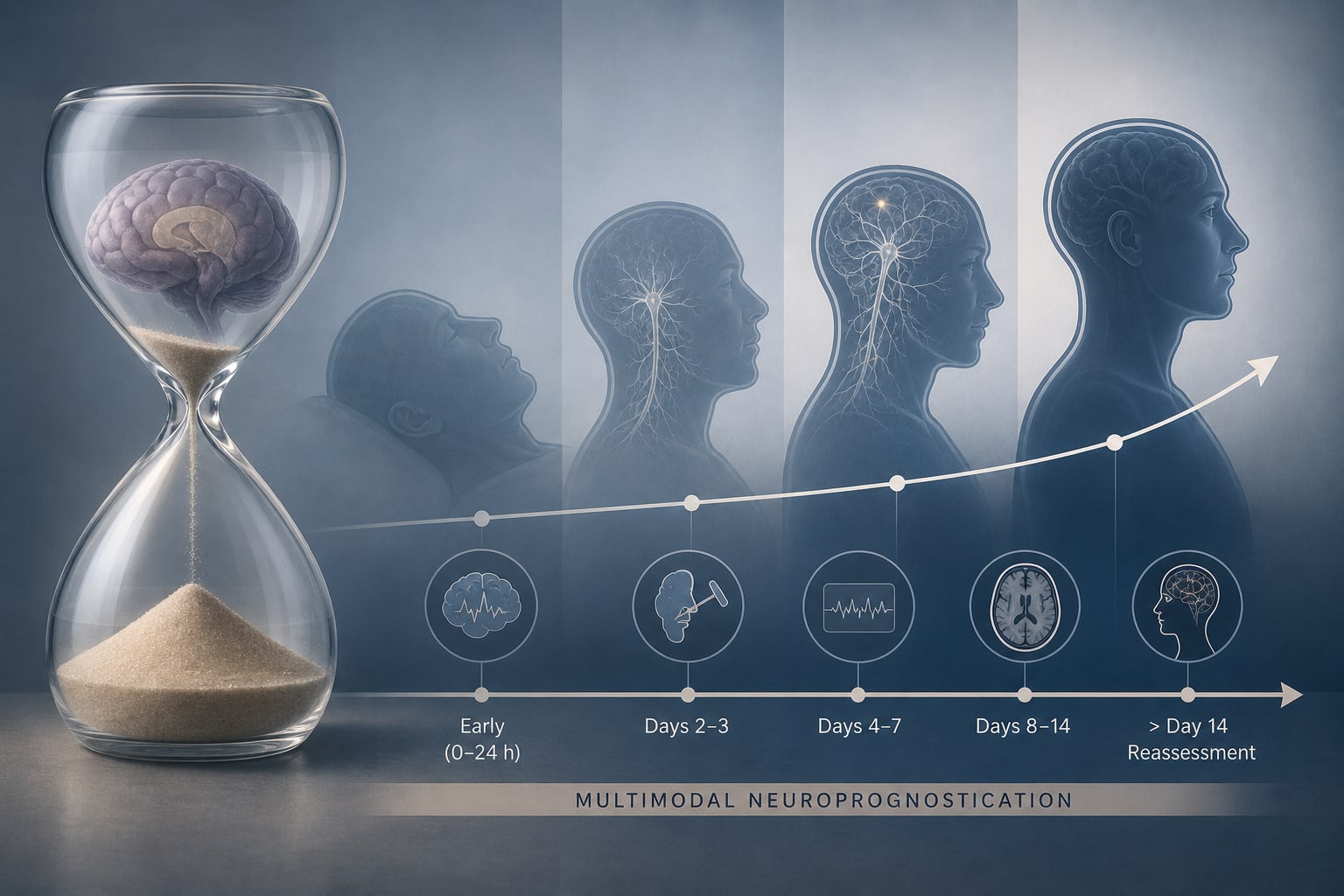
Reassessing Neuroprognostic Indicators Following Cardiac Arrest: Addressing Temporal Factors and the Challenge of Eliminating False Positives
-
By
-
Li-Xia Xu
-
August 21, 2026
Clinical Report: Reassessing Neuroprognostic Indicators Following Cardiac Arrest
Background
Neuroprognostication after cardiac arrest is critical for guiding clinical decisions regarding life-sustaining therapies. Accurate prognostic indicators can help minimize false positives, which may lead to inappropriate withdrawal of life support.
Data Highlights
No numerical data was provided in the source material.
Key Findings
- Reassessment of neuroprognostic markers over 14 days can reduce false-positive rates.
- Substituting initial assessments for final measurements increased false-positive rates for pupillary and corneal reflexes and EEG.
- Temporal evolution of markers may convey additional prognostic information beyond initial assessments.
- Zero false positives were observed among patients with at least two unfavorable markers at day 14, but this does not guarantee a true false-positive rate below 10%.
- Confidence intervals for specificity should be reported to clarify uncertainty in prognostic predictions.
Clinical Implications
Clinicians should consider the timing of neuroprognostic assessments when making decisions about life-sustaining therapies. A dynamic approach that accounts for the evolution of neurophysiological markers may enhance prognostic accuracy.
Conclusion
The findings emphasize the need for careful interpretation of neuroprognostic indicators over time to improve decision-making in post-cardiac arrest care.
Related Resources & Content
- Goetze et al., Neuroprognostication after cardiac arrest, 2023 -- Reassessing Neuroprognostic Indicators Following Cardiac Arrest
- Intensive Care Medicine, 2020 -- Forecasting Adverse Neurological Outcomes in Comatose Cardiac Arrest Survivors: A Comprehensive Review
- Intensive Care Medicine, 2022 -- Forecasting Favorable Neurological Recovery in Comatose Cardiac Arrest Survivors: A Comprehensive Review
- Critical Care, 2025 -- The Role of Continuous EEG Monitoring in Predicting Outcomes for Postanoxic Coma: Significance of Timing After Cardiac Arrest
- American Heart Association, 2025 -- Post-Cardiac Arrest Care
- European Resuscitation Council and European Society of Intensive Care Medicine, 2025 -- Post-Resuscitation Care
- Intensive Care Medicine — Serum Indicators of Cerebral Injury Forecast Favorable Neurological Recovery Following Out-of-Hospital Cardiac Arrest
- Part 11: Post-Cardiac Arrest Care | American Heart Association CPR & First Aid
- European Resuscitation Council and European Society of Intensive Care Medicine Guidelines 2025 Post-Resuscitation Care
- Neuroprognostication after cardiac arrest in patients without withdrawal of life-sustaining therapy: a prospective observational multicenter study - PubMed
Based on findings from:
Neuroprognostication after cardiac arrest: time-anchored reassessment and uncertainty around zero false positives
Li-Xia Xu. Critical Care, 2026.
https://link.springer.com/article/10.1186/s13054-026-06281-6
This content is an AI-generated, fully rewritten summary based on a published scholarly article. It does not reproduce the original text and is not a substitute for the original publication. Readers are encouraged to consult the source for full context, data, and methodology.