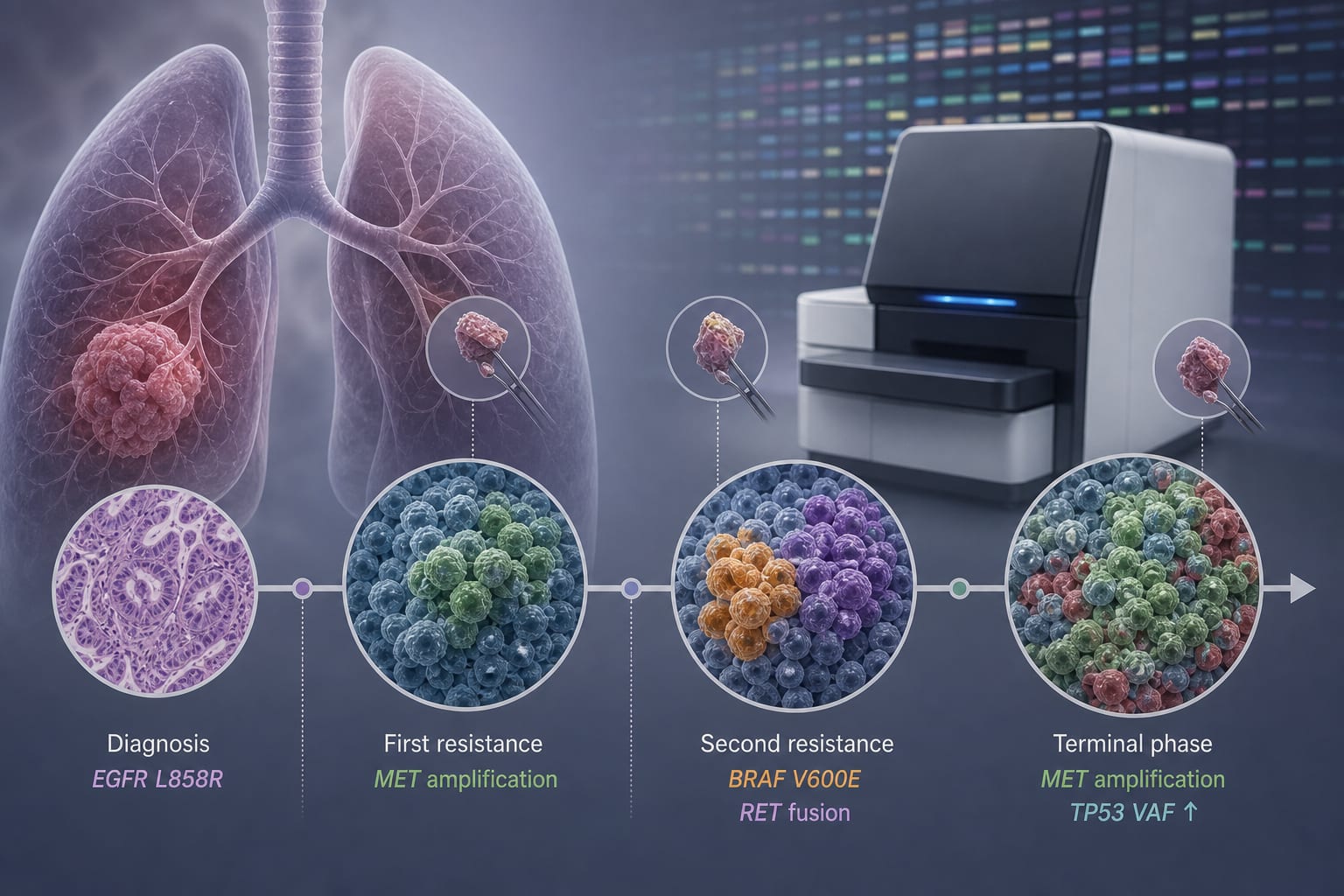
Evolving Clonal Resistance Mechanisms in EGFR-Mutant Lung Adenocarcinoma: Insights from a Case Study
-
By
-
Qingyun Zhang
-
Xiaoyan Yin
-
September 9, 2026
Clinical Report: Evolving Clonal Resistance Mechanisms in EGFR-Mutant Lung Adenocarcinoma
Background
Lung adenocarcinoma is the most prevalent subtype of non-small cell lung cancer (NSCLC), with EGFR mutations being a significant driver of tumorigenesis. Third-generation EGFR tyrosine kinase inhibitors (EGFR-TKIs) have improved patient outcomes, yet acquired resistance remains a major challenge. Understanding the mechanisms of resistance is crucial for optimizing treatment.
Data Highlights
No numerical data or trial data provided in the source material.
Key Findings
- A 62-year-old man with EGFR L858R mutation developed multiple bypass resistance mechanisms during treatment.
- Resistance mechanisms included MET amplification, BRAF V600E mutation, and RET fusion.
- Dynamic next-generation sequencing revealed a sequential trajectory of resistance clone evolution.
- Genotype-guided treatment modifications led to an 11-month progression-free survival with aumolertinib plus savolitinib.
- Subsequent treatment with selpercatinib and chemotherapy resulted in transient disease stabilization.
- The patient died from complications related to progressive disease.
Clinical Implications
The case highlights the necessity of serial biopsies and next-generation sequencing to monitor resistance evolution in patients with EGFR-mutant lung adenocarcinoma.
Conclusion
This case illustrates the complexity of resistance mechanisms in EGFR-mutant lung adenocarcinoma.
Related Resources & Content
- Frontiers in Oncology, 2026 -- Emergence of EML4-ALK Fusion and BRAF V600G Dual Pathway Activation After Osimertinib Resistance in Lung Adenocarcinoma: A Case Study of Successful Lorlatinib Treatment
- Frontiers in Oncology, 2026 -- Case Report: Personalized treatment in an advanced lung adenocarcinoma patient with EGFR exon 21 L858R mutations based on the patient-derived tumor organoids
- The ASCO Post, 2022 -- Acquired EGFR Inhibitor Resistance Alterations Identified in ctDNA Analysis in Patients With Refractory Metastatic Colorectal Cancer
- Survival with Osimertinib plus Chemotherapy in EGFR-Mutated Advanced NSCLC | New England Journal of Medicine
- Navigating the landscape of EGFR TKI resistance in EGFR-mutant NSCLC -- mechanisms and evolving treatment approaches | Nature Reviews Clinical Oncology
- the asco post — Therapy With a Tyrosine Kinase Inhibitor for EGFR-Variant Lung Adenocarcinoma: Lessons From Chronic Myeloid Leukemia?
- Survival with Osimertinib plus Chemotherapy in EGFR-Mutated Advanced NSCLC | New England Journal of Medicine
- Navigating the landscape of EGFR TKI resistance in EGFR-mutant NSCLC — mechanisms and evolving treatment approaches | Nature Reviews Clinical Oncology
- Tepotinib plus osimertinib in patients with EGFR-mutated non-small-cell lung cancer with MET amplification following progression on first-line osimertinib (INSIGHT 2): a multicentre, open-label, phase 2 trial - ScienceDirect
Based on findings from:
Dynamic clonal evolution of multiple bypass resistance mechanisms in EGFR-mutant lung adenocarcinoma: a case report
Qingyun Zhang, Xiaoyan Yin. Frontiers In Oncology, 2026.
https://www.frontiersin.org/journals/oncology/articles/10.3389/fonc.2026.1912859/full
This content is an AI-generated, fully rewritten summary based on a published scholarly article. It does not reproduce the original text and is not a substitute for the original publication. Readers are encouraged to consult the source for full context, data, and methodology.