Association of intraluminal thrombus in thoracoabdominal aortic aneurysms with a blood stasis model - Report - MDSpire

Association of intraluminal thrombus in thoracoabdominal aortic aneurysms with a blood stasis model

  • By

  • Guangqiang Zhao

  • Nan Hu

  • Peng Wu

  • Zijian Dong

  • Kang Han

  • Xiaoqiang Li

  • Ran Tao

  • Xudong Jiang

  • July 2, 2026

  • 0 min

Share

Link Between Intraluminal Thrombus Formation in Thoracoabdominal Aortic Aneurysms

Overview

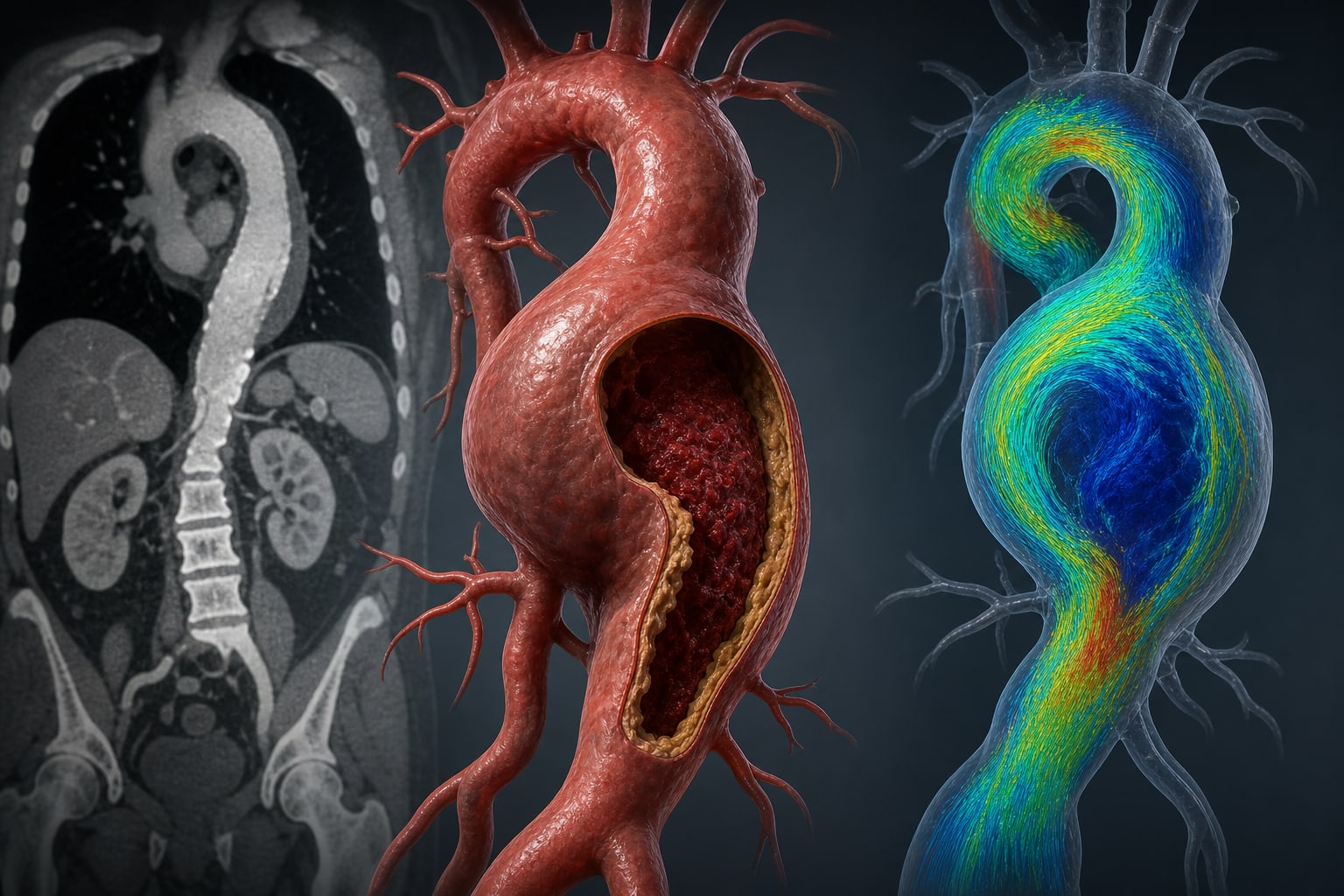
This study investigates the relationship between intraluminal thrombus (ILT) formation and blood stasis in thoracoabdominal aortic aneurysms (TAAA) using patient-specific hemodynamic simulations. Significant differences in old blood volume fraction (OBVF) and convergence time were observed between patients with and without ILT.

Background

Thoracoabdominal aortic aneurysms (TAAA) are serious cardiovascular conditions that can lead to high mortality rates upon rupture. Understanding the mechanisms behind ILT formation is crucial. This study highlights the importance of blood flow dynamics in the progression of TAAA.

Data Highlights

GroupOBVF (%)Convergence Time (s)
ILT76.66 ± 12.3842.58 ± 13.29
Non-ILT21.42 ± 3.3910.93 ± 5.96

Key Findings

  • High blood stasis was observed in TAAA compared to other regions.
  • Patients with ILT had significantly higher OBVF and convergence time than those without ILT.
  • Normalized OBVF in the ILT group was 76.66% ± 12.38% compared to 21.42% ± 3.39% in the non-ILT group.
  • Convergence time in the ILT group was 42.58 ± 13.29 s, significantly longer than 10.93 ± 5.96 s in the non-ILT group.

Clinical Implications

The findings suggest that assessing blood stasis may enhance the understanding of ILT formation in TAAA, potentially guiding clinical decision-making. This model could aid in operative planning and postoperative evaluations for patients with TAAA.

Conclusion

The study establishes a clear link between blood stasis and ILT formation in TAAA, offering insights that could improve clinical management of this condition. Further research may validate these findings and refine treatment strategies.

Related Resources & Content

  1. Frontiers | Association of intraluminal thrombus in thoracoabdominal aortic aneurysms with a blood stasis model
  2. Journal of Endovascular Therapy — Natural History and Impact of Thoracic Endovascular Stent-Grafting on Type B Intramural Hematoma: A World of Caution
  3. Modeling Thoracic Endovascular Aortic Repair in a Patient-Specific Perfused Simulation of Type B Aortic Dissection
  4. Basic Research in Cardiology — Exploring the Cellular and Molecular Characteristics of Ascending Thoracic Aortic Aneurysms and Dissections
  5. Advanced Wall Modeling Techniques for Hemodynamic Analysis of Intracranial Aneurysms Utilizing Histological Imaging
  6. 2024 ESC Guidelines for the management of peripheral arterial and aortic diseases
  7. Evolving Practices of Spinal Drain Use for Branch/Fenestrated Endovascular Aortic Repair Patients in the United States Aortic Research Consortium - PMC
  8. Frontiers | Association of intraluminal thrombus in thoracoabdominal aortic aneurysms with a blood stasis model
  9. Longitudinal ultrasound-based fluid–structure interaction study on hemodynamics and wall mechanics in abdominal aortic aneurysms - ScienceDirect
  10. Morphology and biomechanical index predict the rupture location and rupture risk of abdominal aortic aneurysm | Scientific Reports
  11. Computational Fluid Dynamics Predicting Intraprosthetic Thrombus Formation and Burden Following Endovascular Aortic Repair: A Two-Center Retrospective Study - PubMed

Original Source(s)

Related Content