A hybrid ViT-L/32–MaxViT-L architecture with adaptive gated fusion for multiclass gastrointestinal disease detection and multi-method post-hoc explainability - Report - MDSpire

A hybrid ViT-L/32–MaxViT-L architecture with adaptive gated fusion for multiclass gastrointestinal disease detection and multi-method post-hoc explainability

  • By

  • Shahid Mohammad Ganie

  • Pijush Kanti Dutta Pramanik

  • Zhongming Zhao

  • July 14, 2026

Share

Clinical Report: Adaptive Gated Fusion for Multiclass Detection of GI Disorders

Overview

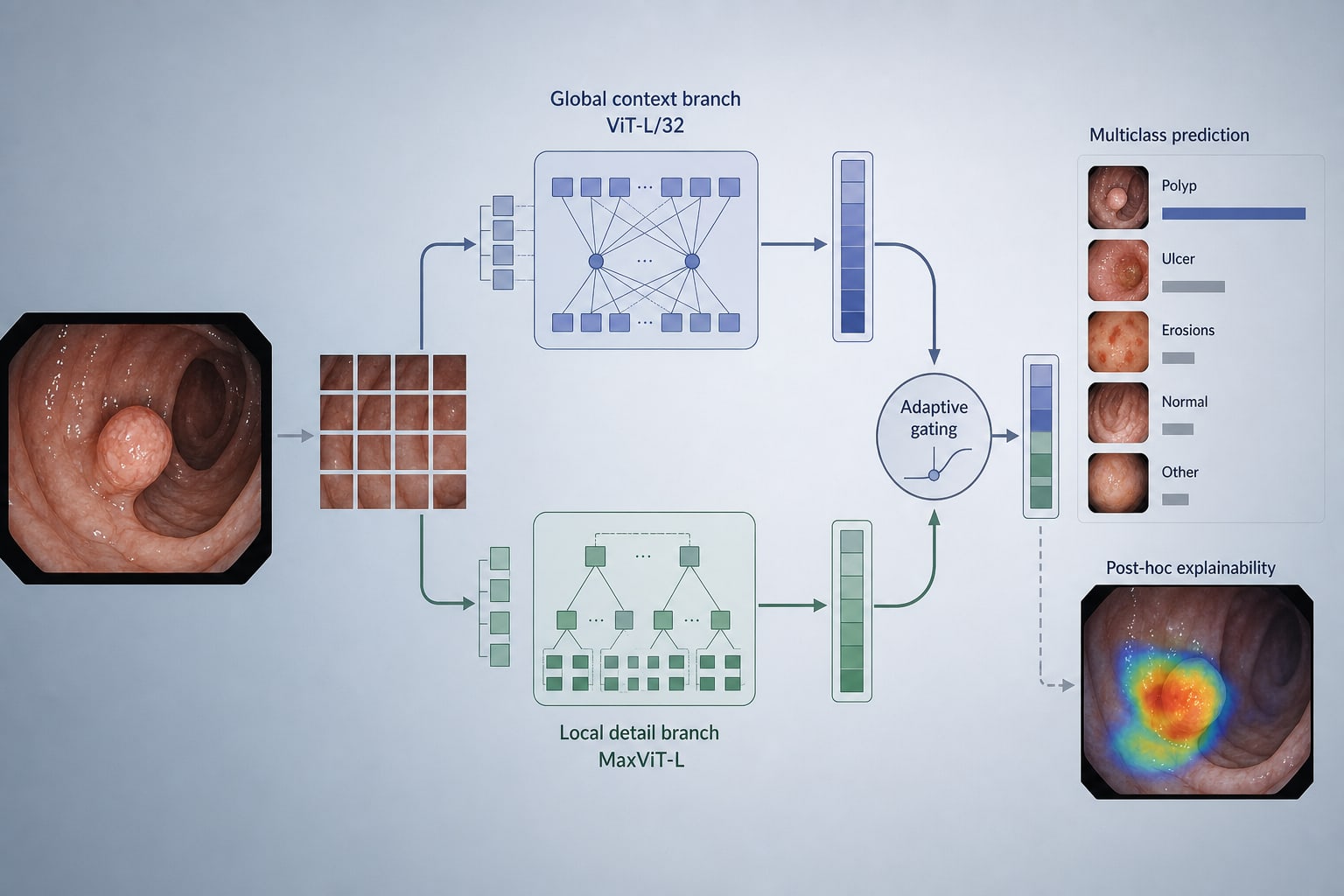
This study presents a hybrid transformer framework for the detection of gastrointestinal diseases from endoscopic images. The model integrates local and global features through an adaptive gated fusion mechanism.

Background

Gastrointestinal diseases pose a significant health burden, necessitating accurate and timely detection for effective management. Endoscopic imaging is crucial for identifying mucosal abnormalities, yet interpretation can be challenging due to operator dependency and variability. Advances in deep learning, particularly hybrid transformer models, offer solutions to improve diagnostic consistency.

Data Highlights

The proposed framework was evaluated on a multi-class gastrointestinal endoscopic dataset.

Key Findings

  • The hybrid transformer framework integrates global reasoning from ViT-L/32 and spatial modeling from MaxViT-L.
  • Adaptive gated fusion dynamically regulates local and global feature contributions on a per-sample basis.
  • The model outperformed several state-of-the-art transformer and hybrid architectures.
  • XAI analyses confirmed lesion-focused activation consistency.

Clinical Implications

The findings indicate that hybrid transformer architectures can enhance the accuracy of gastrointestinal disease classification.

Conclusion

The study presents adaptive local-global feature integration in improving diagnostic performance and interpretability for gastrointestinal disorders.

Related Resources & Content

  1. Frontiers in Oncology, 2026 -- Interpretable deep learning-based hierarchical multi-modal fusion model for predicting HER2 expression in gastric cancer
  2. Surgical Endoscopy, 2025 -- Hierarchical Classification of Ampullary Tumors Using AI: A Deep Learning Method with White-Light and Narrow-Band Imaging Techniques
  3. npj Digital Medicine, 2025 -- Multimodal Integration of Endoscopic and Radiomic Data for Predicting Survival Outcomes in Colorectal Cancer
  4. Frontiers in Oncology — HiGATE: hierarchical graph attention for multi-scale tissue encoder in computational pathology
  5. Surveillance of Barrett’s esophagus - American Gastroenterological Association
  6. Management of epithelial precancerous conditions and early neoplasia of the stomach (MAPS III): ESGE, EHMSG, ESP Guideline update 2025
  7. Checking your browser - reCAPTCHA
  8. https://academic.oup.com/bjs/article/112/Supplement_13/znaf166.072/8241615
  9. Surveillance of Barrett’s esophagus - American Gastroenterological Association
  10. Diagnosis and management of Barrett esophagus: European Society of Gastrointestinal Endoscopy (ESGE) Guideline | ESGE
  11. Curriculum for safe and effective use of artificial intelligence in endoscopy: European Society of Gastrointestinal Endoscopy (ESGE) Position Statement - UCL Discovery
  12. JGES Guidelines | Japan Gastroenterological Endoscopy Society

Original Source(s)

Related Content