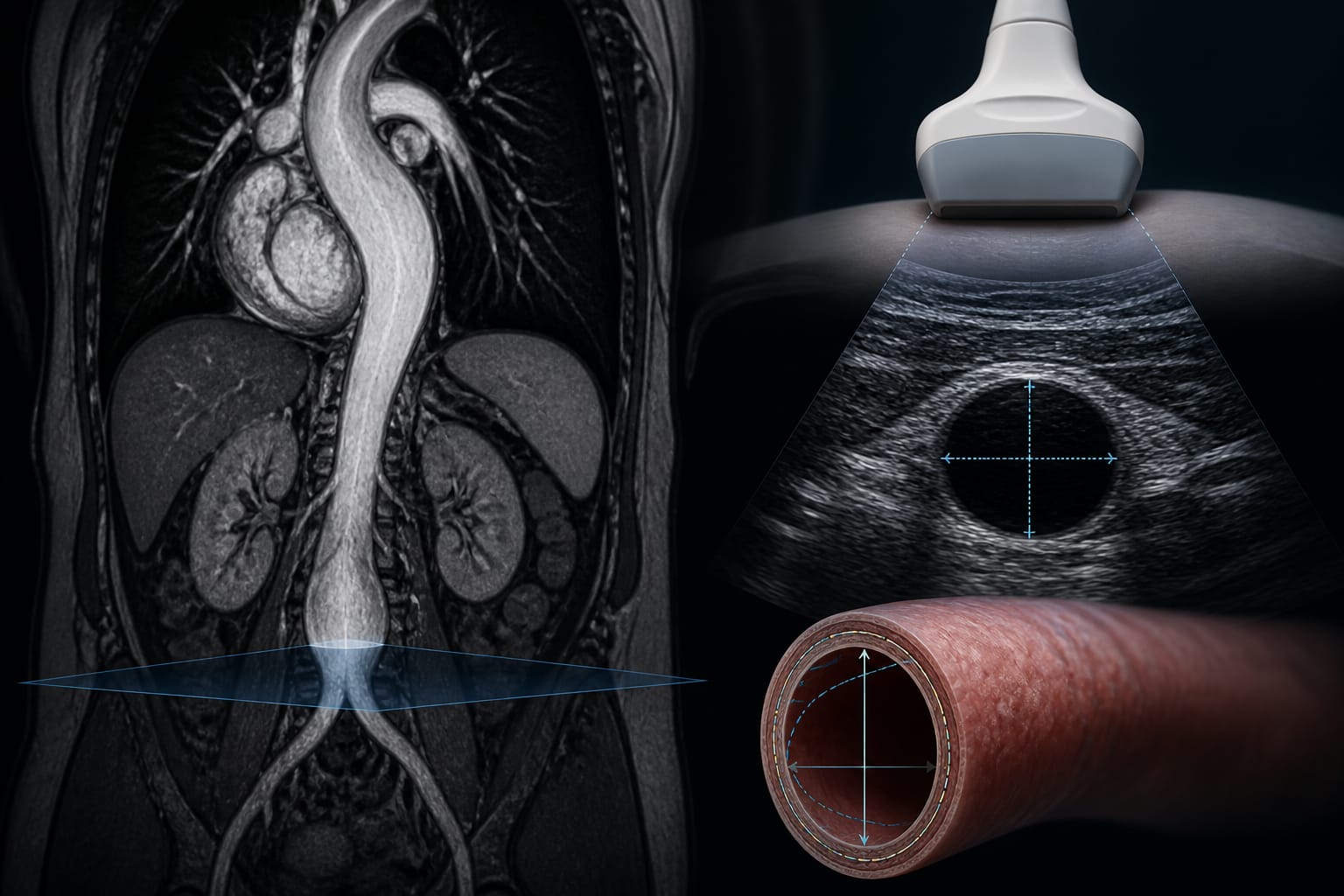
Associations of CMR-based pulse wave velocity and aortic distensibility with infrarenal ultrasound-based aortic parameters in the Hamburg City Health Study - Report - MDSpire
Coming Soon: Introducing MDSpire News. Learn more
Conexiant’s news site is now MDSpire News. Learn more

Relationships Between CMR-Derived Pulse Wave Velocity and Aortic Distensibility with Infrarenal Ultrasound Measurements of Aortic Parameters in the Hamburg City Health Study

  • By

  • Katharina Alina Riedl

  • Eleonora Di Carluccio

  • Gunnar Lund

  • Markus Huellebrand

  • Anja Hennemuth

  • Rickmer Braren

  • Paulus Kirchhof

  • Stefan Blankenberg

  • Lisa Tilemann

  • Andreas Ziegler

  • Christian- Alexander Behrendt

  • Kai Muellerleile

  • Tilo Kölbel

  • September 21, 2026

Share

Clinical Report: Relationships Between CMR-Derived Pulse Wave Velocity and Aortic Distensibility

Overview

This study investigates the associations between CMR-derived aortic stiffness parameters and infrarenal aortic measurements in a population-based cohort.

Background

Abdominal aortic aneurysm (AAA) is a significant health concern due to its potential for rupture and is influenced by various cardiovascular risk factors. Aortic stiffness, measured through pulse wave velocity (PWV) and aortic distensibility (AD), is a key indicator of vascular health and may correlate with AAA development.

Data Highlights

No numerical data available in the provided source material.

Key Findings

  • CMR-derived PWV and AD were assessed in a cohort of 2,093 participants from the Hamburg City Health Study.
  • Previous studies have shown conflicting results regarding the relationship between PWV and AAA.
  • Higher PWV values have been associated with increased AAA progression and rupture risk.
  • CMR imaging allows for precise measurement of aortic stiffness parameters.
  • Population-based studies on CMR-derived aortic stiffness metrics are limited.

Clinical Implications

The findings highlight the importance of assessing aortic stiffness in relation to AAA risk.

Conclusion

The study provides insights into the relationship between CMR-derived aortic stiffness and infrarenal aortic parameters.

Related Resources & Content

  1. Clinical Research in Cardiology, 2026 -- Associations between cardiovascular risk factors and diseases with aortic pulse wave velocity and aortic distensibility: magnetic resonance imaging in the Hamburg city health study
  2. Clinical Research in Cardiology, 2019 -- Assessment of Aortic Distensibility Using Standard 4-Chamber Cine CMR: A Novel Method for Clinical Research Validation
  3. Clinical Research in Cardiology, 2017 -- Automated Oscillometric Measurement of Blood Pressure and Pulse Waveforms for Assessing Vascular Stiffness in Atherosclerotic Conditions
  4. Recommendation: Abdominal Aortic Aneurysm: Screening | United States Preventive Services Taskforce
  5. Clinical Research in Cardiology, 2026 -- Associations of CMR-based pulse wave velocity and aortic distensibility with infrarenal ultrasound-based aortic parameters in the Hamburg City Health Study
  6. Obesity Surgery — Bariatric Surgery-Induced Weight Loss Leads to Notable Enhancements in Carotid and Cardiac Function Among Morbidly Obese Individuals Without Apparent Health Issues
  7. Recommendation: Abdominal Aortic Aneurysm: Screening | United States Preventive Services Taskforce
  8. Associations of CMR-based pulse wave velocity and aortic distensibility with infrarenal ultrasound-based aortic parameters in the Hamburg City Health Study | Clinical Research in Cardiology | Springer Nature Link
  9. Family screening for abdominal aortic aneurysms: a systematic review and meta-analysis - PMC

Original Source(s)

Related Content