Pathogenic mechanisms in Fabry disease - Report - MDSpire

Pathogenic mechanisms in Fabry disease

  • By

  • Siming Wang

  • Chengyue Sun

  • June 23, 2026

  • 0 min

Share

Clinical Report: Mechanisms of Pathogenesis in Anderson-Fabry Disease

Overview

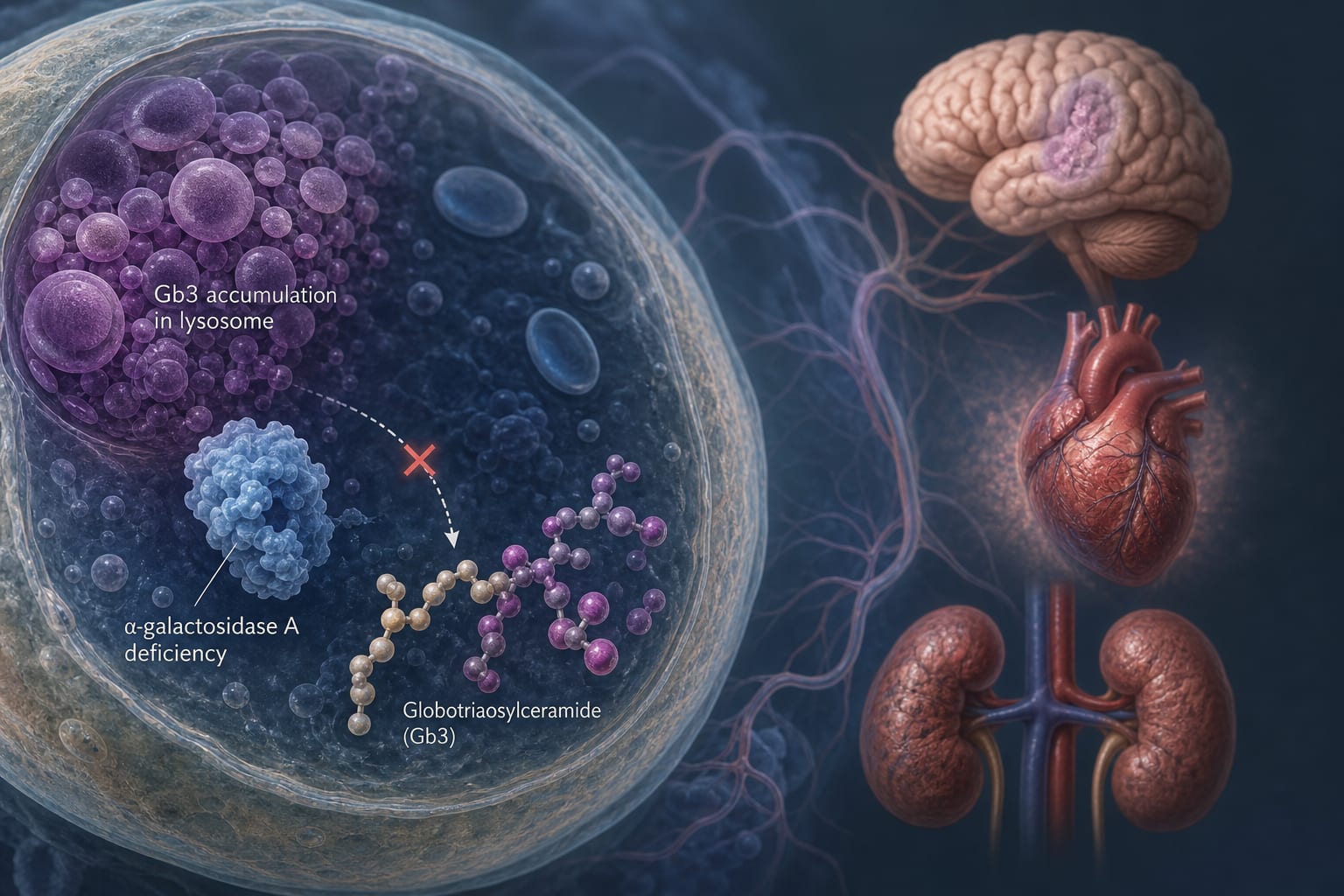
Anderson-Fabry disease (FD) is an X-linked lysosomal storage disorder caused by α-galactosidase A deficiency, leading to glycosphingolipid accumulation. The disease manifests with significant phenotypic variability and multisystem involvement, particularly affecting the kidneys and heart.

Background

Anderson-Fabry disease is a rare genetic disorder that results in the accumulation of globotriaosylceramide (Gb3) due to insufficient enzyme activity. This accumulation leads to progressive damage across multiple organ systems.

Data Highlights

No numerical data available in the source material.

Key Findings

  • FD is caused by mutations in the GLA gene leading to α-galactosidase A deficiency.
  • Phenotypic variability is influenced by residual enzyme activity and X-chromosome inactivation.
  • Classic FD typically presents with severe symptoms in males, while females may experience milder manifestations.
  • Common symptoms include renal insufficiency, cardiovascular issues, and neurological symptoms.
  • Accumulation of Gb3 and lyso-Gb3 contributes to cellular toxicity and organ dysfunction.

Clinical Implications

Healthcare professionals should be aware of the multisystem involvement in FD and the variability in presentation between genders.

Conclusion

Anderson-Fabry disease presents significant clinical challenges due to its complex pathogenesis and phenotypic variability.
Related Resources & Content

  1. Frontiers in Pediatrics, 2026 -- Clinical outcomes of agalsidase Beta (fabrazyme) in Chinese fabry disease patients with proteinuria: a case series
  2. Fabry Disease - StatPearls - NCBI Bookshelf
  3. BIMDG, 2025 -- Clinical Guidance for Fabry Disease
  4. Neurological management and outcome measures in Fabry disease: consensus statements from the Italian Fabry disease neurological working group | Orphanet Journal of Rare Diseases | Springer Nature Link
  5. Clinical Rheumatology — Biomarkers Indicating Pathogenesis, Clinical Features, and Therapeutic Strategies in Systemic Sclerosis: A Comprehensive Review
  6. Brain — Increased Cholesterol Levels as a Common Characteristic of Dominant and Recessive Disorders Linked to ATAD3 Variants
  7. Acta Neuropathologica — Transmission of alpha-synuclein pathology: theories, findings, and ongoing inquiries from both experimental and human neurological research
  8. Fabry Disease - StatPearls - NCBI Bookshelf
  9. https://bimdg.org.uk/wp-content/uploads/2025/07/2025.05.30.Fabry-Clinical-Guidance.pdf
  10. Neurological management and outcome measures in Fabry disease: consensus statements from the Italian Fabry disease neurological working group | Orphanet Journal of Rare Diseases | Springer Nature Link
  11. Lucerastat, an oral therapy for Fabry disease: results from a pivotal randomized phase 3 study and its open-label extension | Nature Communications
  12. Poster # 36

Original Source(s)

Related Content