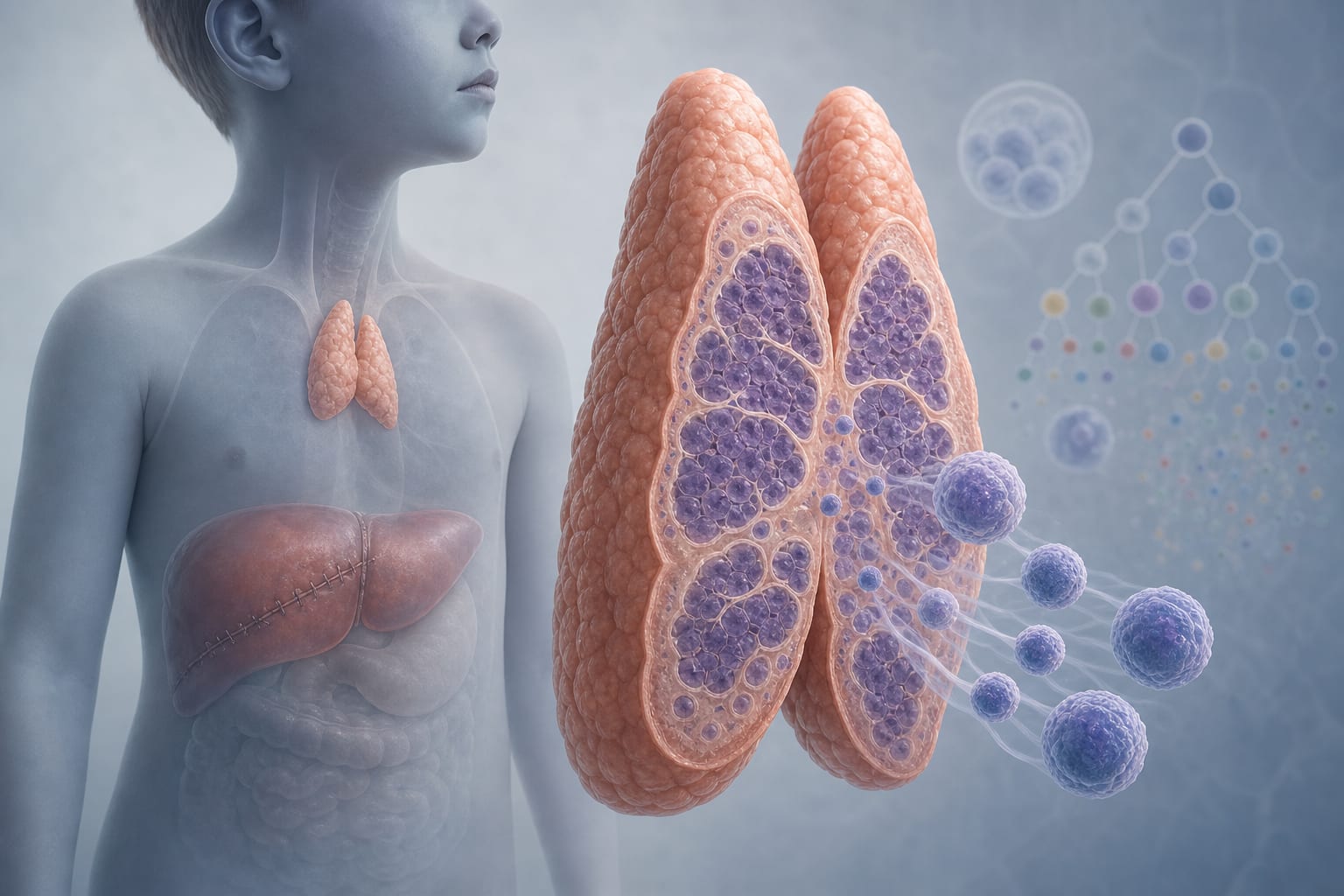
Immunosuppression after pediatric liver transplantation may lead to early and prolonged acute thymic involution: findings from a pilot longitudinal study - Report - MDSpire

Immunosuppression after pediatric liver transplantation may lead to early and prolonged acute thymic involution: findings from a pilot longitudinal study

  • By

  • Guillermo Costaguta

  • Brenda Dinatale

  • Itauá Leston Araujo

  • Wilson Savino

  • Fernando Alvarez

  • Oscar Bottasso

  • Ana Rosa Perez

  • Florencia Belén González

  • Alejandro Costaguta

  • June 26, 2026

  • 0 min

Share

Clinical Report: Impact of Immunosuppressive Therapy on Thymic Function

Overview

This pilot study investigates the effects of immunosuppressive therapy on thymic function and morphology in pediatric liver transplant recipients. Significant declines in thymic output and size were observed over a 12-month follow-up period.

Background

Thymopoiesis is crucial for T-cell development in children, and pediatric liver transplant recipients are particularly vulnerable to disruptions in thymic function due to immunosuppressive therapy.

Data Highlights

ParameterChangeStatistical Significance
Thymic output (sjTRECs)Declined significantlyp<0.01
sj/βTREC ratioSignificant reduction after 3 monthsNot specified
Thymic sizeDecreased significantly at 3 monthsNot specified

Key Findings

  • Thymic output measured by sjTRECs declined significantly over 12 months.
  • The sj/βTREC ratio showed a significant reduction after 3 months post-transplant.
  • Recent thymic emigrants (RTEs) correlated positively with sjTREC levels but did not reach statistical significance.
  • Thymic size assessed by ultrasound decreased significantly at 3 months, with partial recovery thereafter.
  • Findings suggest early and persistent changes in thymic function following immunosuppression.

Clinical Implications

The observed decline in thymic function and morphology post-transplantation indicates a potential area of concern for pediatric liver transplant recipients.

Conclusion

The study provides preliminary evidence of significant changes in thymic function following immunosuppressive therapy in pediatric liver transplant recipients.

Related Resources & Content

  1. Updates in Surgery, 2023 -- Twenty-Year Follow-Up on Health-Related Quality of Life and Outcomes After Pediatric Liver Transplantation
  2. Pediatric Cardiology, 2024 -- Assessment of Heart Function in Pediatric Patients Undergoing Liver Transplantation
  3. Updates in Surgery, 2024 -- Presence of an Active Thymus in an Adult Lung Cancer Patient: Initial Findings from the Adult Thymic Project
  4. AASLD -- New Guidelines Advance Pediatric Liver Transplant Care
  5. Impact of early immunosuppression on pediatric liver transplant outcomes within one year - PMC
  6. Basiliximab Induction and Postoperative Steroid-free Immunosuppression With Tacrolimus in Pediatric Liver Transplantation: A Randomized Clinical Trial - PubMed
  7. Frontiers | Immunosuppression after pediatric liver transplantation may lead to early and prolonged acute thymic involution: findings from a pilot longitudinal study
  8. Bone Marrow Transplantation — Advancements in Haploidentical Stem Cell Transplantation Techniques
  9. New Guidelines Advance Pediatric Liver Transplant Care | AASLD
  10. Impact of early immunosuppression on pediatric liver transplant outcomes within one year - PMC
  11. Basiliximab Induction and Postoperative Steroid-free Immunosuppression With Tacrolimus in Pediatric Liver Transplantation: A Randomized Clinical Trial - PubMed
  12. Frontiers | Immunosuppression after pediatric liver transplantation may lead to early and prolonged acute thymic involution: findings from a pilot longitudinal study
  13. Endogenous thymic regeneration: restoring T cell production following injury | Nature Reviews Immunology

Original Source(s)

Related Content